
TL;DR:
- True smart HVAC systems learn, adapt, and work with integrated sensors for energy efficiency.
- Proper installation and system assessment are essential; technology alone won’t fix underlying issues.
- Working with experienced professionals ensures optimal performance and maximizes comfort and savings.
Many Kansas City homeowners assume that swapping out an old thermostat for a programmable model means they’ve gone “smart.” That’s one of the most common misconceptions we see. A true smart HVAC system is a fully integrated solution that learns your habits, responds to real-time conditions, and automatically adjusts to keep you comfortable while using less energy. It’s not just about scheduling. It’s about your entire heating and cooling system working together intelligently, and for homeowners dealing with Kansas City’s hot summers and cold winters, that difference shows up directly on your utility bills.
Table of Contents
- What defines a smart HVAC system?
- Key components of smart HVAC: what’s inside?
- Smart HVAC vs. programmable and commercial systems
- Smart HVAC: benefits, challenges, and installation tips for Kansas City homes
- The truth most homeowners miss about smart HVAC
- Maximize HVAC comfort and savings with Kansas City professionals
- Frequently asked questions
Smart HVAC Guide Contents for Kansas City Homeowners
| Point | Details |
|---|---|
| Smart HVAC is adaptive | Unlike programmable systems, smart HVAC learns from your habits and adapts to save energy. |
| Components drive efficiency | Features like smart thermostats and variable-speed controls maximize comfort and lower bills. |
| Installation matters most | Proper setup and duct sealing are critical to making smart HVAC work as promised. |
| Benefits outweigh challenges | Smart HVAC systems deliver comfort and savings but require careful planning and compatible equipment. |
What defines a smart HVAC system?
A smart HVAC system goes well beyond a timer on your thermostat. It’s an integrated network of hardware and software that monitors your home’s conditions, learns your behavior, and adjusts your heating and cooling automatically, without you lifting a finger.
Traditional HVAC systems run on simple on/off logic. You set a temperature, the system runs until it hits that target, then shuts off. Programmable thermostats add scheduling, so you can tell the system to cool down before you get home. But programmable thermostats don’t adapt to your actual behavior the way smart ones do. If your schedule changes, a programmable thermostat doesn’t know. A smart system does.
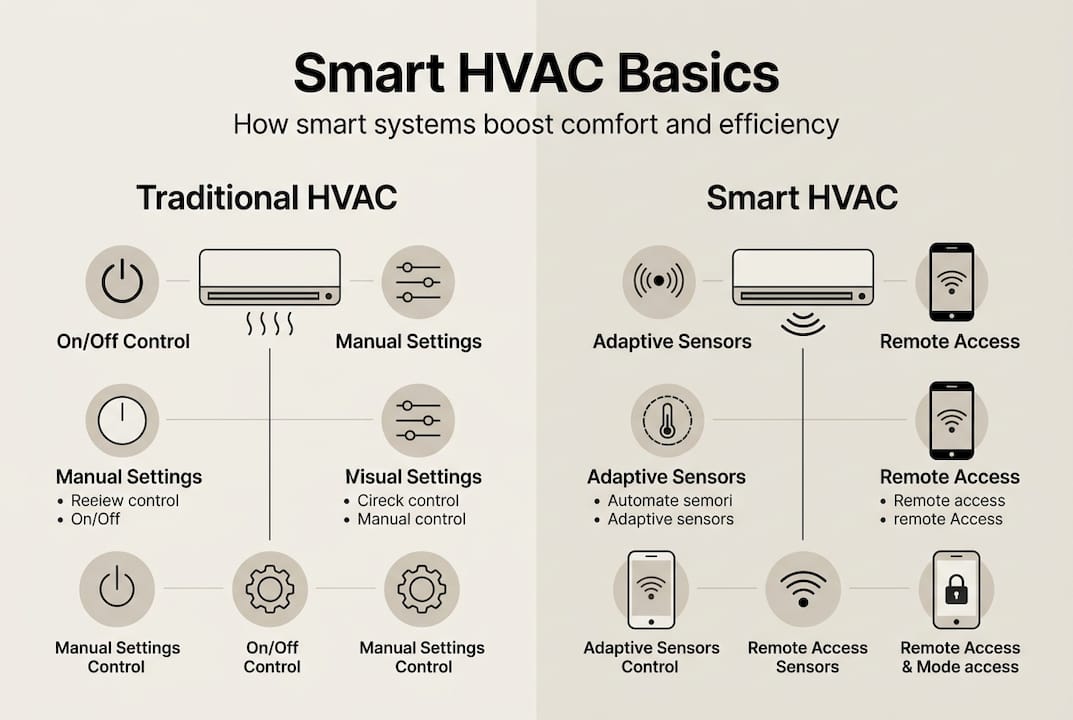
Smart HVAC pulls together several key components to make this work. ENERGY STAR certified smart thermostats use adaptive algorithms, occupancy sensors, and connectivity to optimize your system’s output in real time. Zone dampers let you control temperatures room by room. Indoor air quality (IAQ) sensors monitor humidity, CO2, and particulates. Variable frequency drives (VFDs) allow motors and compressors to run at partial speeds instead of always full blast, which cuts energy use significantly.
Two features that truly separate smart systems from the rest are geofencing and remote access. Geofencing uses your phone’s location to detect when you’re heading home and starts conditioning your space before you arrive. Remote access lets you monitor and adjust your system from anywhere through an app. Both features support home comfort and energy efficiency in ways that older systems simply can’t match.
Here’s a quick comparison to clarify the differences:
| Feature | Traditional HVAC | Programmable thermostat | Smart HVAC |
|---|---|---|---|
| Scheduling | No | Yes | Yes |
| Learns behavior | No | No | Yes |
| Remote access | No | Limited | Yes |
| Zone control | No | No | Yes |
| IAQ monitoring | No | No | Yes |
| Energy optimization | Minimal | Moderate | Advanced |
If you want to understand the full picture of what is HVAC before evaluating smart upgrades, starting with the basics will help you make a more informed decision.
Key capabilities that define a smart HVAC system:
- Real-time sensor data for temperature, humidity, and air quality
- Learning algorithms that adapt to your daily patterns
- Geofencing for automatic presence detection
- Remote monitoring and control via smartphone
- Zone-based temperature management for individual rooms
Key components of smart HVAC: what’s inside?
With a smart system defined, let’s look inside and examine the parts that make it work. Understanding each component helps you know what to ask for and what to expect when upgrading your home.
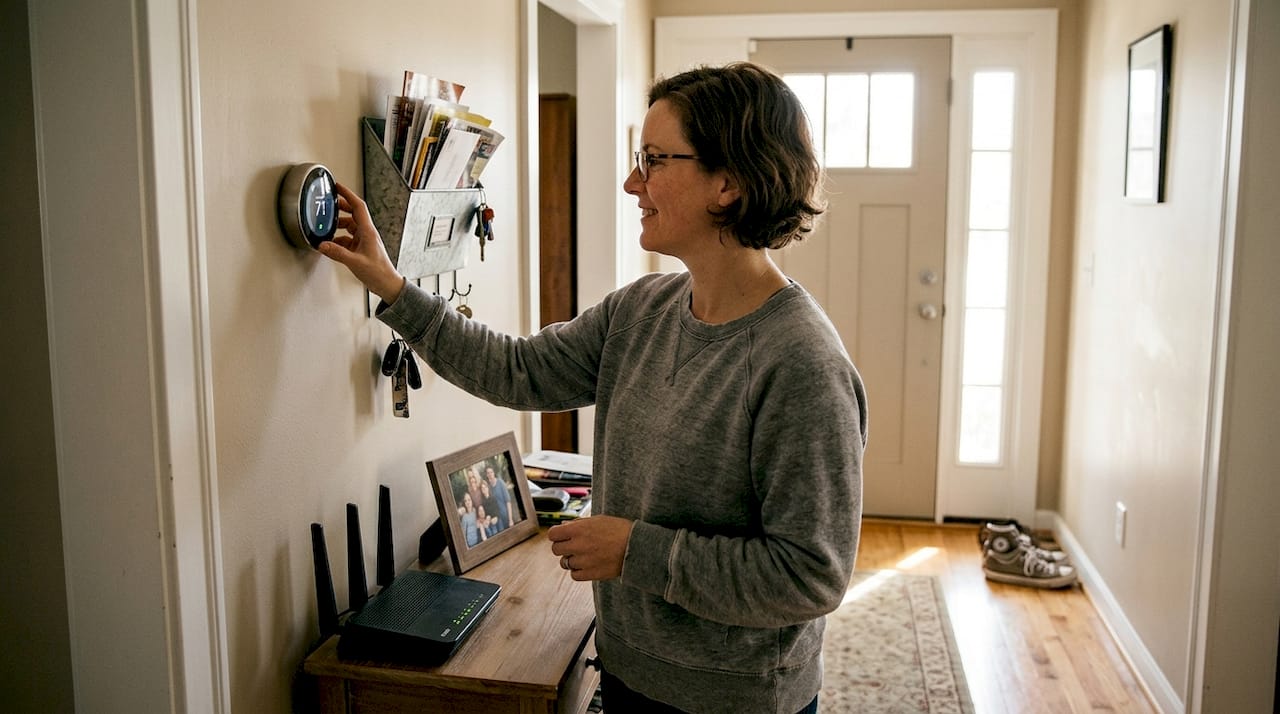
ENERGY STAR certified smart thermostats are the brain of the operation. They connect to your Wi-Fi, communicate with other devices, and use machine learning to build a picture of your schedule and preferences. Over time, they stop needing manual input entirely.
Here’s a breakdown of the main components:
| Component | Function | Efficiency impact |
|---|---|---|
| Smart thermostat | Learns schedule, controls system | High |
| Zone dampers | Direct airflow room by room | High |
| IAQ sensors | Monitor air quality, trigger ventilation | Moderate |
| Variable frequency drives (VFDs) | Adjust motor speed to match demand | Very high |
| Communication gateway | Connects components to the cloud | Enables integration |
Zone dampers are motorized panels inside your ductwork. They open and close based on which rooms need conditioning. Instead of cooling your entire house when only the living room is occupied, zone dampers focus the energy where it’s needed. This alone can produce noticeable savings on your monthly bill.
IAQ sensors are often overlooked but genuinely important. They detect humidity levels, carbon dioxide concentrations, and airborne particles. When levels rise, the system can automatically increase ventilation or activate filtration. For Kansas City homeowners, where humidity swings are common, this feature adds real comfort value.
VFDs are the efficiency workhorses. Instead of running your blower motor or compressor at full speed every cycle, VFDs modulate the speed based on actual demand. This reduces wear, lowers energy consumption, and keeps temperature more stable.
Pro Tip: Even the most advanced smart HVAC system will underperform if your ducts are leaking. Studies suggest that leaky ducts can waste up to 30% of conditioned air before it ever reaches your rooms. Before installing smart HVAC essentials, have your ductwork inspected and sealed. It’s one of the highest-return improvements you can make.
If your home has an older system, HVAC retrofitting insights can help you understand what’s compatible and what needs replacing. And when you’re ready to evaluate options, choosing the right smart HVAC for your home’s size and layout is the critical next step.
Smart HVAC vs. programmable and commercial systems
Now, let’s clarify how smart HVAC goes beyond simple programmable units and what sets homes apart from commercial systems. This distinction matters because many homeowners either underestimate what they’re getting or assume commercial-grade technology automatically translates to residential settings.
Programmable thermostats and commercial BAS differ substantially from residential smart systems. A building automation system (BAS) used in an office building manages dozens of zones, complex mechanical equipment, and often requires professional commissioning and ongoing IT support. It’s powerful, but it’s built for scale, not for a three-bedroom home in Overland Park.
Residential smart HVAC is designed to be user-friendly, self-commissioning, and manageable through a consumer app. The AI built into residential systems focuses on occupancy patterns, sleep schedules, and personal comfort preferences. Commercial systems prioritize energy compliance, demand response at the utility level, and facility management reporting.
Basic programmable thermostats sit at the opposite end of the spectrum. They follow whatever schedule you program, nothing more. If you forget to adjust the schedule when your work hours change, the system keeps running the old program. There’s no adaptation, no learning, and no awareness of whether anyone is actually home.
“Smart residential HVAC controls bridge the gap between simple scheduling and full building automation, offering homeowners adaptive, connected comfort without the complexity of commercial BAS infrastructure.” — HVAC Maintenance Authority
The AI and predictive features in modern residential smart systems are genuinely impressive. They analyze patterns over days and weeks, factor in local weather forecasts, and even participate in utility demand response programs, automatically reducing load during peak grid hours to save you money. Reviewing energy efficient HVAC savings can show you how these features translate into real dollar amounts for Kansas City households.
The bottom line: a programmable thermostat is a scheduling tool. A commercial BAS is a facility management platform. A residential smart HVAC system is an intelligent comfort partner built specifically for your home.
Smart HVAC: benefits, challenges, and installation tips for Kansas City homes
With distinctions in mind, it’s essential to recognize the real-world benefits and challenges, and what every Kansas City homeowner should consider before making the investment.
Benefits you can expect:
- Lower monthly energy bills through adaptive scheduling and VFD efficiency
- Consistent comfort with fewer temperature swings between rooms
- Better indoor air quality with automated ventilation and filtration
- Remote control and monitoring from anywhere
- Reduced environmental impact through lower energy consumption
The savings vary by climate and habits, so results won’t be identical for every household. A family that’s home all day will see different patterns than a household where everyone leaves by 8 a.m. That’s actually where smart systems shine, because they adjust to your specific routine rather than a generic preset.
Common challenges to watch for:
- Compatibility issues between new smart controls and older HVAC equipment
- Wi-Fi reliability affecting system responsiveness
- Privacy concerns related to data collected by connected devices
- Higher upfront cost compared to basic thermostats
- Interoperability gaps when mixing brands
Short-cycling, Wi-Fi congestion, and battery drain are common installation mistakes that lead to frustrating performance problems. Short-cycling happens when a system turns on and off too frequently, often caused by improper sizing or a misconfigured smart control. It wastes energy and accelerates equipment wear.
Tips for a successful smart HVAC installation:
- Have a licensed HVAC technician assess your current system’s compatibility before purchasing any smart components.
- Seal and test your ductwork before upgrading controls.
- Ensure your home Wi-Fi signal is strong in the area where your air handler or furnace is located.
- Choose components from brands that support open standards for better interoperability.
- Schedule a follow-up visit 30 days after installation to verify the system is learning and operating correctly.
Pro Tip: Don’t skip duct sealing just because you’re adding smart technology. Even a perfectly configured smart thermostat can’t compensate for conditioned air leaking into your attic or crawl space. Sealing ducts first maximizes the return on every other upgrade you make.
For homeowners considering upgrading HVAC for comfort and savings, the combination of smart controls and a well-maintained system delivers the best long-term results. You can also explore the full range of energy efficient HVAC benefits and review a detailed smart HVAC installation guide to plan your upgrade with confidence.
The truth most homeowners miss about smart HVAC
After exploring the practical benefits and challenges, here’s a candid perspective most guides overlook: technology alone does not fix a poorly maintained or improperly installed system.
We’ve seen homeowners invest in top-of-the-line smart thermostats and connected controls, only to be disappointed when their bills barely move. In nearly every case, the issue wasn’t the technology. It was the system underneath. Leaking ducts, an undersized air handler, or a furnace running past its service life will defeat even the smartest controls on the market.
Smart HVAC works best as the final layer of optimization on a solid foundation. Think of it this way: the controls are only as effective as the equipment and ductwork they’re managing. A smart thermostat managing a leaky, aging system is like putting a high-performance engine management system in a car with worn tires and a cracked exhaust. The technology is real, but the results won’t be.
Our honest advice is to start with a whole-system evaluation. Look at HVAC retrofitting options, assess your ductwork, and confirm your equipment is properly sized before adding smart controls. That sequence delivers the comfort and savings you’re actually after.
Maximize HVAC comfort and savings with Kansas City professionals
If you’re ready to take the next step, working with experienced local professionals makes all the difference. Smart HVAC upgrades require accurate system assessment, proper installation, and local knowledge of Kansas City’s climate demands.

At KC Air Control, we bring over 70 years of experience to every job, from furnace repair services to full smart system installations. Our team can evaluate your current setup, recommend the right upgrades, and handle everything from duct sealing to smart thermostat integration. Whether you’re starting with a single upgrade or planning a full system overhaul, explore our energy efficient HVAC installation options and see how we help Kansas City homeowners get the most from their systems. Visit our HVAC systems optimization page to learn more and schedule your assessment today.
Frequently asked questions
How do smart HVAC systems actually save money?
Smart HVAC systems use demand response and adaptive scheduling to reduce energy use during off-peak hours and match output to actual occupancy, which lowers your bills especially during Kansas City’s temperature extremes.
Do smart HVAC systems work with older homes?
Retrofitting requires compatible systems and attention to duct integrity, so older homes can often be upgraded but need a professional assessment first to confirm compatibility and identify any ductwork issues.
Is a programmable thermostat the same as a smart HVAC system?
No. Programmable thermostats lack adaptation and prediction capabilities, while smart HVAC systems use sensors and AI to learn your patterns and adjust automatically without manual input.
What common issues can arise when installing smart HVAC?
Improper installation leads to short-cycling and unstable operation, and issues like Wi-Fi congestion or system incompatibility can significantly reduce performance and negate the efficiency benefits you’re expecting.
Recommended
- How HVAC systems optimize home comfort and energy efficiency – KC Air Control – Heating & Cooling
- Energy efficient HVAC: lower bills and better comfort – KC Air Control – Heating & Cooling
- Why upgrade your HVAC? Boost comfort & cut energy bills – KC Air Control – Heating & Cooling
- HVAC Retrofitting: Boost Home Comfort and Efficiency – KC Air Control – Heating & Cooling
Pingback: HVAC zoning explained: guide to efficient home comfort - KC Air Control - Heating & Cooling
Pingback: Advances in shutter technology for modern UK homes