
TL;DR:
- HVAC retrofitting improves efficiency, comfort, and extends system lifespan without full replacement.
- Proper load calculations, duct sealing, and control upgrades are key to maximizing savings.
- Kansas City homeowners can save up to 40% on energy bills with incentives and smart upgrades.
HVAC systems account for 30-40% of home energy use in a typical American household, and many Kansas City homes are paying far more than they should every month. If your system is more than a decade old, you may be losing money on heating and cooling without realizing it. HVAC retrofitting is not just a repair option for systems on their last legs. It is a smart, strategic upgrade that improves comfort, reduces energy bills, and extends the life of your existing infrastructure. This guide walks you through what retrofitting actually involves, the steps specific to Kansas City homes, real savings numbers, and how to avoid the mistakes that cost homeowners the most.
Table of Contents
- What is HVAC retrofitting and why does it matter?
- Core steps in a Kansas City home HVAC retrofit
- How much can you save? Real world results and incentives
- Common pitfalls and how to get retrofit-ready
- Hard truths and smart moves: Our take on HVAC retrofitting
- Ready to transform home comfort? Your next steps
- Frequently asked questions
HVAC Retrofitting Guide: What’s Inside
| Point | Details |
|---|---|
| Major savings potential | Retrofitting older HVAC systems can cut Kansas City home energy costs by 20-40 percent. |
| Prioritize the right upgrades | Controls, ductwork, and insulation often boost comfort and ROI more than equipment replacement alone. |
| Start with an expert assessment | Manual J load calculations and audits ensure you only upgrade what matters, right-sized for your home. |
| Local incentives increase ROI | Programs like Evergy and the Inflation Reduction Act help pay for retrofits, shortening payback to under five years. |
What is HVAC retrofitting and why does it matter?
HVAC retrofitting means upgrading specific components or systems within your existing heating and cooling setup without replacing the entire unit. Think of it as targeted improvement rather than a full overhaul. You keep what still works and upgrade what is holding your system back.
Many homeowners assume retrofitting is only for systems that are breaking down. That is one of the most common misconceptions we hear. In reality, retrofitting delivers the best results on systems that are still functional but inefficient. If your system is 10 to 15 years old and running, it is the ideal candidate.
Key methodologies for HVAC retrofitting in residential homes typically include:
- Load calculations to make sure your system is properly sized for your home
- Controls upgrades such as smart thermostats and zoning systems
- Ductwork sealing and insulation to stop conditioned air from escaping
- High-efficiency component swaps for compressors, air handlers, or coils
- Ventilation improvements to support indoor air quality
These upgrades work together. Replacing a thermostat alone does not deliver the same results as combining controls with duct sealing and right-sizing.
On the savings side, retrofitting saves 20-40% on energy costs for most buildings. For a Kansas City homeowner spending $200 a month on heating and cooling, that translates to $480 to $960 per year back in your pocket.
A regular HVAC tune-up keeps your system performing between retrofits, but a retrofit goes deeper. It addresses the structural and mechanical reasons your system is inefficient in the first place.
Pro Tip: If your HVAC system is between 10 and 15 years old and your energy bills have been creeping up, that is your signal to explore retrofitting before problems force a full replacement.
Core steps in a Kansas City home HVAC retrofit
Knowing what retrofitting is, here is how the step-by-step process actually plays out for a Kansas City homeowner.
1. Home energy audit and Manual J calculation
Every solid retrofit starts here. A Manual J calculation determines the exact heating and cooling load your home requires based on square footage, insulation levels, window placement, and local climate data. Kansas City’s hot summers and cold winters make this step especially important. Skipping it leads to oversized or undersized equipment, which wastes energy and reduces comfort.
2. Controls and thermostat upgrades
Smart thermostats and zoning systems let you control temperatures room by room and schedule heating and cooling around your actual schedule. This alone can cut energy waste significantly in homes where rooms sit empty for hours.
3. Ductwork sealing and insulation
Leaky ducts are one of the biggest hidden energy drains in Kansas City homes. Sealing and insulating ductwork keeps conditioned air where it belongs. Effective retrofit methodologies consistently identify duct improvements as among the highest-ROI upgrades available.

4. High-efficiency component replacement
This may include swapping out an older air handler, upgrading to a variable-speed compressor, or installing a higher-SEER (Seasonal Energy Efficiency Ratio) cooling unit. These components work harder with less energy. Learn more about what goes into an energy efficient HVAC installation for Kansas City homes.
5. Performance verification and system testing
After upgrades are complete, a qualified technician tests airflow, refrigerant levels, and system balance to confirm everything is working as designed. This step is often skipped by less thorough contractors, and it is where real performance gains are confirmed. Review a full HVAC inspection checklist to understand what this process involves.
| Retrofit upgrade | Avg. cost range | ROI impact |
|---|---|---|
| Smart thermostat | $150-$400 | High, fast payback |
| Duct sealing and insulation | $1,000-$3,000 | High, 2-4 year payback |
| Variable-speed air handler | $1,500-$4,000 | Moderate to high |
| Zoning system | $2,000-$5,000 | High in larger homes |
| High-SEER cooling unit | $3,000-$7,000 | Moderate, 5-8 year payback |
Pro Tip: Ask your HVAC contractor to show you the Manual J results before any equipment is ordered. If they cannot produce this document, that is a red flag.
How much can you save? Real world results and incentives
Now that you know what upgrades are involved, here is what savings and rebates you can realistically expect.
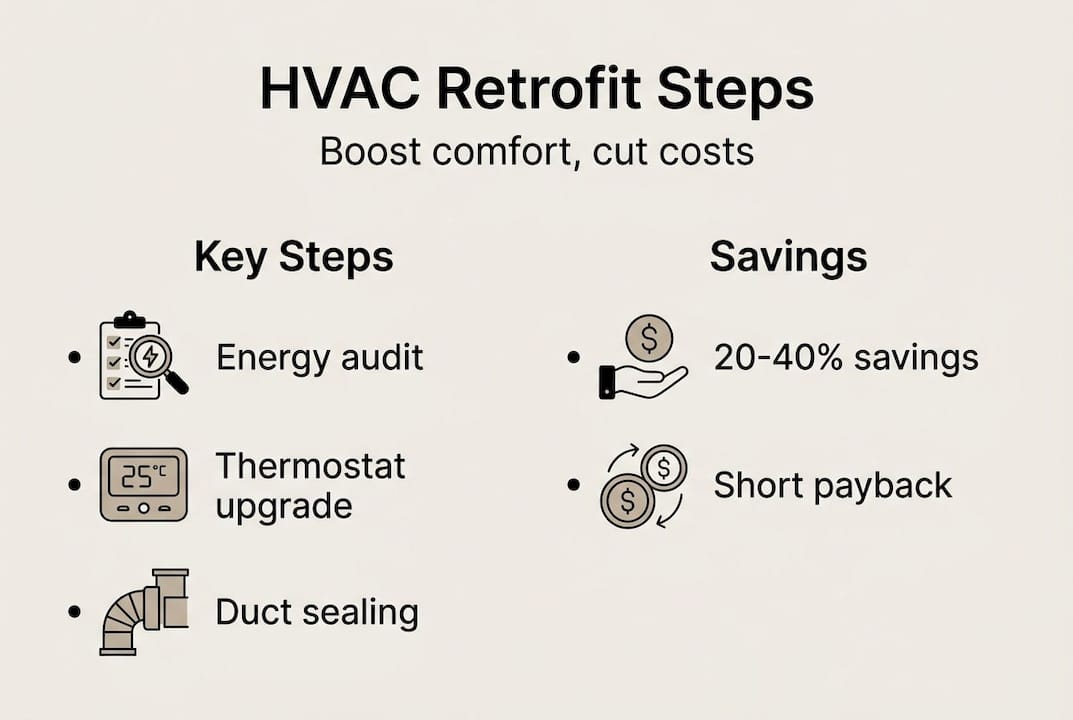
The benchmark is clear. Empirical data shows 20-40% energy savings from well-executed retrofits. For Kansas City homeowners, that range depends on your starting point, your home’s age, and which upgrades you choose.
Here is a practical comparison based on a home spending $2,400 per year on HVAC energy costs:
| Retrofit level | Upgrades included | Est. annual savings | Payback period |
|---|---|---|---|
| Basic | Smart thermostat only | $240-$360 | 1-2 years |
| Standard | Thermostat plus duct sealing | $480-$720 | 3-5 years |
| Advanced | Full system right-sizing plus controls and ducts | $720-$960 | 5-8 years |
Pairing HVAC retrofits with envelope upgrades such as added attic insulation and air sealing pushes savings even higher. Homes with poor baseline efficiency actually see the best ROI because there is more room to improve.
Kansas City homeowners also have access to meaningful financial incentives:
- Evergy rebates for qualifying high-efficiency equipment and smart thermostats
- Federal tax credits through the Inflation Reduction Act (IRA) covering up to 30% of costs for qualifying energy-efficient upgrades
- Federal HVAC incentives that apply to heat pumps, insulation, and energy audits
These programs can significantly reduce your out-of-pocket cost. If you want to understand the full picture before committing, reviewing HVAC cost estimates for Kansas City projects is a smart first step. And if you are motivated by lowering monthly expenses, see how the right upgrades cut energy bills over time.
Factors that influence your specific ROI include your current system’s efficiency rating, how old it is, the local climate demands of Kansas City, and whether you combine HVAC upgrades with home envelope improvements.
Common pitfalls and how to get retrofit-ready
With the benefits clear, it is equally important to set yourself up for success by avoiding common homeowner mistakes.
The biggest mistake we see is skipping the load calculation. Homeowners focus on the equipment label and assume a higher SEER rating automatically means better results. It does not, if the system is the wrong size for your home. Oversized equipment short-cycles, meaning it turns on and off too frequently, which wastes energy and creates humidity problems.
Another common error is ignoring ductwork. You can install a brand-new, high-efficiency unit and still see poor results if your ducts are leaking 20-30% of your conditioned air into unconditioned spaces. The equipment gets the attention, but the ducts do the work.
As controls and ventilation retrofits often outperform equipment swaps alone, prioritizing smart controls and proper ventilation upgrades before jumping to full equipment replacement is the smarter sequence.
Pro Tip: Pair your HVAC retrofit with attic insulation or air sealing improvements. These envelope upgrades reduce the load on your HVAC system and amplify the savings from every other upgrade you make.
Before scheduling a retrofit consultation, gather the following:
- 12 months of utility bills to establish your energy baseline
- Your current system’s age and model number
- A list of comfort complaints such as hot or cold rooms, humidity issues, or uneven airflow
- Any recent home improvements like added rooms, new windows, or insulation
- Questions about financing options available for the upgrades
Knowing which system to move toward starts with choosing the right HVAC system for your home’s specific needs. And once upgrades are in place, consistent HVAC servicing keeps your investment performing at its best.
Hard truths and smart moves: Our take on HVAC retrofitting
After more than 70 years serving Kansas City homeowners, we have seen the same pattern repeat itself. Homeowners invest heavily in new equipment and expect dramatic results, but they overlook the controls, the ductwork, and the insulation. The equipment gets the credit or the blame, when the real performance drivers are often invisible.
The honest truth is that a well-controlled, properly sealed older system will outperform a brand-new unit installed in a leaky, undersized duct system every single time. Kansas City’s climate demands real balance. Our summers push cooling systems hard. Our winters test furnaces. Retrofitting has to account for both extremes, not just one season.
We also believe that maintenance is not optional after a retrofit. Upgrades raise your system’s potential, but regular tune-ups are what keep that potential realized year after year. If you want to optimize HVAC maintenance for your home, that is where long-term comfort and savings actually come from.
Ready to transform home comfort? Your next steps
If you are considering making your KC home more comfortable and efficient, here is where to begin.
KC Air Control has been helping Kansas City homeowners get more from their HVAC systems for over 70 years. We assess your current setup, run the numbers, and recommend a retrofit plan that fits your home and your budget. No guesswork, no overselling.

Start by exploring our energy efficient HVAC installation guide for Kansas City homes, or learn what is involved in installing a new HVAC system if a full upgrade makes more sense for your situation. When you are ready to talk to an expert, book a consultation online and we will take it from there.
Frequently asked questions
How do I know if HVAC retrofitting is right for my home?
Retrofitting is ideal if your system is 10-15 years old and showing signs of inefficiency or uneven comfort, but is not completely failing. A professional assessment will confirm whether targeted upgrades make more sense than full replacement.
How long does an HVAC retrofit project usually take?
Most residential HVAC retrofits take 1 to 3 days depending on the scope of work. More complex projects involving ductwork modifications or zoning installation may take a bit longer.
Will retrofitting disrupt my daily routine?
Minor disruptions like brief system shutdowns or technician access to mechanical areas are normal, but experienced installers work efficiently to minimize the impact on your household.
What’s the ROI for HVAC retrofitting in Kansas City?
With Evergy rebates and IRA incentives combined with ongoing energy savings, most Kansas City homeowners see a payback period of under five years on a well-planned retrofit.
Recommended
- Why upgrade your HVAC? Boost comfort & cut energy bills – KC Air Control – Heating & Cooling
- How HVAC systems optimize home comfort and energy efficiency – KC Air Control – Heating & Cooling
- HVAC Maintenance: Boosting Home Comfort and Savings – Air Control
- HVAC tune-up: boost efficiency and lower costs in 2026 – KC Air Control – Heating & Cooling