

Choosing a new HVAC system in Kansas City is not as simple as picking the biggest unit or the most popular brand. Kansas City’s climate swings hard, from humid summers pushing heat indexes past 100°F to winters that drop well below freezing. Many homeowners make costly mistakes by relying on outdated rules of thumb, skipping proper sizing, or choosing a contractor based on price alone. This guide walks you through the real factors that determine comfort, efficiency, and reliability so you can make a confident, informed decision before spending thousands of dollars on new equipment.
Table of Contents
- Understand your home’s requirements
- Evaluate energy efficiency ratings
- Assess installation quality and contractor credentials
- Plan for long-term savings and comfort
- Most homeowners get HVAC system choice wrong—here’s what actually matters
- Get expert HVAC help for your Kansas City home
- Frequently asked questions
Quick Navigation: Kansas City HVAC Selection Guide
| Point | Details |
|---|---|
| Manual sizing is essential | Always require a load calculation for proper HVAC sizing—never guess by square footage. |
| Efficiency ratings matter | AFUE, SEER2, HSPF2, and ENERGY STAR certifications impact comfort, savings, and rebates. |
| Installer quality trumps brand | Top brands can underperform if installation is poor, so always check credentials and reviews. |
| Long-term savings count | Consider total cost, available rebates, and maintenance needs—not just the upfront price. |
| Comfort features boost value | Year-round comfort comes from features like variable-speed motors and smart thermostats matched to your home. |
Understand your home’s requirements
Before you compare brands or request quotes, you need a clear picture of what your home actually demands from an HVAC system. Kansas City’s climate creates specific challenges. Summers are hot and humid, winters are cold and dry, and the shoulder seasons can swing dramatically within a single week. Your system needs to handle all of it without wasting energy or struggling to keep up.
Several factors directly affect how much heating and cooling capacity your home needs:
- Square footage and ceiling height: More volume means more air to condition.
- Insulation levels: Poor insulation forces your system to work harder year-round.
- Window size and orientation: South-facing windows add significant heat gain in summer.
- Ductwork condition: Leaky or undersized ducts reduce system performance regardless of equipment quality.
- Local shading and landscaping: Trees and overhangs can meaningfully reduce cooling loads.
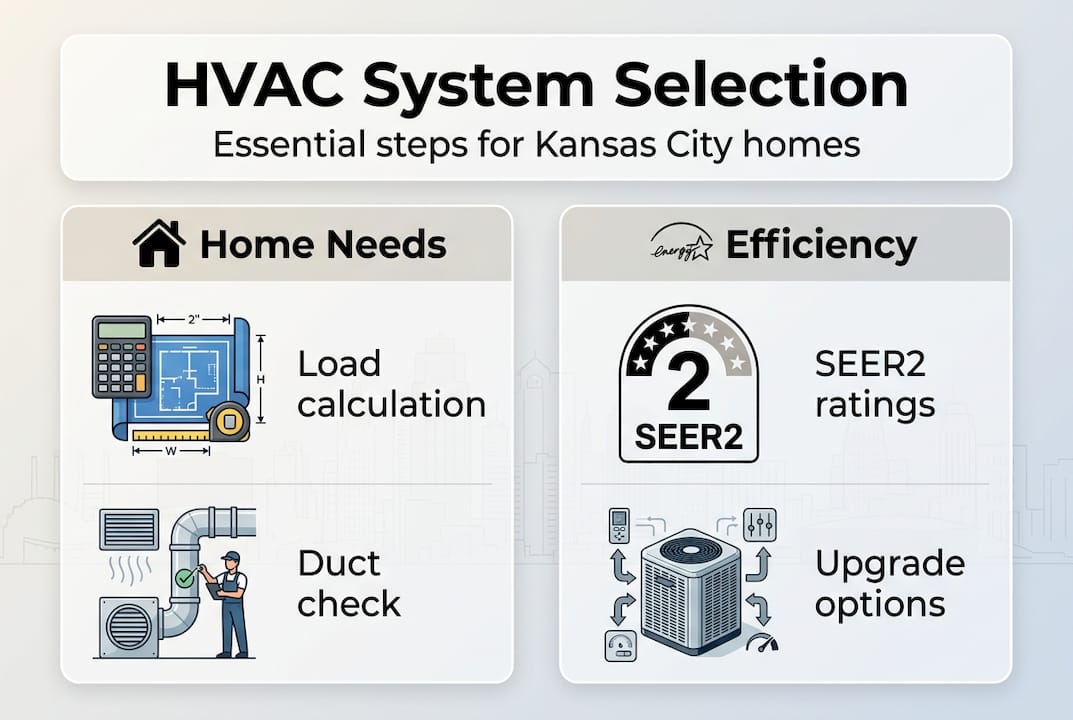
Many contractors still quote systems using a rough rule of thumb, such as one ton of cooling per 500 square feet. That approach is unreliable. Homeowners should insist on a Manual J load calculation, which accounts for all the variables listed above and produces an accurate sizing recommendation.
When you install an HVAC system without a proper load calculation, you risk oversizing or undersizing the equipment. An oversized system short-cycles, meaning it turns on and off too frequently, which wears out components faster and leaves your home feeling humid. An undersized system runs constantly and still can’t keep up on the hottest or coldest days.
Pro Tip: Before getting any quotes, ask contractors to inspect your ductwork and insulation. Upgrading these before installing new equipment will improve HVAC comfort and efficiency and may reduce the system size you actually need.
Evaluate energy efficiency ratings
Once you know your home’s real capacity needs, efficiency ratings become your next critical filter. These ratings tell you how much useful heating or cooling a system delivers for every unit of energy it consumes. Higher ratings mean lower monthly utility bills, but they also affect rebate eligibility and long-term value.
Here are the three main ratings you’ll encounter:
- AFUE (Annual Fuel Utilization Efficiency): Applies to furnaces. A 96% AFUE furnace converts 96 cents of every dollar of gas into heat. Standard models start around 80% AFUE; high-efficiency models reach 96–98%.
- SEER2 (Seasonal Energy Efficiency Ratio 2): Applies to central air conditioners and heat pumps in cooling mode. The federal minimum SEER2 is 14, while the most efficient home ACs reach up to 28 SEER2.
- HSPF2 (Heating Seasonal Performance Factor 2): Applies to heat pumps in heating mode. Higher HSPF2 means more efficient winter heating.
| Rating | System type | Minimum (2026) | High-efficiency range |
|---|---|---|---|
| AFUE | Furnace | 80% | 95–98% |
| SEER2 | AC / heat pump | 14 | 18–28 |
| HSPF2 | Heat pump | 7.5 | 9–10+ |
For Kansas City homeowners, targeting ENERGY STAR certified models is a smart move. ENERGY STAR equipment meets stricter efficiency thresholds and can qualify you for local HVAC rebates through utility providers like Evergy. These rebates can reduce your upfront cost by hundreds of dollars.
ENERGY STAR certification can qualify you for significant rebates. Always verify current rebate requirements with your contractor before purchasing.
Reviewing an energy efficient HVAC guide before you shop helps you understand which models qualify and how to boost HVAC efficiency beyond just equipment selection.
Assess installation quality and contractor credentials
With efficiency understood, the next step is finding the right person to do the work. This is where many homeowners lose money. They focus entirely on equipment specs and ignore the quality of the installation itself. That’s a costly mistake.
Installation quality matters more than brand for long-term system reliability, according to Consumer Reports surveys. A well-installed mid-range system will consistently outperform a premium brand that was rushed or improperly sized.

Here’s what to look for when evaluating contractors:
| Credential | Why it matters |
|---|---|
| State license | Required by law; confirms basic competency |
| Liability insurance | Protects you if something goes wrong |
| NATE certification | Industry-recognized technical training |
| Customer reviews | Real-world track record of quality and service |
| AHRI-verified models | Required for most utility rebates |
Follow these steps when gathering bids for professional HVAC installation:
- Request at least three bids from licensed, insured contractors.
- Require each contractor to provide a written Manual J load calculation.
- Ask for documentation of NATE certification for the technician doing the work.
- Confirm that proposed equipment is AHRI-verified for rebate eligibility.
- Review HVAC estimates carefully and compare scope of work, not just price.
Pro Tip: Ask contractors upfront whether the equipment they’re proposing is AHRI-verified. This matters for rebate eligibility and confirms the system components are tested together as a matched set. Also review HVAC warranty information to understand what’s covered and for how long before you sign anything.
Plan for long-term savings and comfort
Once you’ve chosen a qualified installer, shift your thinking beyond the purchase price. The real cost of an HVAC system includes energy bills, maintenance, repairs, and how comfortable your home feels every day for the next 15 to 20 years.
Kansas City homeowners can access rebates through Evergy and other programs, but rebates may require ENERGY STAR and AHRI-certified models, and pre-install duct or insulation upgrades are often recommended to qualify. Check current requirements before purchasing.
Here are the key factors that affect long-term value:
- Warranty terms: Look for at least 10 years on parts and ask whether labor is covered. Register your equipment promptly after installation.
- Maintenance agreements: Annual tune-ups keep your system running at peak efficiency and catch small problems before they become expensive repairs.
- Variable-speed motors: These adjust output based on demand, which improves humidity control and reduces energy use compared to single-speed systems.
- Smart thermostats: A connected thermostat lets you control your system remotely and can learn your schedule to reduce waste.
- Zoning systems: If your home has rooms that are consistently too hot or too cold, zoning can solve the problem without oversizing the main unit.
Understanding what HVAC systems do for your home’s overall comfort helps you prioritize these features. Knowing how to identify HVAC issues early also protects your investment after installation.
Pro Tip: Schedule a pre-install maintenance check on your existing ductwork. Sealing leaks and improving airflow before the new system goes in can reduce your required equipment size and improve efficiency from day one.
Most homeowners get HVAC system choice wrong—here’s what actually matters
After working on HVAC projects across Kansas City for decades, we’ve seen the same pattern repeat itself. A homeowner replaces their system, chooses a well-known brand at a competitive price, and still ends up with rooms that won’t cool down or utility bills that don’t improve. When we investigate, the cause is almost always the same: the previous installation was done poorly.
Conventional wisdom says to buy the best brand you can afford. We’d push back on that. A mid-range system installed correctly, with properly sealed ducts, accurate sizing, and a matched AHRI-certified configuration, will optimize HVAC comfort far better than a top-tier unit dropped into a poorly designed system.
Chasing the highest SEER2 rating on the market also rarely pays off the way homeowners expect. The efficiency gains between a 20 SEER2 and a 28 SEER2 unit are real, but the payback period can stretch well beyond 10 years. For most Kansas City homes, a well-installed 16 to 18 SEER2 system with proper ductwork delivers better real-world results than a premium unit in a compromised setup.
The counterintuitive truth is this: invest in the team and the total solution first. The equipment specs matter, but they matter far less than the quality of the design, the condition of your ductwork, and the expertise of the person doing the work.
Get expert HVAC help for your Kansas City home
Ready to move forward with a system that actually fits your home? KC Air Control has been serving Kansas City homeowners for over 70 years, and we bring that experience to every installation, repair, and consultation we handle.

Whether you need a full load calculation, a personalized equipment bid, or fast Kansas City furnace repair, our team is ready to help. If your current system is struggling, our emergency HVAC troubleshooting service gets you answers quickly. We also offer duct cleaning services to prepare your home for a new system or improve the performance of your existing one. Contact us today to schedule your consultation and get a solution built around your home’s real needs.
Frequently asked questions
Does the size of my house determine what HVAC system I need?
No. System sizing should be based on a full Manual J load calculation, not just square footage. Insulation, windows, ductwork, and local climate all play a role in accurate sizing.
What is the best SEER2 rating to aim for in Kansas City?
The federal minimum SEER2 is 14, but a rating of 15 to 18 SEER2 offers the best balance of efficiency and value for most Kansas City homes without an excessive payback period.
How can I qualify for local HVAC rebates?
Choose ENERGY STAR and AHRI-certified equipment and ensure your installation includes any required ductwork or insulation upgrades to meet eligibility requirements.
Is brand or installation more important for system reliability?
Installation quality impacts long-term reliability far more than the equipment brand. A properly installed mid-range system will outperform a premium brand with a poor installation.
What features help improve year-round comfort in Kansas City?
Variable-speed blowers, smart thermostats, and properly sized equipment maintain consistent temperatures and humidity levels through Kansas City’s demanding seasonal changes.
Recommended
- Energy efficient HVAC installation guide for KC homeowners – KC Air Control – Heating & Cooling
- Optimize your HVAC maintenance workflow for KC homes – KC Air Control – Heating & Cooling
- How to identify HVAC issues: Kansas City homeowner’s guide – KC Air Control – Heating & Cooling
- HVAC estimates in Kansas City: 2026 homeowner guide – KC Air Control – Heating & Cooling