
TL;DR:
- Upgrading to energy-efficient HVAC systems can reduce home energy costs by 20-40%.
- Proper installation, duct sealing, and home insulation are crucial for real-world efficiency gains.
- Kansas City homeowners can benefit from rebates, tax credits, and long-term savings with high-SEER and variable-speed systems.
Your HVAC system is the single biggest energy consumer in your home, and most Kansas City homeowners are surprised to learn just how much it costs them. HVAC accounts for 40-53% of total home energy use, and upgrading to an efficient system can cut those costs by 20-40%. Many homeowners assume the savings are modest or that the upfront cost is not worth it. The reality is different. Modern energy-efficient HVAC systems deliver lower monthly bills, more consistent indoor temperatures, better air quality, and real long-term value. If you are weighing your options in Kansas City, this guide breaks down exactly what you need to know.
Table of Contents
- How energy efficient HVAC systems work
- The real impact: Savings, comfort, and home value
- Local standards, rebates, and incentives in Kansas City
- Key real-world considerations: What most Kansas City homeowners miss
- What most energy efficiency articles miss: Practical lessons from Kansas City
- Get help upgrading your HVAC for maximum savings
- Frequently asked questions
Quick Links: Energy-Efficient HVAC Savings, Comfort & Rebates
| Point | Details |
|---|---|
| Major bill reductions | Energy efficient HVAC systems commonly cut annual energy costs by up to 40%. |
| Comfort and health improvements | Better systems create steadier temperatures and superior air quality for Kansas City homes. |
| Local rebates boost ROI | Kansas City homeowners can combine local rebates and federal tax credits for faster payback. |
| Installation quality matters | Even the best-rated HVAC loses efficiency without proper installation and ductwork. |
| Smart controls enhance savings | Upgrades like smart thermostats and occupancy sensors deliver extra real-world energy savings. |
How energy efficient HVAC systems work
Understanding efficiency starts with two key ratings: SEER2 and AFUE. SEER2 (Seasonal Energy Efficiency Ratio 2) measures how efficiently a cooling system uses electricity over a season. AFUE (Annual Fuel Utilization Efficiency) measures how much of your fuel a furnace converts into usable heat. Higher numbers in both cases mean less energy wasted and more money saved.
Modern efficient systems reduce energy bills by 20-40% through these ratings and through advanced technologies that older systems simply do not have. Here is what sets them apart:
- Variable-speed compressors: Instead of running at full blast and then shutting off, these compressors adjust their output continuously. This eliminates the energy spikes that happen every time a traditional system cycles on.
- Two-stage or modulating furnaces: These match heat output to what your home actually needs, rather than blasting at 100% every time.
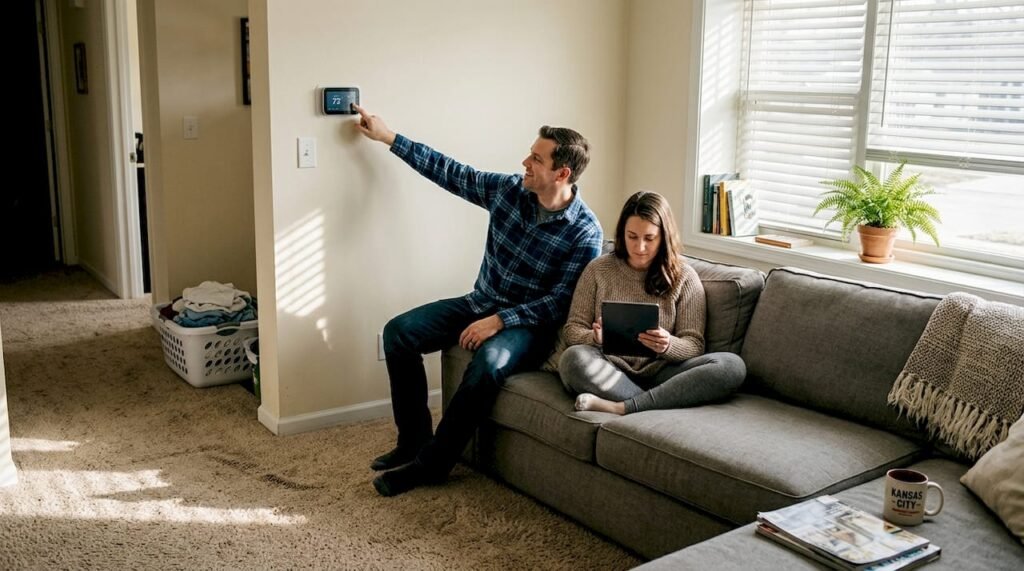
- Smart thermostats and controls: Programmable and Wi-Fi-enabled thermostats prevent your system from working harder than necessary, especially when you are away from home.
- Advanced filtration and ventilation: High-efficiency systems often include better air filtration, which improves indoor air quality alongside comfort.
“The biggest efficiency gains come not just from the equipment rating, but from how well the system matches your home’s actual load at any given moment.”
Variable-speed technology is worth highlighting separately. A traditional single-stage system is either fully on or fully off. A variable-speed system can run at 30%, 60%, or 90% capacity depending on conditions. This means it runs longer at lower speeds, which actually dehumidifies your home more effectively in Kansas City summers. You feel cooler at higher thermostat settings.
Pro Tip: If you are exploring why upgrading your HVAC pays off, focus on the combination of SEER2 rating and variable-speed technology together. Either feature alone delivers benefits, but both together is where you see the biggest difference.
Smart controls also play a bigger role than most people expect. Learning thermostats track your schedule and adjust automatically. Some integrate with utility demand-response programs, which can earn you bill credits during peak demand periods. Pairing a high-efficiency system with smart controls is one of the most practical upgrades available for optimizing home comfort and energy efficiency.
The real impact: Savings, comfort, and home value
Once you understand how efficient systems work, the next question is what that actually means for your household. The benefits go well beyond a lower utility bill each month.
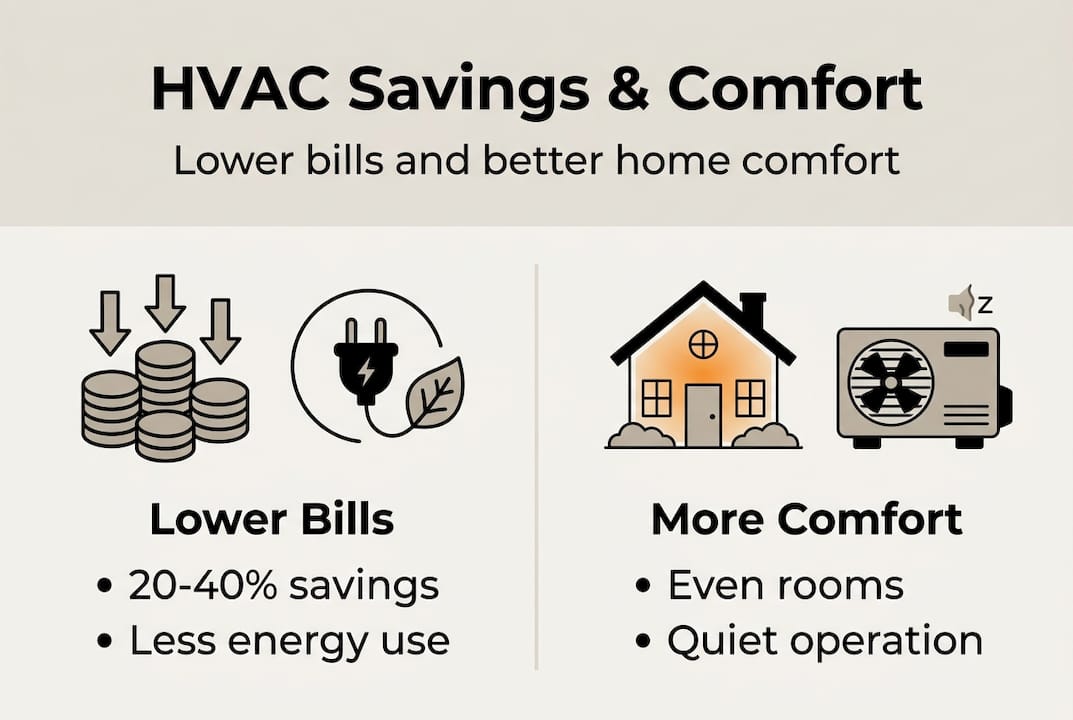
Energy bill savings are the most immediate benefit. Because HVAC accounts for up to 53% of home energy use in Kansas City, even a 20% reduction in system energy consumption translates to meaningful monthly savings. A 40% reduction can be genuinely significant over a year.
| Benefit | Typical impact for KC homeowners |
|---|---|
| Monthly energy savings | 20-40% reduction in HVAC costs |
| System lifespan | 15-20 years vs. 10-12 for older systems |
| Home resale value | Measurable increase for buyers |
| Indoor air quality | Fewer allergens, better humidity control |
| Repair frequency | Lower with newer, better-built components |
Comfort improvements are something homeowners notice immediately. Older systems often create hot and cold spots, run loudly, and struggle to control humidity. Efficient systems with variable-speed technology maintain more consistent temperatures throughout your home. In Kansas City’s humid summers, better dehumidification alone makes a noticeable difference in how comfortable your home feels.
Home value is a benefit that surprises many people. Buyers increasingly look at operating costs, not just purchase price. An efficient HVAC system signals lower utility bills and fewer near-term repair needs, which adds real appeal and value to your home on the market.
Here is a quick summary of additional benefits worth knowing:
- Longer system lifespan due to reduced mechanical stress from variable-speed operation
- Fewer breakdowns because modern components are built to tighter tolerances
- Better indoor air quality through improved filtration and humidity management
- Quieter operation, especially with variable-speed compressors running at lower speeds
For a closer look at how these savings add up locally, the energy efficient HVAC guide for Kansas City homeowners covers specific scenarios. If your current system is aging, HVAC retrofitting for efficiency is also worth reviewing before committing to a full replacement.
Local standards, rebates, and incentives in Kansas City
Kansas City sits in Climate Zone 4A, which has specific minimum efficiency requirements for new HVAC equipment. Knowing these standards helps you make a smarter purchase decision.
Kansas City’s minimum SEER2 is 14-15, depending on the equipment type. However, most efficiency-focused homeowners and HVAC professionals recommend a SEER2 of 16 or higher for meaningful long-term savings. The difference in upfront cost between a minimum-standard unit and a SEER2 16+ unit is often recovered within a few years through lower bills.
Available rebates and tax credits in 2026:
| Incentive source | Amount available |
|---|---|
| Evergy (electric utility) rebate | Up to $400-$1,000 per qualifying system |
| Spire (gas utility) rebate | Varies by equipment type |
| Federal IRA tax credit | Up to $2,000 for qualifying heat pumps |
| Federal IRA tax credit | Up to $600 for qualifying furnaces/ACs |
The Kansas rebate incentive chart from Evergy details current qualifying equipment and rebate amounts. These rebates change periodically, so checking before you purchase is always a good idea.
Here is how to claim your incentives:
- Choose qualifying equipment that meets the minimum efficiency thresholds for each program.
- Have the system professionally installed by a licensed HVAC contractor.
- Submit your rebate application to Evergy or Spire with proof of purchase and installation.
- Claim the federal tax credit on IRS Form 5695 when you file your taxes.
- Keep all receipts, model numbers, and installation documentation.
The combined effect of rebates and tax credits can significantly reduce your net cost. A heat pump system that costs $5,000 installed might net out closer to $2,500 to $3,000 after all available incentives. That changes the payback calculation considerably.
For guidance on efficient HVAC installation in Kansas City or help choosing the right HVAC system for your KC home, working with a local expert who knows these programs saves you time and money.
Key real-world considerations: What most Kansas City homeowners miss
Ratings and rebates tell part of the story. What many articles skip is the gap between a system’s rated efficiency and what you actually experience in your home.
Real-world efficiency can fall 10-20% below rated values in Kansas City homes due to duct leakage, improper static pressure, and installation variables. A SEER2 18 system installed in a home with leaky, undersized ducts may perform closer to SEER2 14 in practice. The equipment rating is only as good as the system it is installed into.
Here is what actually determines your real-world efficiency:
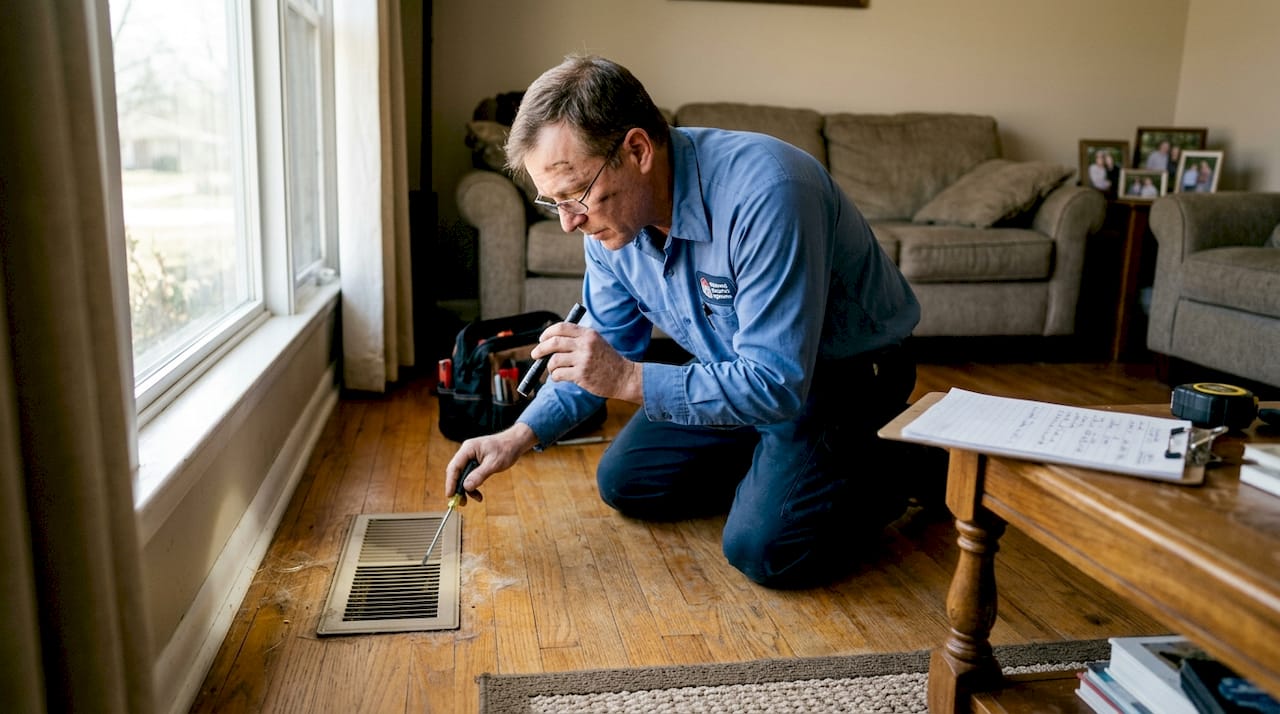
- Ductwork condition: Leaky or poorly insulated ducts waste a significant portion of conditioned air before it reaches your living spaces.
- System sizing: An oversized system short-cycles (turns on and off too quickly), which wastes energy and reduces comfort. Undersized systems run constantly.
- Installation quality: Refrigerant charge, airflow calibration, and electrical connections all affect performance.
- Home envelope: Insulation, windows, and air sealing determine how hard your HVAC has to work.
“Upgrading your equipment without addressing ductwork or insulation is like buying a fuel-efficient car and leaving the windows open.”
Kansas City winters add another layer of consideration. Heat pumps are increasingly popular and efficient, but they lose effectiveness in very cold temperatures. Pairing a heat pump with an efficient gas furnace backup (a dual-fuel system) is often the smartest approach for Kansas City’s climate. You get heat pump efficiency for most of the heating season and reliable gas heat during cold snaps.
Smart thermostats and advanced HVAC controls can add 17-47% in additional savings on top of equipment efficiency gains. That is a wide range, but it reflects how much usage patterns and home conditions vary.
Pro Tip: Before getting HVAC estimates in Kansas City, request a Manual J load calculation. This is the industry-standard method for sizing equipment correctly. Any professional HVAC installation in Kansas City should include this step. If a contractor skips it, that is a red flag.
ROI (return on investment) for efficient HVAC upgrades in Kansas City typically runs 5-7 years when you factor in energy savings, rebates, and reduced repair costs. That is a reasonable timeline for equipment that will last 15-20 years.
What most energy efficiency articles miss: Practical lessons from Kansas City
Most articles about energy-efficient HVAC focus almost entirely on equipment ratings and rebate amounts. We think that misses the most important part of the picture.
In our experience serving Kansas City homeowners, the biggest efficiency gains rarely come from simply swapping one system for another. They come from treating the upgrade as part of a whole-home comfort strategy. That means starting with a home energy audit, checking duct condition, and addressing air sealing before or alongside the equipment upgrade.
We have seen homeowners spend thousands on a high-efficiency system only to get disappointing results because their ductwork was losing 25-30% of conditioned air. Addressing real-world efficiency factors like duct sealing first often delivers faster payback than the equipment upgrade alone.
For Kansas City specifically, the dual-fuel approach and smart thermostat pairing are two upgrades that consistently outperform expectations. Understanding how HVAC maintenance affects your long-term financing and comfort is also something most homeowners overlook until they are already dealing with a problem.
The bottom line: efficiency is a system, not a product.
Get help upgrading your HVAC for maximum savings
If you are ready to lower your energy bills and improve comfort in your Kansas City home, KC Air Control is here to help. With over 70 years of experience serving local homeowners, we understand what works in this climate and what does not.

We handle everything from system selection and professional installation to rebate paperwork and ongoing maintenance. Whether you need a full system upgrade, an HVAC tune-up to boost efficiency, or emergency HVAC repair options when something goes wrong, our team is ready. Start with our energy efficient HVAC guide for Kansas City or schedule a consultation today to find out exactly how much you could save.
Frequently asked questions
How much can Kansas City homeowners save with energy efficient HVAC?
Upgrading to an efficient system typically reduces bills by 20-40%, though your exact savings depend on your home size, current system age, and usage habits.
Are there rebates for energy efficient HVAC in Kansas City?
Yes. Evergy and Spire offer rebates of $400-$1,000 per qualifying system, and the federal Inflation Reduction Act provides tax credits up to $2,000 for qualifying heat pumps.
Does installing an efficient HVAC improve home value?
Efficient systems increase home resale value by lowering operating costs and signaling fewer near-term repair needs, which is increasingly important to buyers.
What SEER rating is recommended for Kansas City homes?
A SEER2 rating of 16 or higher is recommended for Kansas City homes to achieve meaningful long-term efficiency and savings beyond the minimum code requirements.
Is it worth the higher upfront cost for energy efficient HVAC?
Most Kansas City homeowners recover the investment in 5-7 years through lower energy bills, available rebates, and improved home value, making it a sound long-term financial decision.
Recommended
- How HVAC systems optimize home comfort and energy efficiency – KC Air Control – Heating & Cooling
- Energy efficient HVAC guide: Save 20-50% in KC – KC Air Control – Heating & Cooling
- Why upgrade your HVAC? Boost comfort & cut energy bills – KC Air Control – Heating & Cooling
- HVAC tune-up: boost efficiency and lower costs in 2026 – KC Air Control – Heating & Cooling
Pingback: Furnace Efficiency Explained: Save Energy and Boost Comfort - KC Air Control - Heating & Cooling