
TL;DR:
- Furnace efficiency is measured by AFUE, indicating how much fuel is converted into usable heat.
- High-efficiency furnaces (90% and above) save homeowners $150 to $500 annually in Kansas City.
- Proper installation, duct sealing, and home insulation are essential to maximize real-world efficiency gains.
Most Kansas City homeowners assume that any modern furnace will keep their energy bills in check. That assumption can cost hundreds of dollars every single winter. Furnace efficiency varies widely across equipment, and the difference between a low-efficiency and a high-efficiency unit in a Kansas City home can mean $150 to $500 in annual savings. In this guide, we break down exactly what furnace efficiency means, how it’s measured, what numbers make sense for our local climate, and how to make sure you’re actually getting the performance you’re paying for.
Table of Contents
- What furnace efficiency really means
- Decoding AFUE ratings: What’s good, better, and best
- How furnace efficiency impacts Kansas City homes
- Why real-world efficiency is often lower than you think
- Getting the most from your furnace investment
- Furnace efficiency: What most guides leave out
- Next steps: Expert help for Kansas City furnace efficiency
- Frequently asked questions
Key Takeaways
| Point | Details |
|---|---|
| AFUE rating matters | Furnace efficiency is measured by AFUE, which tells you how much fuel is converted into usable heat. |
| KC homes need 90%+ | High-efficiency furnaces (90% or more AFUE) work best and save money in Kansas City’s climate. |
| Real savings depend on your home | Ductwork, insulation, and proper installation are just as important as buying a high-AFUE furnace. |
| Upgrade and maintain | You get the best performance by upgrading, tuning up, and optimizing your whole system—not just replacing the furnace. |
What furnace efficiency really means
Furnace efficiency sounds technical, but the core idea is simple: how much of the fuel your furnace burns actually becomes heat in your home? Furnace efficiency is measured by AFUE, which stands for Annual Fuel Utilization Efficiency. It’s a percentage that tells you how much fuel gets converted into usable heat over a full year of operation.
Think of it this way. An 80% AFUE furnace turns 80 cents of every dollar of fuel into heat. The remaining 20 cents escapes as waste, typically through the flue or exhaust. A 95% AFUE furnace wastes only 5 cents on the dollar. Over a Kansas City winter, that difference stacks up fast.
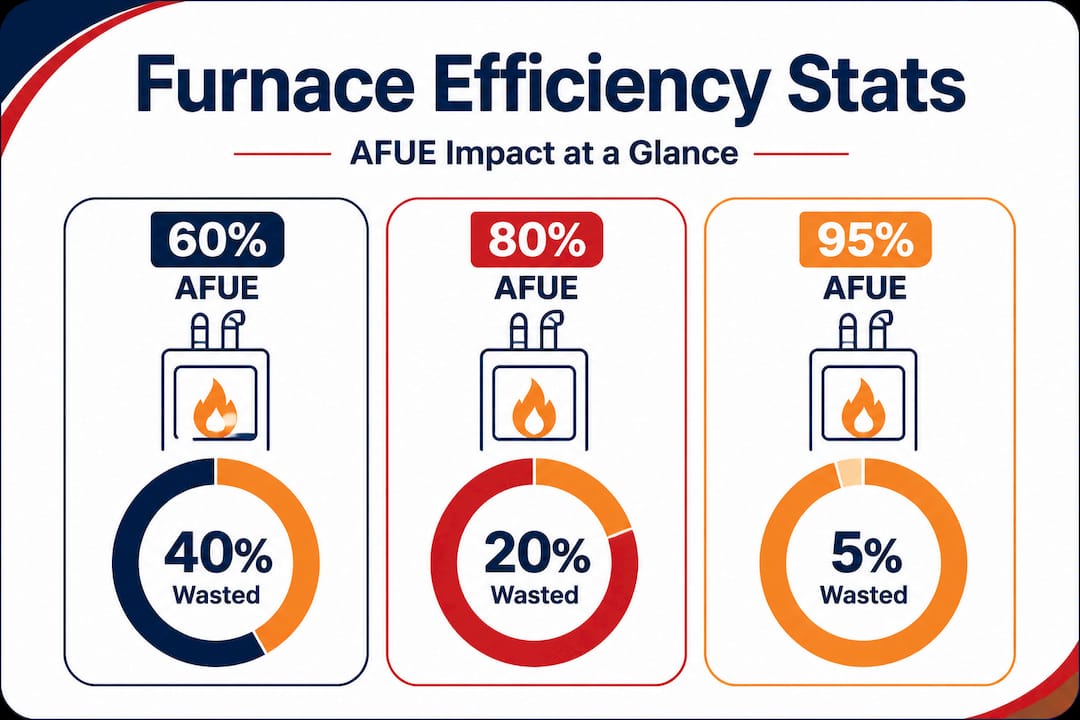
AFUE is calculated using a straightforward formula: annual heat output in BTUs divided by annual fuel energy input in BTUs, then multiplied by 100. The calculation accounts for cycling losses (when the furnace turns on and off), standby losses (heat that escapes when the unit isn’t running), and normal operating losses. This gives you a realistic picture of seasonal performance, not just peak performance on a perfect day.
AFUE ratings are determined through standardized U.S. Department of Energy (DOE) lab tests that simulate a full heating season with varied cycles and conditions. That means the number on the label reflects a controlled standard, not your specific home’s conditions. More on that distinction later.
Here’s a quick look at how AFUE percentages translate to real fuel waste:
| AFUE Rating | Fuel Converted to Heat | Fuel Lost as Waste Heat |
|---|---|---|
| 60% | 60% | 40% |
| 80% | 80% | 20% |
| 90% | 90% | 10% |
| 95% | 95% | 5% |
| 98% | 98% | 2% |
The jump from 60% to 80% cuts waste in half. Moving from 80% to 95% cuts waste by another 75%. Understanding these numbers helps you make a real financial decision, not just a gut-call at the showroom. For a deeper look at the energy efficient HVAC benefits that come with upgrading, our resource library breaks down the full picture.
Decoding AFUE ratings: What’s good, better, and best
With the basics of efficiency clear, you might wonder what numbers are actually considered good or great in Kansas City’s climate. Common AFUE benchmarks break down into three broad categories: low efficiency (below 80%), standard efficiency (80-89%), and high efficiency (90% and above). Modern condensing furnaces often reach 95-98% or higher. As of 2023, the DOE raised the minimum efficiency standard for northern states to 90%, which directly applies to the Kansas City region.
Here’s how the categories compare side by side:
| Category | AFUE Range | Pros | Cons |
|---|---|---|---|
| Low efficiency | Below 80% | Lower upfront cost | High operating costs, poor output |
| Standard efficiency | 80-89% | Widely available, moderate price | Misses out on major savings |
| High efficiency (condensing) | 90-98%+ | Lowest operating costs, best comfort | Higher upfront investment |
A common upgrade path for Kansas City homeowners looks something like this:
- Older low-efficiency unit (below 80% AFUE): These are often 15 to 20 years old, using outdated combustion technology and costing far more per heating season than necessary. Replacement almost always pays off.
- Standard unit (80-89% AFUE): A reasonable mid-range option, but given Kansas City’s cold winters and the new 90% minimum standard, these units leave savings on the table.
- High-efficiency condensing unit (90-98%+ AFUE): These extract heat from combustion gases that older designs simply vent out. They run cooler exhaust, which is why they use PVC pipes instead of metal flues. The performance gain is real and measurable.
Kansas City homes benefit most from units in the 90-98% AFUE range, where the combination of our cold winters and longer heating seasons means the efficiency gains translate directly into significant annual savings.
For a full breakdown tailored to our local conditions, check out our efficient HVAC guide for KC, which covers equipment selection, sizing, and seasonal considerations in detail.
How furnace efficiency impacts Kansas City homes
Understanding these categories is one thing. Seeing how those numbers actually play out in Kansas City homes is another. Our winters are real. January temperatures regularly drop into the teens, and the heating season typically runs from October through April. That’s six full months of consistent furnace use, which means efficiency differences translate into significant dollar amounts.
Kansas City’s mixed to cold climate (climate zones 4 and 5) benefits from furnaces rated at 90-95% AFUE or higher. High-efficiency units in this region typically save $150 to $500 per year compared to standard models, with a payback period of roughly five to ten years depending on the unit cost and current gas rates. Natural gas furnaces remain the recommended choice for Kansas City’s long winters, given the combination of availability and cost per BTU.
One point worth understanding: electric furnaces technically operate at 100% AFUE because all the electricity converts directly to heat with no flue losses. But electricity costs significantly more per BTU than natural gas in Kansas City, so an electric furnace with “perfect” efficiency often results in higher monthly bills than a gas unit at 95% AFUE. The AFUE number alone doesn’t tell the full story.
Upgrading from an 80% to a 95% AFUE furnace can cut heating bills by 15-20%, which translates to more than $190 per year for a typical Kansas City household. Utility rebates from companies like Evergy and Spire can reduce your upfront investment by $100 to $500 or more depending on the equipment and the current incentive programs.
The benefits of a high-efficiency upgrade in Kansas City include:
- Lower monthly energy bills throughout the entire heating season
- More consistent indoor temperatures because high-efficiency units often run longer, lower-output cycles instead of short, intense blasts
- Reduced carbon footprint from burning less fuel to achieve the same level of warmth
- Quieter operation with variable-speed blowers common in condensing models
- Fewer breakdowns in newer, more efficiently engineered equipment
Pro Tip: Before you finalize an equipment purchase, ask your HVAC contractor to pull up current rebate programs from your utility provider. These change throughout the year, and timing your purchase right can knock a meaningful amount off the total cost. For guidance on planning your upgrade financially, our HVAC budgeting resource walks through the numbers clearly.
Why real-world efficiency is often lower than you think
While the numbers look promising, the story isn’t complete without accounting for real-world factors. The AFUE rating on the equipment label is a lab measurement under controlled conditions. Your home is not a lab.
Real-world AFUE can fall well below the rated value due to duct leakage (which can account for 20-30% heat loss), poor insulation, oversizing (which causes short cycling), and improper installation. Short cycling means the furnace kicks on, heats quickly, and shuts off before finishing a proper cycle. This wastes fuel and puts extra wear on components.
Gains from higher AFUE diminish incrementally as you climb the scale. Moving from 80% to 90% AFUE cuts waste by about 10%. Moving from 90% to 95% only saves an additional 5%. This means that a home with leaky ducts or poor insulation will not see the full benefit of a 98% AFUE unit. The DOE’s 2023 standards raising the northern minimum to 90% reflect exactly this reality.
Common issues that lower real-world efficiency include:
- Oversized furnace: Produces too much heat too fast, causing short cycling and uneven temperatures
- Leaky ductwork: Conditioned air escapes into attics, crawl spaces, and wall cavities before reaching living areas
- Poor home insulation: The furnace has to work harder and longer to maintain set temperatures
- Skipped maintenance: Dirty filters, neglected heat exchangers, and worn components all reduce output
- Improper installation: Incorrect flue sizing, refrigerant charge, or airflow settings undermine even top-tier equipment
Pro Tip: Sealing your ductwork and adding insulation in the right places can improve effective efficiency more than bumping up one AFUE tier alone. A qualified technician can measure your duct leakage and identify where your home is losing the most heat. Our energy saving HVAC tips page covers many of these fixes in plain language. You can also explore our furnace tune-up services to get a professional assessment of your current system.
Getting the most from your furnace investment
Knowing the pitfalls, here’s a practical game plan for squeezing the most value from your furnace investment. These steps apply whether you’re buying a new system or optimizing what you already have.
- Professional installation: Improper installation is one of the top reasons efficiency ratings don’t translate to real savings. A licensed HVAC technician will size the equipment correctly, configure airflow settings, and verify that all connections meet manufacturer specs.
- Ductwork inspection and sealing: AFUE lab ratings overstate real performance in homes with significant duct leakage; duct sealing and zoning often yield greater savings than simply choosing the highest AFUE unit on the market.
- Regular maintenance and tune-ups: An annual furnace tune-up keeps combustion efficient, catches developing problems early, and maintains your manufacturer warranty. Skipping maintenance is one of the most common ways homeowners lose efficiency gains they paid for.
- Use available rebates and incentives: Federal tax credits and local utility rebates can offset a significant portion of upgrade costs. Always check current programs before purchasing.
- Consider zoning and smart controls: Variable-speed blowers and programmable thermostats let you match output to actual demand, reducing unnecessary runtime and fuel consumption.
Many efficiency losses are house-related, not equipment-related. A high-efficiency furnace in a poorly sealed home will never perform to its potential. For resources on planning an upgrade that addresses the full picture, visit our pages on upgrading for comfort and savings, HVAC retrofitting options, and why furnace maintenance matters.
Furnace efficiency: What most guides leave out
Here’s something we’ve observed across years of serving Kansas City homeowners: chasing the highest AFUE number often misses the point entirely. A 98% AFUE furnace in a home with 25% duct leakage and uninsulated rim joists is not going to perform like a 98% AFUE furnace. It may not even outperform a well-installed 92% unit in a properly air-sealed home.
The honest advice is this: a mid-90s AFUE furnace paired with duct improvements and basic air sealing will almost always outperform a top-of-the-line unit dropped into the same leaky system without any building envelope work. We’ve seen homeowners spend extra on premium equipment and then wonder why their bills barely budged. The equipment wasn’t the problem.
Improperly sized high-efficiency furnaces actually create new problems. Oversized condensing furnaces short-cycle, which means the heat exchanger never reaches optimal operating temperature, condensation doesn’t drain correctly, and components wear out faster. The result is higher repair costs and lower effective efficiency, despite paying a premium for the unit.
Our practical recommendation: always pair any equipment upgrade with a home efficiency checkup. That means having a technician assess your duct system, check insulation levels in key areas, and verify that the selected unit is sized to match your actual load, not just the square footage estimate from a quick phone call. The efficient HVAC tips we’ve compiled reflect exactly this whole-home perspective. Real savings come from treating the furnace as one part of a system, not the entire solution.
Next steps: Expert help for Kansas City furnace efficiency
Ready to take these ideas from the page into your own home? KC Air Control has been serving Kansas City homeowners for over 70 years, and we understand exactly how our local winters stress heating equipment and where efficiency losses tend to hide in regional homes.

Whether you need a furnace repair to get your current system running at its best, a full efficiency assessment, or guidance on upgrading to a high-efficiency condensing unit, our team is ready to help. We also offer professional duct cleaning services to address one of the most common sources of real-world efficiency loss. The best first step for most homeowners is a professional inspection. Schedule a furnace tune-up with our team today and get a clear picture of where your system stands and what it would take to improve it.
Frequently asked questions
What is a good AFUE rating for Kansas City homes?
A good AFUE rating for Kansas City is 90% or higher, as recommended for mixed or cold climates like the zones 4 and 5 that cover our region. Units in the 90-95% range deliver strong savings without overshooting what the home’s ductwork and insulation can actually support.
How much can upgrading my furnace actually save?
Upgrading from 80% to 95% AFUE can save 15-20% on heating bills, which amounts to more than $190 per year for a typical Kansas City household, and potentially much more depending on home size and current gas rates.
Does a higher AFUE always mean lower bills?
Not always. Actual savings depend heavily on duct leakage, poor insulation, and proper installation. A high-AFUE furnace in a home with significant duct losses may underperform a properly installed lower-rated unit.
What affects my furnace’s real efficiency besides the equipment?
Duct leakage accounting for 20-30% of heat loss, poor home insulation, oversized equipment that short-cycles, and skipping annual maintenance are all factors that can pull your real-world efficiency well below the AFUE number on the label.
Recommended
- Why Maintain Your Furnace: Cut KC Heating Costs 15% in 2026 – Air Control
- Why replace your furnace? Savings, comfort, and smart timing – KC Air Control – Heating & Cooling
- Energy efficient HVAC: lower bills and better comfort – KC Air Control – Heating & Cooling
- Furnace tune-up – Air Control
- Central heating systems: A Reading homeowner’s guide