
TL;DR:
- Properly integrated humidifiers help maintain indoor humidity levels between 30% and 50%, preventing dry skin, static electricity, and wood damage during Kansas City’s cold winters. Different types, including bypass, fan-assisted, and steam humidifiers, offer various benefits and maintenance requirements suited to specific home sizes and climates. Regular maintenance and correct sizing are essential to ensure healthy, efficient, and reliable indoor moisture control.
Kansas City winters are no stranger to dry, biting air that leaves your skin cracked, your throat scratchy, and your wood floors creaking. The role of humidifiers in HVAC systems is often misunderstood. Many homeowners assume a furnace alone handles indoor comfort, but heating your air actually strips moisture from it, pushing indoor humidity far below the levels your body and home need. This guide covers how HVAC-integrated humidifiers work, which type fits your home, and how to maintain them safely for real, lasting comfort.
Table of Contents
- Understanding the role of humidifiers in HVAC systems
- Types of whole-house HVAC humidifiers and how they work
- Comparing humidifier types: features, benefits, and limitations
- Humidifier maintenance: ensuring health and performance
- Applying humidifiers in Kansas City homes: practical tips and considerations
- The overlooked truth about humidifiers in home HVAC systems
- Professional humidifier and HVAC services for Kansas City homeowners
- Frequently asked questions
Understanding the role of humidifiers in HVAC systems
Your HVAC system does more than heat and cool your home. It also controls air quality and moisture levels, and humidity is a bigger part of that equation than most people realize. When your furnace runs through a Kansas City winter, it heats incoming air and lowers its relative humidity (RH), which is the percentage of moisture in the air compared to what it can hold at that temperature. The result is dry indoor air that affects your health, your furniture, and your energy bills.
The recommended comfort range for indoor relative humidity sits between 30% and 60%, per ASHRAE Standard 55. Below that range, you experience dry skin, irritated sinuses, static electricity, and wood shrinkage. The EPA advises keeping indoor humidity below 60% and ideally between 30% and 50% to prevent mold growth. Staying in that sweet spot is the job of a properly integrated humidifier.
Here is what a whole-house humidifier addresses when connected to your HVAC system:
- Dry skin and irritated airways caused by low-humidity winter air
- Static electricity buildup that damages electronics and shocks family members
- Wood floor and furniture cracking from moisture loss in building materials
- Perceived coldness since dry air feels cooler, causing you to raise the thermostat and spend more on heating
- Increased respiratory discomfort for allergy and asthma sufferers
You can explore additional indoor comfort strategies that work alongside humidity control for a well-rounded approach to home air quality.
Types of whole-house HVAC humidifiers and how they work
Whole-house humidifiers fall into a few main technology categories, each operating differently and suited to different home setups. Understanding these types is the first step toward choosing the right one.
Evaporative humidifiers are the most common type. They work by passing air over a water-saturated pad or panel, which allows moisture to evaporate naturally into the airstream. There are two subtypes:
- Bypass evaporative humidifiers tap into the supply and return ducts of your furnace system. They rely entirely on the furnace blower to push air through the water panel. They are the most affordable option and work well in moderately sized homes.
- Fan-assisted evaporative humidifiers include their own internal fan, so they can humidify even when the furnace is not actively heating. This makes them more consistent and better suited for larger or two-story homes.
Steam humidifiers take a different approach. They heat water to boiling and inject clean steam directly into the ductwork. Because they generate steam independently, they work any time you need humidity, regardless of whether your furnace is running. This makes them the most flexible and precise option available.
| Feature | Bypass evaporative | Fan-assisted evaporative | Steam |
|---|---|---|---|
| Energy use | Low | Moderate | Higher |
| Humidification output | Moderate | High | Highest |
| Works without furnace running | No | Yes | Yes |
| Best for | Small to medium homes | Medium to large homes | Larger or colder homes |
| Upfront cost | Lowest | Moderate | Highest |
Pro Tip: If your Kansas City home has zoned HVAC or a variable-speed furnace, a fan-assisted or steam humidifier will give you far more consistent results than a bypass unit because they are not dependent on blower speed or heating cycles.
For guidance on proper installation for any of these systems, our HVAC installation resource covers what to expect from the process.
Comparing humidifier types: features, benefits, and limitations
Knowing how each type works is one thing. Knowing which one fits your specific home situation is what actually matters. Here is a closer look at the real-world trade-offs.
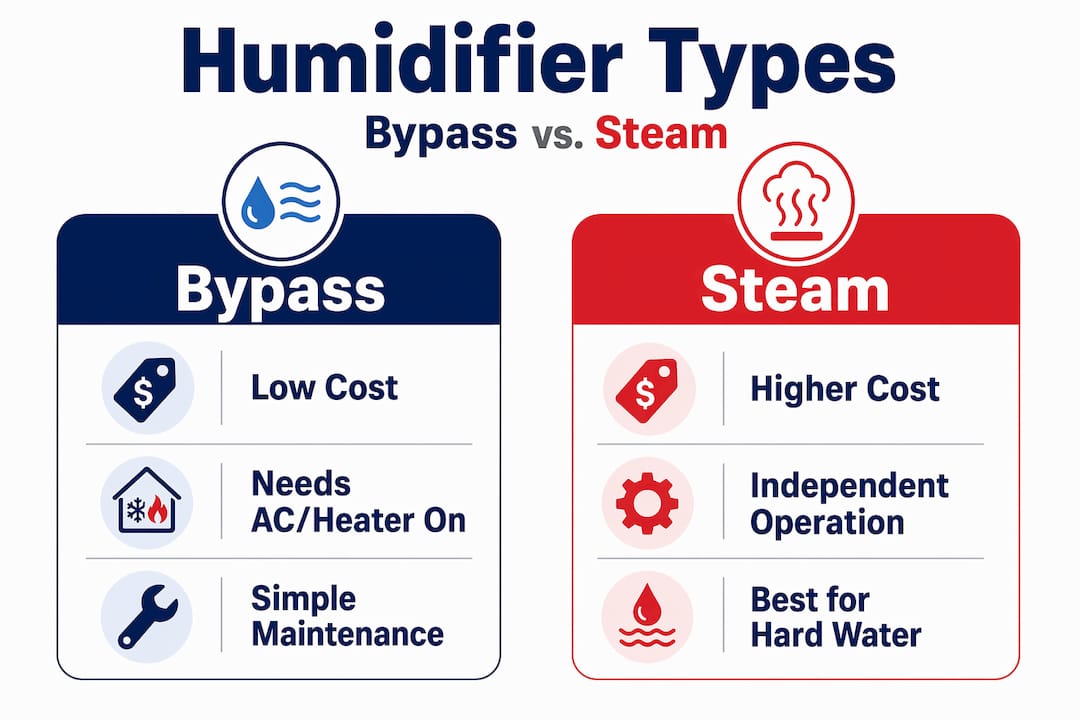
Bypass humidifiers are budget-friendly and reliable for many homes, but they come with a significant limitation. They depend on the furnace blower and produce limited output during short heating cycles. In a Kansas City winter when temperatures fluctuate and your furnace cycles on and off frequently, you may notice inconsistent humidity levels. They also require annual replacement of the water panel to maintain performance.
Fan-assisted evaporative humidifiers resolve the blower dependency issue. Because they run their own fan, they can maintain a steady humidity output regardless of what your furnace is doing. They cost more upfront than bypass models but deliver better results in homes with higher ceilings, open floor plans, or above-average air leakage.
Steam humidifiers offer the highest level of precision and independence. They maintain your target humidity setting consistently. The trade-off is real: steam models carry higher upfront costs and require a dedicated electrical circuit. For homeowners dealing with very dry winters or living in larger homes, however, the investment pays off in comfort and indoor air quality.
Here is a quick summary of maintenance demands for each:
- Bypass: Replace the water evaporator pad once per season
- Fan-assisted: Replace the pad annually and clean the housing
- Steam: Clean or replace the steam canister regularly and descale the heating element to prevent mineral buildup
Pro Tip: Hard water is common in many Kansas City neighborhoods. If your water has high mineral content, a steam humidifier will require more frequent descaling. Consider using a pre-filter or water treatment to reduce maintenance demands.
If your current HVAC equipment is aging, adding a humidifier is also a good time to assess whether an upgrade makes sense for your home as a whole.
Humidifier maintenance: ensuring health and performance
A humidifier that is not maintained does not just stop working well. It can actively cause problems. Dirty humidifiers or overly humid environments increase the risk of mold growth, bacterial contamination, and worsened allergy symptoms. The good news is that maintenance is straightforward when you follow a consistent schedule.
Here are the key steps every Kansas City homeowner should follow:
- Replace evaporative pads annually. Seasonal inspection and pad replacement are essential to maintaining stable performance and preventing microbial buildup.
- Inspect and clear drain lines. Standing water in humidifier drain lines creates an ideal environment for mold and bacteria. Check the drain at the start of each heating season.
- Calibrate your humidistat. Use a separate hygrometer (a device that measures air humidity) to verify that your humidistat is reading accurately. Off-calibration settings can cause under or over-humidification.
- Avoid over-humidification. Humidity above 60% promotes condensation on windows and walls, which can lead to hidden mold growth inside wall cavities.
- Use distilled or filtered water where possible. Mineral deposits from hard tap water shorten the life of pads, canisters, and heating elements.
Pro Tip: Set a calendar reminder at the start of every October to schedule your humidifier inspection before the heating season begins. Catching problems before the season starts is far easier than addressing a mold issue in January.
Our seasonal HVAC maintenance guide walks through the full checklist for keeping your system in top shape year round.
Applying humidifiers in Kansas City homes: practical tips and considerations
Kansas City homeowners face a specific climate challenge. Winters bring cold, dry air that pushes indoor humidity well below comfortable levels, while summers can bring high outdoor humidity that requires dehumidification instead. A humidifier integrated with your HVAC system needs to be sized and installed with this seasonal swing in mind.

Before choosing a system, sizing based on home volume, ceiling height, and heating patterns is critical. A unit too small for your space will run constantly without meeting your humidity targets. A unit too large can quickly push humidity above safe levels.
Follow these practical steps when planning your humidifier installation:
- Assess your square footage and ceiling height before selecting a model. Most manufacturer specs list coverage capacity in gallons per day for a reason.
- Install the humidistat in a central location away from exterior walls and heat sources for the most accurate readings.
- Monitor humidity with a standalone hygrometer at least once a week during the heating season.
- Fix any water leaks or moisture sources promptly. The EPA emphasizes that controlling existing moisture issues is foundational to mold prevention. Adding a humidifier without fixing a leaky pipe or a damp basement is counterproductive.
- Work with a licensed HVAC professional for installation. Improper connections to ductwork or drain lines are the leading cause of humidifier-related water damage.
You can learn more about year-round HVAC maintenance and review our indoor air quality homeowner guide for a broader picture of what affects the air inside your home.
Pro Tip: During Kansas City’s mild spring and fall seasons, turn off your whole-house humidifier and switch to ventilation-only mode. Running a humidifier when outdoor air is already humid adds unnecessary moisture and maintenance wear.
The overlooked truth about humidifiers in home HVAC systems
Here is something most articles on this topic skip: a humidifier does not automatically improve your indoor air quality. It improves it only when it is properly sized, correctly maintained, and treated as one part of a broader moisture management strategy rather than a standalone fix.
We have seen Kansas City homeowners invest in whole-house humidifiers and then wonder why they have condensation on windows or a musty smell in January. The cause is almost always the same: excess moisture combined with a dirty unit creates exactly the conditions humidifiers are supposed to prevent. Running humidity above the recommended range does not make your home more comfortable. It makes it a better environment for mold and dust mites.
The other issue we see regularly is homeowners who treat humidifiers as a set-it-and-forget-it solution. Bypassing annual maintenance because the system seems to be working is a common mistake. A water panel caked in mineral deposits or a drain line silently holding standing water can undermine an otherwise solid HVAC system. The hygiene side of humidifier ownership deserves as much attention as the comfort side.
Moisture control in any home is an active process: fix leaks promptly, dry wet areas within 24 to 48 hours, ventilate appropriately, and use your humidifier as a calibrated tool within that larger system. When that balance is right, you feel it every day: comfortable air, no static shocks, no morning congestion, and energy bills that do not spike because you had to crank the thermostat to compensate for dry air.
If your current system feels overdue for a review, our breakdown of why upgrading your HVAC matters covers what to look for and when to make a move.
Professional humidifier and HVAC services for Kansas City homeowners
Managing indoor humidity is easier when you have experienced professionals handling installation, sizing, and seasonal care. At KC Air Control, we have served Kansas City homeowners for over 70 years with reliable HVAC solutions, including whole-house humidifier installation and maintenance.

Getting the right humidifier matched to your home, your HVAC system, and your local climate is not guesswork. Our team sizes every system based on your specific square footage, heating setup, and water quality. We also offer indoor air quality services that assess your home’s air health from multiple angles, not just humidity. Pair that with our seasonal HVAC maintenance plans to keep your system performing year round without surprises. And if your current equipment is aging, explore how upgrading your HVAC can cut your energy bills while improving comfort from the ground up. Reach out to schedule your consultation today.
Frequently asked questions
What relative humidity should I maintain in my Kansas City home with a humidifier?
Maintain indoor relative humidity between 30% and 50% for daily comfort and mold prevention. This range keeps air comfortable without creating the conditions that allow mold and bacteria to grow.
How often should I maintain or replace parts of my whole-house humidifier?
Seasonal pad replacement and thorough cleaning are recommended at least once per year, ideally at the start of the heating season. Skipping annual service is the fastest way to reduce performance and introduce hygiene risks.
Can a humidifier cause health problems if not maintained?
Yes. Dirty or over-used humidifiers promote mold and bacterial growth that can worsen allergies, trigger asthma, and create respiratory discomfort. Proper maintenance eliminates most of that risk.
Which type of humidifier is best for a larger Kansas City home with dry winter air?
Steam humidifiers are the strongest choice for larger homes because they offer precise, independent humidity control regardless of whether your furnace is running. They perform reliably in cold, dry Midwestern winters where consistent output matters most.
Recommended
- How to identify HVAC issues: Kansas City homeowner’s guide – KC Air Control – Heating & Cooling
- Optimize your HVAC maintenance workflow for KC homes – KC Air Control – Heating & Cooling
- HVAC inspections for Kansas City homeowners: 2026 guide – KC Air Control – Heating & Cooling
- How UV lights improve HVAC air quality in Kansas City homes – KC Air Control – Heating & Cooling