
TL;DR:
- Proper insulation reduces HVAC energy consumption by limiting heat transfer through walls and ducts, enhancing overall efficiency. Combined with meticulous air sealing and continuous insulation, it minimizes heat loss, decreases system workload, and extends equipment lifespan. Addressing thermal bridging, choosing appropriate insulation types, and insulating ducts in unconditioned spaces are essential for maximizing performance and savings.
Insulation is defined as a material that resists heat flow between conditioned indoor spaces and the outside environment, and its role in HVAC performance is direct. The DOE states that insulation reduces the heating and cooling load on your HVAC system, which lowers energy costs and improves indoor comfort. Without adequate insulation, your furnace and air conditioner work harder, run longer, and wear out faster. For Kansas City homeowners and property managers, understanding how insulation affects HVAC efficiency is one of the most practical steps toward lower utility bills and a more comfortable home year-round.
How does insulation improve HVAC efficiency?
Insulation improves HVAC efficiency by slowing three types of heat transfer: conduction, convection, and radiation. Conduction moves heat through solid materials like walls and ceilings. Convection carries heat through air movement. Radiation transfers heat as energy across open spaces, such as from a sun-heated roof into your attic. Insulation addresses all three, depending on the material used, which is why material selection matters as much as R-value.
When heat transfer slows, your HVAC system faces a smaller load. A smaller load means shorter run cycles, less wear on components, and lower monthly energy bills. This is the core mechanism behind the importance of insulation in HVAC systems: the less heat that moves through your building envelope, the less work your equipment must do to maintain your set temperature.
The numbers back this up. Combining air sealing with insulation saves homeowners about 15% on heating and cooling costs on average. That figure represents real money on a Kansas City utility bill, particularly during the region’s hot summers and cold winters.
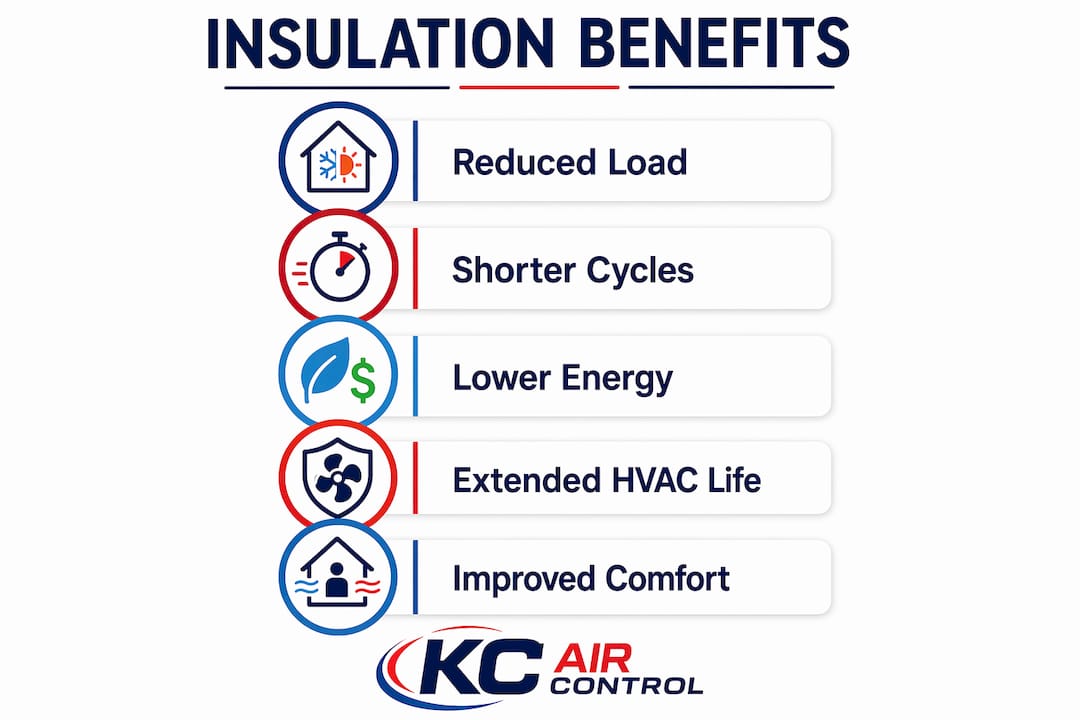
Here is what proper insulation delivers for your HVAC system:
- Reduced heating and cooling loads by limiting heat gain in summer and heat loss in winter
- Fewer temperature swings throughout the day, which reduces how often your system cycles on and off
- Lower equipment strain, extending the service life of your furnace, air conditioner, or heat pump
- More consistent comfort in every room, since conditioned air stays where it belongs
- Improved indoor air quality by reducing the infiltration of outdoor allergens and humidity through gaps in the building envelope
Each of these benefits compounds over time. A system that runs less often not only costs less to operate but also requires fewer repairs, which is why insulation is one of the highest-return investments a homeowner can make.
What insulation types affect HVAC performance?
The DOE notes that different insulation materials suit different climates, locations, and heat transfer types. Choosing the wrong material for your application can leave your HVAC system working harder than necessary, even if the R-value looks correct on paper.
| Insulation type | How it works | Best application | Climate fit |
|---|---|---|---|
| Fiberglass batts | Resists conduction and convection through fibrous air pockets | Wall cavities, attic floors | All climates |
| Rigid foam board (XPS, EPS, polyiso) | Traps inert gases to block conduction; provides continuous coverage | Exterior walls, basement walls, crawlspaces | All climates, especially cold |
| Spray foam (open and closed cell) | Expands to fill gaps, combining insulation and air sealing | Rim joists, irregular cavities, attic rooflines | All climates |
| Reflective foil and radiant barriers | Reflects radiant heat rather than absorbing it | Attic rafters, crawlspace ceilings | Hot, sunny climates |
| Blown-in cellulose or fiberglass | Fills irregular spaces and existing cavities without demolition | Attic floors, existing wall cavities | All climates |
Rigid foam board, including products like XPS (extruded polystyrene) and polyisocyanurate, provides a continuous layer of insulation that does not rely on cavity depth. This makes it particularly effective at reducing thermal bridging, which is covered in the next section. Reflective foil products like radiant barriers work differently: they do not slow conduction but instead reflect radiant heat away from living spaces. In Kansas City’s summer heat, a radiant barrier in the attic can meaningfully reduce cooling loads.
Pro Tip: If you are adding insulation to an existing attic, blown-in cellulose or fiberglass is often the most cost-effective choice because it fills irregular spaces and covers existing framing without requiring demolition.
Why installation quality and thermal bridging matter
Good insulation installed poorly delivers poor results. Compressed insulation fails to reach its rated R-value because the air pockets that provide resistance are crushed out of the material. A batt rated R-19 that is compressed into a 2×4 wall cavity performs closer to R-13. That gap in performance means your HVAC system compensates by running more.
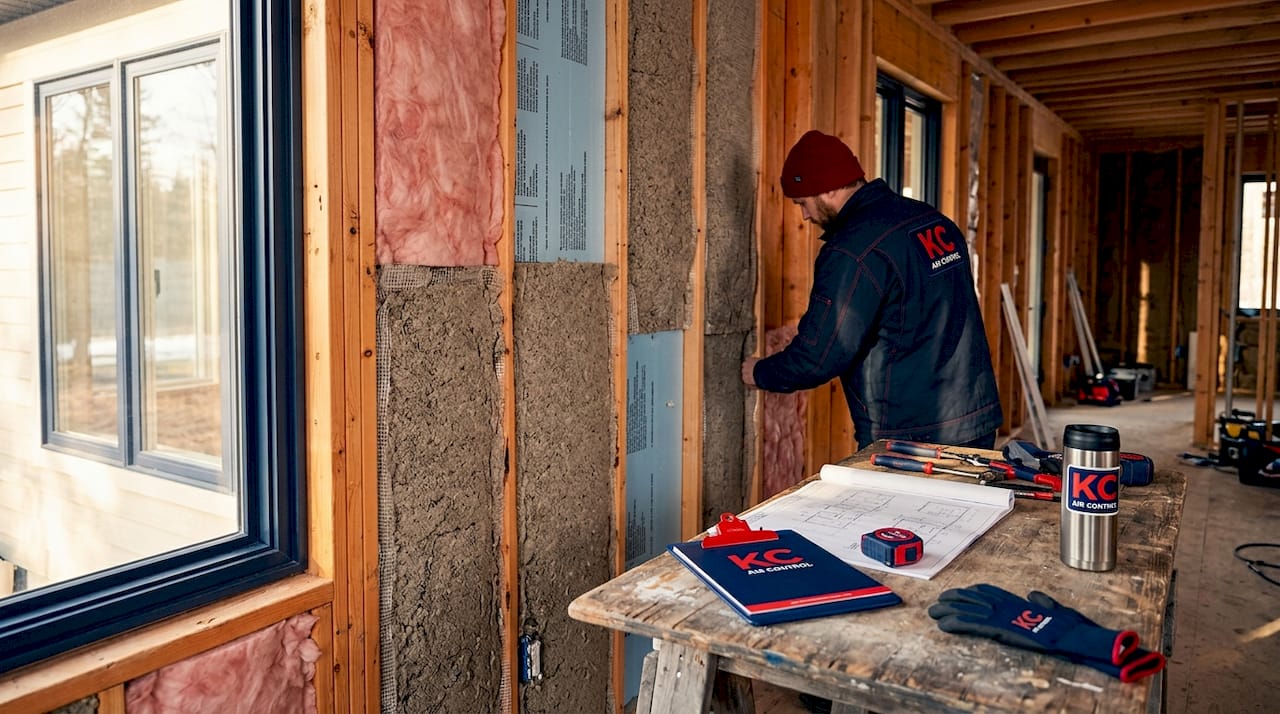
Thermal bridging is a related problem that most homeowners never hear about. Wood studs have a much lower R-value than the insulation filling the cavities between them. Heat bypasses the insulation by traveling through the framing itself. Thermal bridging reduces effective wall insulation performance by 15 to 25%, which directly increases the heating and cooling load your HVAC system must handle. This is not a minor rounding error. It is a structural inefficiency built into standard framing.
The solution is continuous insulation, defined by the 2018 IRC energy code as a layer installed uninterrupted over framing members. Rigid foam board applied to the exterior of a wall before cladding is the most common example. It wraps the entire assembly, including the studs, in a thermal break that stops heat from bypassing the cavity insulation.
Air sealing works alongside insulation to close a different pathway. While insulation resists conductive and radiant heat transfer, it does not stop air movement. Air sealing is critical to allowing insulation to achieve its label-rated performance because air leakage creates convective heat loss that insulation alone cannot prevent.
“Insulation is not just about R-value. Assembly quality, including air sealing and thermal bridging mitigation, determines real-world performance.” — U.S. Department of Energy
Key installation factors that affect how insulation performs in practice:
- No compression: Batts must fit snugly without being forced into undersized cavities
- No gaps or voids: Even small gaps allow air movement that undermines the entire assembly
- Continuous coverage: Rigid foam or continuous insulation layers eliminate thermal bridging through framing
- Air sealing first: Seal all penetrations, gaps, and joints before installing insulation for maximum effectiveness
- Correct R-value for climate zone: Kansas City sits in DOE Climate Zone 4, which has specific minimum R-value requirements for walls, attics, and floors
Poor HVAC installation practices and insulation shortcuts often compound each other, leading to systems that underperform from day one.
How does duct insulation impact HVAC system performance?
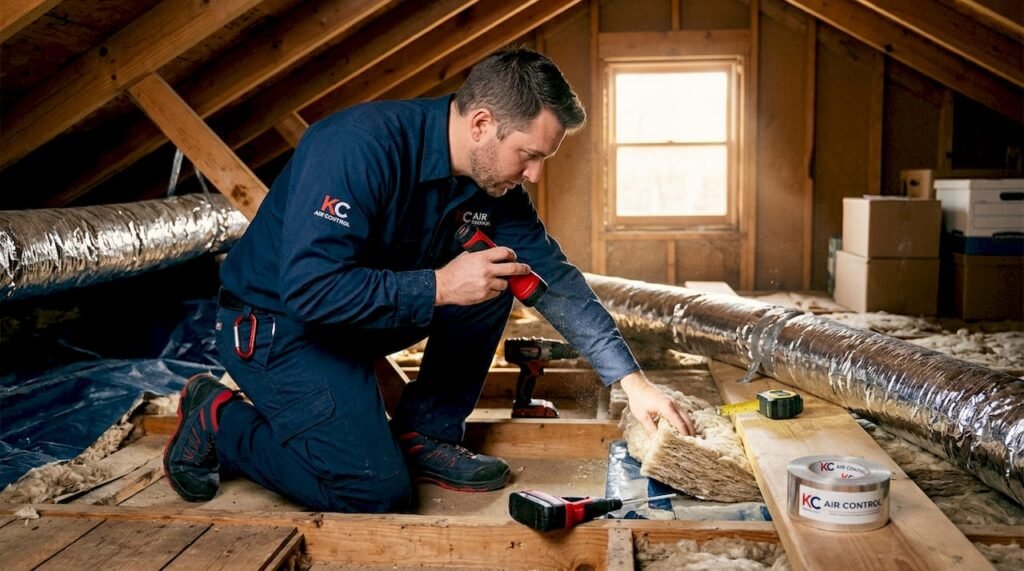
Duct insulation is one of the most overlooked factors in HVAC efficiency, and it is also one of the most impactful. When supply and return ducts run through unconditioned spaces like attics, crawlspaces, or garages, they are exposed to extreme temperatures. In a Kansas City summer, attic temperatures can exceed 130°F. Uninsulated ducts running through that space deliver warm air to your living areas instead of the cool air your system produced.
Uninsulated or leaky ducts can waste 20% or more of delivered heating and cooling energy. That means your HVAC system could be producing conditioned air that never reaches you at full effectiveness. The financial and comfort cost of that waste is significant over a full heating and cooling season.
The 2021 IRC energy provisions address this directly. Ducts outside conditioned spaces require a minimum of R-6 insulation for supply ducts and R-8 for ducts in unconditioned attics. These are minimum standards, not performance targets. In extreme climates or older homes with long duct runs, higher R-values deliver better results.
Follow these steps to address duct insulation effectively:
- Inspect all duct runs in unconditioned spaces to identify uninsulated or under-insulated sections
- Seal all joints and fittings first using mastic sealant or metal-backed tape before applying any insulation
- Apply insulation wrap meeting at least R-6 (supply) or R-8 (attic) per IRC 2021 requirements
- Check for disconnected sections where ducts have separated at joints, which creates both air leakage and thermal loss
- Consider duct encapsulation for older systems with extensive leakage throughout the duct network
The sequencing in step two is not optional. Sealing ducts before insulation creates a continuous thermal barrier. Insulating over leaky joints traps the problem and makes future repairs harder.
Pro Tip: Before scheduling duct insulation work, ask your HVAC contractor to perform a duct leakage test. This identifies exactly where air is escaping and ensures sealing work targets the right locations before insulation goes on.
Key takeaways
Insulation reduces HVAC energy use by limiting heat transfer through walls, ceilings, and ducts, but only when installed correctly with proper air sealing and thermal bridging control.
| Point | Details |
|---|---|
| Insulation reduces HVAC workload | Slowing heat transfer lowers heating and cooling loads, cutting energy costs and equipment wear. |
| Air sealing multiplies insulation value | Combined air sealing and insulation saves about 15% on heating and cooling costs on average. |
| Thermal bridging cuts performance | Framing bypasses cavity insulation by 15 to 25%, making continuous insulation layers a practical fix. |
| Duct insulation is non-negotiable | Uninsulated ducts in unconditioned spaces waste up to 20% of delivered heating and cooling energy. |
| Installation quality determines results | Compression, gaps, and skipped air sealing reduce real-world R-value below rated performance. |
What I’ve learned from watching insulation and HVAC interact
After years of working with homeowners on HVAC performance, the pattern I see most often is this: a homeowner upgrades to a high-efficiency furnace or air conditioner, expects dramatic savings, and then wonders why their bills barely moved. The answer is almost always the building envelope. A 96% AFUE furnace running in a poorly insulated house still runs constantly. The equipment efficiency number means very little if heat is escaping through the walls, attic, or duct system faster than the furnace can replace it.
The second mistake I see is treating insulation as a one-time installation that never needs attention. Insulation settles, gets compressed by storage in attics, gets disturbed during plumbing or electrical work, and develops gaps over time. A home that was well insulated in 1995 may have significant performance gaps today. Pairing a periodic HVAC maintenance check with an insulation inspection is one of the most practical things a homeowner can do.
The third and most underappreciated issue is continuous insulation. Most contractors do not install it unless the project specifically calls for it, because it adds cost and complexity. But the 15 to 25% performance loss from thermal bridging is real, and it shows up in every heating and cooling bill. If you are doing a major renovation or addition, specifying continuous insulation on exterior walls is worth the conversation with your contractor.
My honest advice: before you spend money on a new HVAC system, spend money on an energy audit. Know what your building envelope is doing. Fix the insulation and air sealing first. Then size your new equipment to the actual load, not the old system’s capacity. You will get better comfort, lower bills, and a system that lasts longer.
— AB
How Kcaircontrol helps you get more from your HVAC system
If your home is not as comfortable as it should be, or your energy bills seem higher than they should be, insulation and duct performance are often the first place to look. Kcaircontrol has served Kansas City homeowners for over 70 years, and our team knows how to identify where your system is losing efficiency.

We offer professional HVAC inspections that assess duct condition, system performance, and the factors affecting your comfort and energy costs. Whether you need duct sealing, a system tune-up, or a full HVAC efficiency upgrade, we can help you find the right solution. Visit kcaircontrol.com to learn about our services, or book your appointment online and get expert advice from a team you can trust.
FAQ
What is the role of insulation in HVAC systems?
Insulation resists heat flow through walls, ceilings, floors, and ducts, which reduces the heating and cooling load on your HVAC system. Less load means shorter run cycles, lower energy bills, and longer equipment life.
How much can insulation save on heating and cooling costs?
Combining air sealing with insulation saves homeowners about 15% on heating and cooling costs on average, according to EPA and ENERGY STAR data. Results vary based on climate zone, existing insulation levels, and the quality of installation.
What R-value do HVAC ducts need outside conditioned spaces?
The 2021 IRC energy code requires a minimum of R-6 for supply ducts and R-8 for ducts located in unconditioned attics. These are minimums, and higher R-values are recommended for homes in extreme climates or with long duct runs.
Does insulation type affect HVAC performance differently?
Yes. Fibrous materials like fiberglass resist conduction and convection, rigid foam provides continuous coverage that reduces thermal bridging, and reflective foil products reduce radiant heat gain. The right choice depends on your climate, installation location, and the primary heat transfer type you are addressing.
Why does air sealing matter as much as insulation R-value?
Air sealing prevents convective heat loss that insulation alone cannot stop. Without it, air movement through gaps and penetrations bypasses the insulation entirely, reducing real-world performance well below the rated R-value.
Recommended
- Energy efficient HVAC: lower bills and better comfort – KC Air Control – Heating & Cooling
- The Role of Regular Maintenance for Your HVAC System – KC Air Control Heating & Cooling – Expert HVAC Services – Kansas City, MO
- HVAC Retrofitting: Boost Home Comfort and Efficiency – KC Air Control – Heating & Cooling