

A compressor failure can cost between $1,500 and $2,800 in parts alone, and a full HVAC system replacement can run $6,000 to $15,000. Many Kansas City homeowners assume their warranty will cover the bill, only to find out it doesn’t. Warranties have real limits, and the gap between what you expect and what’s actually covered can mean thousands of dollars out of your pocket. Understanding how HVAC warranties work before something breaks is one of the smartest financial moves you can make as a homeowner.
Table of Contents
- What is an HVAC warranty?
- Types of HVAC warranties: Manufacturer, installer, extended, and home warranty plans
- What do HVAC warranties cover and what do they usually exclude?
- Coverage by the numbers: Real-life HVAC repair costs for Kansas City homes
- Brand benchmarks: How leading HVAC warranties compare
- Claim denials and warranty pitfalls: What really voids coverage?
- Special notes for Kansas City homeowners: Local options and details
- Get reliable HVAC protection and service in Kansas City
- Frequently asked questions
Key Takeaways
| Point | Details |
|---|---|
| Parts vs. Labor | Most HVAC warranties cover parts, not labor, so check your policy’s fine print. |
| Maintenance matters | Skipping required maintenance is the top reason warranty claims get denied. |
| Major costs excluded | Without the right coverage, you could face thousands of dollars in repairs out of pocket. |
| Local nuances | Kansas City homeowners use a mix of installer, manufacturer, and home warranty plans—know your provider. |
| Stay proactive | Register your equipment, keep records, and schedule yearly tune-ups to protect your coverage. |
What is an HVAC warranty?
An HVAC warranty is not a blanket promise that everything will be fixed for free. It’s a specific contract with defined rules. As one industry source puts it, an HVAC warranty is “a legally binding commitment from a manufacturer, installer, or third-party to repair or replace defined components within a specified period under defined conditions, primarily covering defects in materials or workmanship, not normal wear or external damage.”
Key takeaway: A warranty covers manufacturing defects. It does not cover everything that can go wrong with your system.
Three different parties can offer you warranty coverage: the manufacturer of the equipment, the installer who put it in, and a third-party company offering an extended or home warranty plan. Each one covers different things, for different lengths of time, under different conditions. Homeowner’s insurance is a separate product entirely. It covers sudden damage from events like fires or storms, not mechanical failures. Knowing who is responsible for what can save you a lot of frustration when you need to file a claim.
Types of HVAC warranties: Manufacturer, installer, extended, and home warranty plans
With the basics in mind, it’s important to know which type of warranty you have and what it really covers. Here’s a breakdown of the four main types:
Manufacturer warranty: This is the most common type. It comes with your new equipment and covers parts only for 5 to 10 years if unregistered, or 10 to 12 years if you register the product. Labor, refrigerant, and diagnostic fees are not included.
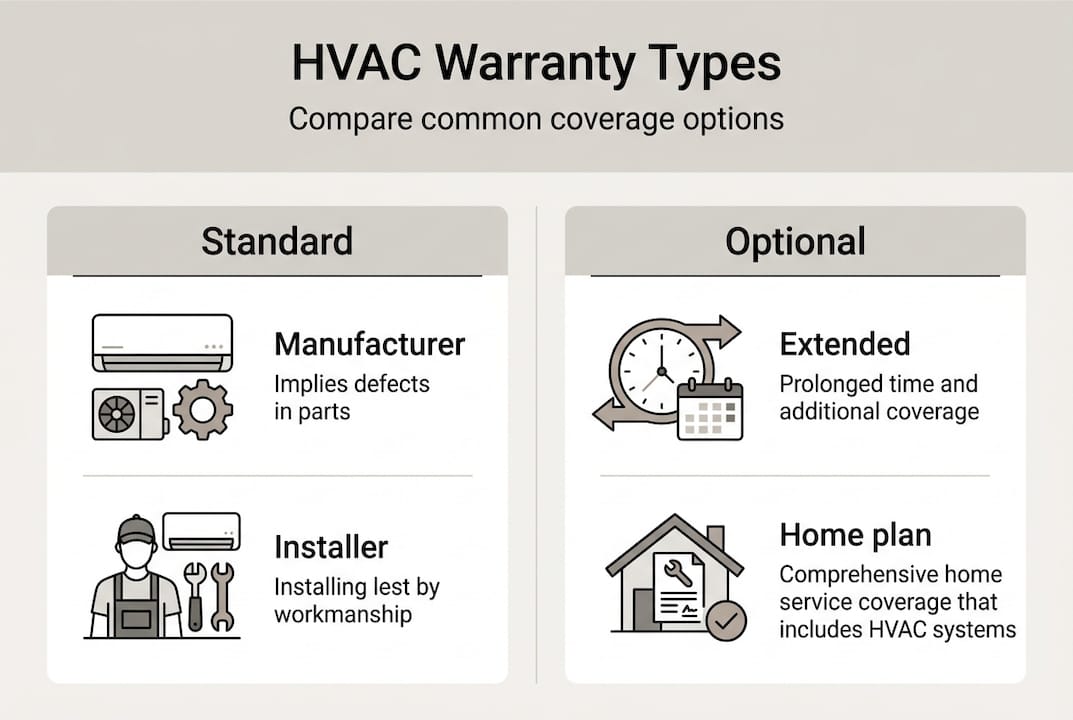
Installer labor warranty: Your HVAC contractor may offer a short-term labor warranty, typically lasting 1 to 2 years. This covers the quality of their installation work, not the parts themselves.
Extended warranty: You can purchase an extended plan that adds labor coverage, sometimes refrigerant, and longer terms. These plans typically cost $500 to $1,200 for 10 years of parts and labor combined.
Home warranty plan: A third-party annual plan that covers wear and tear breakdowns, not just manufacturing defects. Annual costs run $400 to $800, with payout caps of $1,500 to $5,000 per system.
| Warranty type | What it covers | Labor included? | Typical length |
|---|---|---|---|
| Manufacturer | Parts (defects) | No | 5 to 12 years |
| Installer labor | Workmanship | Yes | 1 to 2 years |
| Extended warranty | Parts and labor | Yes | Up to 10 years |
| Home warranty plan | Wear and tear | Yes (with caps) | Annual renewal |
These plans can overlap, but they can also leave gaps. For example, your manufacturer warranty may cover a failed compressor part, but you’ll still pay for labor unless you have an extended plan. Before you need a repair, check out our HVAC estimates guide to understand what costs to expect.
Common items covered by manufacturer warranties:
- Compressors
- Heat exchangers
- Evaporator and condenser coils
- Control boards
- Blower motors (on some plans)
What do HVAC warranties cover and what do they usually exclude?
Understanding your warranty type is half the puzzle. Now, let’s get clear on what is and isn’t actually protected when repairs are needed.
Most manufacturer warranties cover the big-ticket parts: compressors, heat exchangers, and coils. But the list of common exclusions is long and often surprises homeowners. Refrigerant leaks, labor charges, improper installation or sizing, lack of maintenance, unlicensed repairs, power surges, flood damage, and incompatible refrigerants are all typically excluded. Missed maintenance is the top reason claims get denied.
What is typically NOT covered:
- Labor and diagnostic fees (unless extended plan)
- Refrigerant recharges
- Damage from power surges or flooding
- Repairs done by unlicensed technicians
- Failures caused by improper installation
- Systems that haven’t had regular professional maintenance
Pro Tip: Keep a folder with every service receipt, maintenance record, and warranty registration confirmation. If you ever file a claim, this documentation is your best defense against a denial.
DIY repairs are a major risk. If you attempt to fix something yourself and it causes further damage, your warranty is likely void. The same applies if you hire an unlicensed technician. Always use a licensed professional for any work on your system. If you’re dealing with a recurring issue, our guide on Kansas City HVAC problems can help you identify what’s going wrong before it gets worse.
Coverage by the numbers: Real-life HVAC repair costs for Kansas City homes
Knowing what’s excluded shows why having coverage matters. Let’s look at what failing components actually cost in Kansas City.

| Component | Repair or replacement cost | Typically covered by manufacturer? |
|---|---|---|
| Compressor | $1,500 to $2,800 (parts) | Yes (parts only) |
| Heat exchanger | $1,000 to $2,000 | Yes (parts only) |
| Evaporator coil | $600 to $1,200 | Yes (parts only) |
| Full system replacement | $6,000 to $15,000 | No |
| Labor per repair visit | $75 to $200/hour | No (standard warranty) |
A full HVAC replacement runs $6,000 to $15,000, and home warranty payout caps often fall well below that number. That gap is your out-of-pocket exposure. Heat exchanger failures are especially serious because a cracked heat exchanger can allow carbon monoxide to enter your home. It’s not just a budget issue. It’s a safety issue.
Pro Tip: Schedule annual tune-ups to catch small problems before they become expensive failures. Our HVAC maintenance tips walk you through what to expect from a professional inspection.
For a broader look at repair pricing, this cost of repairs guide offers useful context on what different components typically cost to service.
Brand benchmarks: How leading HVAC warranties compare
Cost isn’t the only variable. Not all warranties are created equal. Here’s how leading brands stack up on coverage length for major components.
| Brand | Compressor coverage | Heat exchanger | Labor included? |
|---|---|---|---|
| Goodman/Amana | Lifetime (premium models) | Lifetime (premium) | No |
| Trane | 12 years (premium) | 20 years (select) | No |
| Lennox | 10 years (standard) | 20 years (select) | No |
| Carrier | 10 years (registered) | 20 years (select) | No |
As the data shows, Goodman and Amana offer lifetime compressor and heat exchanger coverage on premium models, while Trane covers compressors for 12 years on premium lines and Lennox offers 20-year heat exchanger coverage on select units. All brands follow the same standard rule: parts only, no labor without an extended plan. Transferability is also limited. If you sell your home, the warranty may transfer with the equipment, but the new owner often gets a shorter coverage period or must re-register.
Claim denials and warranty pitfalls: What really voids coverage?
Even the best coverage can be lost if you miss key steps. Here are the most common pitfalls and how to avoid them.
Top reasons HVAC warranty claims get denied:
- Unregistered equipment. Many manufacturers require you to register your system within 60 to 90 days of installation to get the full warranty term. Missing this step can cut your coverage in half.
- Skipped annual maintenance. Manufacturers expect you to service the system every year. No records means no coverage.
- Improper installation. If the original installer made errors, the manufacturer may deny the claim. This is why choosing a licensed, reputable contractor matters from day one.
- DIY repairs or unlicensed technicians. Any unauthorized work can void the entire warranty.
- Missing service receipts. Even if you did everything right, you need proof.
Important: Warranties attach to the equipment, not the home or the owner. If you buy a house with an existing HVAC system, confirm the warranty status and transferability before closing.
Pro Tip: Use our Kansas City maintenance checklist to stay on top of annual service requirements and keep your coverage intact. You can also reference this air conditioner maintenance checklist for a detailed seasonal walkthrough.
Special notes for Kansas City homeowners: Local options and details
Every region’s market has its quirks. Here’s what Kansas City area homeowners need to know about local warranty options.
Kansas City’s weather swings are hard on HVAC systems. Hot, humid summers and cold winters mean your equipment works harder than systems in milder climates. That added stress makes regular maintenance even more important for keeping your warranty valid.
Local Kansas City providers typically offer 30-day to 1-year labor warranties on installation work. National home warranty plans from companies like American Home Shield and America’s Preferred Home Warranty are widely available and can be a smart option for older systems that no longer qualify for manufacturer coverage.
What Kansas City homeowners should do:
- Confirm your installer’s labor warranty length in writing before work begins
- Ask whether your new system comes pre-registered or if you need to do it yourself
- Consider a home warranty plan if your system is more than 8 to 10 years old
- Schedule annual inspections with a licensed local technician to keep records current
- Use a provider who documents every visit and provides written service reports
There are no unique local regulations that affect HVAC warranties in Kansas City, but working with a reputable local contractor ensures your maintenance is done correctly and documented properly. You can schedule HVAC inspections with a trusted local provider to stay ahead of any issues.
Get reliable HVAC protection and service in Kansas City
Now that you know what’s at stake, protecting your warranty starts with choosing the right service partner. Warranty-compliant maintenance is not just about keeping your system running. It’s about keeping your coverage valid so you’re protected when a major repair hits.

At KC Air Control, we’ve been serving Kansas City homeowners for over 70 years. Our licensed technicians provide documented, warranty-compliant service for every visit. Whether you need emergency repairs, a seasonal tune-up, or a full system inspection, we’re here to help. Our furnace repair pros and furnace tune-up experts know exactly what manufacturers require to keep your coverage intact. Ready to protect your home and your warranty? Book a service appointment online today and get the reliable, professional service your system deserves.
Frequently asked questions
Does an HVAC warranty cover labor costs?
Most standard manufacturer warranties cover parts only, not labor. You’ll need an extended or upgraded plan to include labor costs in your coverage.
How do I keep my HVAC warranty valid?
Register your equipment promptly, schedule annual professional maintenance, and keep all service records. Missed maintenance is the top reason warranty claims are denied.
Are home warranties better than manufacturer warranties for older HVAC systems?
Home warranties are often a better fit for older systems because they cover wear and tear without requiring registration. However, payout caps may not cover a full system replacement.
What is the biggest reason HVAC warranty claims get denied?
Skipping regular professional maintenance or having improper installation are the most common causes. Always use a licensed technician and keep your service records organized.
Do Kansas City homeowners need special warranty considerations?
There are no unique local regulations affecting HVAC warranties in Kansas City, but partnering with a reputable local provider for labor coverage and documented maintenance is strongly recommended.
Recommended
- HVAC inspections for Kansas City homeowners: 2026 guide – KC Air Control – Heating & Cooling
- HVAC maintenance affects financing for Kansas City homes – KC Air Control – Heating & Cooling
- HVAC estimates in Kansas City: 2026 homeowner guide – KC Air Control – Heating & Cooling
- How to schedule HVAC inspections for Kansas City homes – KC Air Control – Heating & Cooling