

TL;DR:
- Proper HVAC load calculation ensures accurate system sizing, improving efficiency and comfort.
- Manual J is the industry-standard method that considers detailed home and climate factors.
- Skipping proper load analysis leads to higher energy bills, equipment wear, and comfort issues.
HVAC load calculation: A homeowner’s guide to efficiency
Most homeowners assume a bigger HVAC system always means better heating and cooling. That belief is one of the most expensive mistakes you can make. Studies show that oversized systems cause short-cycling, poor dehumidification, and 20 to 40% higher energy bills compared to properly sized equipment. The good news is that a proper HVAC load calculation eliminates the guesswork entirely. In this guide, we will walk you through what a load calculation is, how the industry-standard Manual J method works, how different sizing methods compare, and how getting this step right shapes every aspect of your home comfort and long-term savings.
Table of Contents
- What is an HVAC load calculation?
- Manual J: The gold standard for homes
- Comparing load calculation methods: Manual J, rules-of-thumb, and more
- How load calculation shapes your HVAC choices and home comfort
- Why most HVAC estimates miss the mark: Our take
- Get expert HVAC load calculation and installations in Kansas City
- Frequently asked questions
Key Takeaways
| Point | Details |
|---|---|
| Load calculation is essential | Proper HVAC sizing relies on a detailed load calculation, not guesswork. |
| Manual J is the standard | Manual J offers 95-98% accuracy and is required for new systems by code. |
| Skipping calculation is costly | Oversized or undersized systems waste energy, shorten equipment life, and reduce comfort. |
| Ask for the report | Always request a load calculation report before installation or upgrades. |
What is an HVAC load calculation?
An HVAC load calculation is the process of determining exactly how much heating and cooling your home actually needs. Not a rough guess. Not a number based on square footage alone. A true calculation that accounts for your specific home, your local climate, and dozens of variables that affect how heat moves in and out of your living spaces.
Think of it this way: your home gains heat from sunlight, appliances, people, and outdoor air in summer. In winter, it loses heat through walls, windows, floors, and gaps in the building. A load calculation measures both of those forces, which experts call heat gain and heat loss, and then sizes your equipment to handle both reliably.
According to a detailed HVAC load calculation guide, a thorough analysis covers over 40 factors, including building envelope, windows, insulation, orientation, infiltration, internal gains, solar heat gain, ventilation, duct losses, and local climate conditions. For Kansas City homeowners, that local climate factor matters a lot. Our region experiences hot, humid summers and cold winters, which means your system needs to perform well on both ends of the spectrum.
Here are the core factors that go into a proper load calculation:
- Building envelope: Wall construction, ceiling height, floor type, and foundation
- Windows and doors: Size, orientation, glass type, and shading
- Insulation levels: Attic, walls, basement, and crawl space
- Air infiltration: How much outside air leaks in through gaps and cracks
- Internal heat sources: Appliances, lighting, and occupants
- Solar heat gain: Sunlight entering through windows based on compass direction
- Duct system: Losses from ducts running through unconditioned spaces like attics
- Local design conditions: Kansas City’s specific temperature and humidity extremes
A load calculation is not a formality. It is the foundation of every smart HVAC decision you make for your home.
One of the most common misconceptions we hear from homeowners is that rules of thumb work just fine. “My neighbor has a 3-ton unit and their house is the same size, so I need a 3-ton unit too.” This thinking ignores the fact that two homes with identical square footage can have vastly different load requirements based on window placement, insulation quality, shading, and dozens of other variables. If you want accurate HVAC estimates in Kansas City, you need a real load calculation, not a ballpark figure.
The result of a proper load calculation is a number expressed in BTUs (British Thermal Units) per hour. That number tells your HVAC contractor exactly what size system to install. Too small and it cannot keep up on the hottest or coldest days. Too large and it runs in short bursts that waste energy and leave your home feeling clammy and uncomfortable.
Manual J: The gold standard for homes
Understanding the definition and importance of load calculation sets the stage for the tools experts trust. In residential HVAC, the most trusted tool is Manual J, created by the Air Conditioning Contractors of America (ACCA).
ACCA Manual J, 8th Edition is the ANSI-recognized standard for residential HVAC load calculations, and it is required by the International Energy Conservation Code (IECC) and the International Residential Code (IRC). In practical terms, this means that most building permit inspections for new HVAC installations in Kansas City and surrounding areas will ask for a Manual J report.
Here is what a professional collects to perform a proper Manual J analysis:
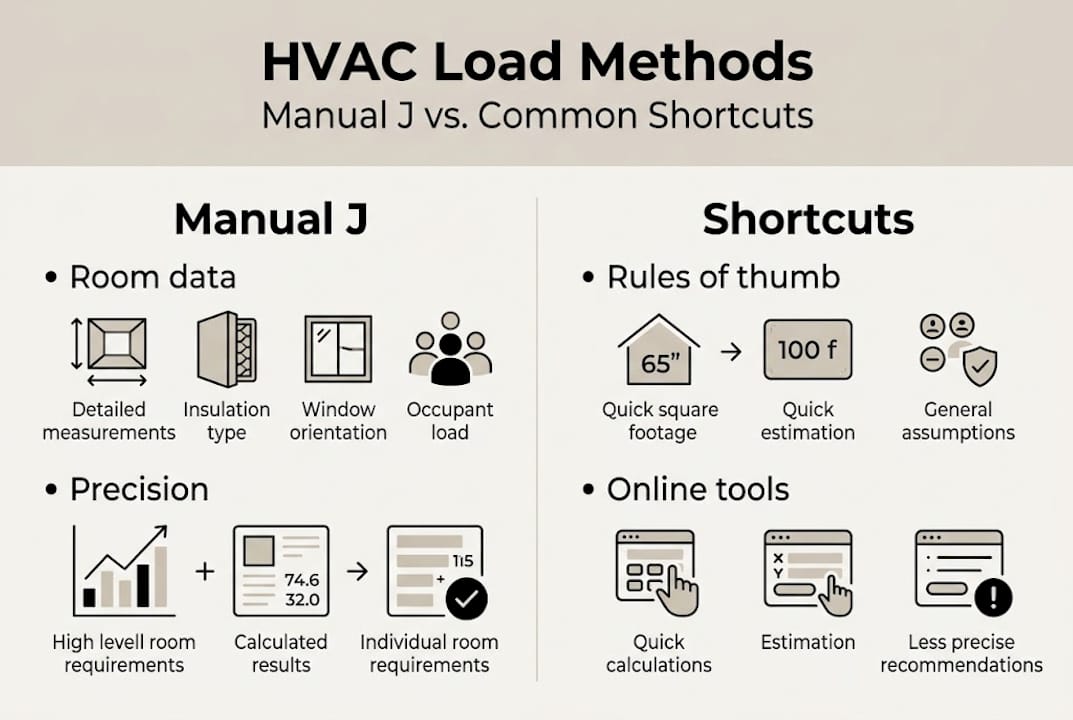
- Home dimensions: Square footage, ceiling heights, and layout of each room
- Construction details: Wall assembly, roof and attic construction, foundation type
- Window inventory: Size, location, glass type (single, double, low-E), and orientation
- Insulation values: R-values for each area of the building envelope
- Air leakage data: Blower door test results or standard infiltration assumptions
- Internal loads: Number of occupants, major appliances, and lighting type
- Duct system details: Location, size, insulation, and estimated losses
- Local climate data: Kansas City design temperatures and humidity levels
Manual J uses a room-by-room heat balance formula, written as Q = U x A x ΔT for conduction, and calculates both sensible loads (temperature) and latent loads (humidity) separately. That distinction is critical for Kansas City homeowners because our region sits in Climate Zone 4A, which means high humidity in summer. An oversized system that short-cycles never runs long enough to pull moisture out of the air, leaving your home feeling sticky even when the temperature reads 72°F.
| Manual J output | What it means for you |
|---|---|
| Sensible cooling load | How much the system must cool the air temperature |
| Latent cooling load | How much moisture the system must remove |
| Heating load | How much heat the system must produce on the coldest day |
| Room-by-room breakdown | Helps size duct registers for balanced airflow in every room |
Pro Tip: Before any contractor installs a new system, ask them directly: “Will you provide a written Manual J report?” If they say no or seem unsure what that means, that is a serious red flag. Reputable pros who install HVAC systems to code will always provide this documentation. It also protects your manufacturer warranty, since some equipment warranties are voided when systems are installed without proper sizing documentation.
Working with a team that prioritizes efficient HVAC installation means they will complete Manual J before they ever recommend a specific unit size. This protects your investment and your comfort for years to come.
Comparing load calculation methods: Manual J, rules-of-thumb, and more
Knowing that Manual J is the trusted approach, let’s see how it differs from other methods you might encounter when getting HVAC quotes.
Rules of thumb are the most commonly misused approach. The typical shortcut assigns roughly 400 to 600 square feet of home per ton of cooling capacity. The problem is that this method is only 40 to 60% accurate compared to Manual J’s 95 to 98% accuracy, and the errors it produces cause real consequences including short-cycling, poor dehumidification, and 20 to 40% higher energy costs. Undersizing, on the other hand, means your system cannot reach the set temperature on peak summer or winter days.
Online HVAC calculators are a step up from square-footage rules of thumb, but they are still simplified tools. Most only ask for square footage, location, and a few basic home details. They cannot account for your specific insulation values, window types, duct layout, or air leakage. They are useful for getting a very rough ballpark, but they should never drive a final purchasing decision.
For broader context, here is how the main calculation methodologies compare:
| Method | Accuracy | Best use case | Limitation |
|---|---|---|---|
| Rules of thumb (sq ft) | 40 to 60% | Never, for sizing decisions | Ignores almost all home-specific variables |
| Online calculators | 60 to 75% | Early research only | Missing key inputs like ducts and infiltration |
| CLTD/CLF method | 75 to 85% | Commercial simplified analysis | Tabular and less precise for residential |
| RTS (Radiant Time Series) | 85 to 92% | Detailed commercial design | Complex, hour-by-hour radiant factors |
| Heat Balance method | 92 to 97% | High-accuracy commercial work | Solves simultaneous equations for all surfaces |
| Manual J (residential) | 95 to 98% | Residential homes, code-required | Requires trained professional to perform |
It is worth knowing that CLTD/CLF, RTS, and Heat Balance methods exist primarily in commercial HVAC design. The CLTD (Cooling Load Temperature Difference) approach uses corrected temperature values to account for solar effects in a tabular format. RTS (Radiant Time Series) factors in hour-by-hour heat storage in walls and ceilings. Heat Balance is the most accurate of all but requires solving complex simultaneous equations across all surfaces and air volumes. Manual J uses a variant of the CLF/CLTD approach adapted specifically for residential use, which is why it strikes the right balance between accuracy and practicality.
Pro Tip: Before signing any HVAC contract, ask the contractor to show you the completed Manual J report, not just a verbal recommendation. If they choose the right HVAC system for your home based on a proper report, you will see it reflected in the specific BTU numbers and room-by-room airflow targets.
The takeaway here is clear. Rules of thumb and quick online tools have a place in early conversations, but they cannot replace a full Manual J when it is time to actually buy and install equipment.
How load calculation shapes your HVAC choices and home comfort
After seeing how calculation methods differ, it is crucial to connect the dots to your actual equipment choices and everyday comfort.

A properly sized system runs longer, steadier cycles. This matters because longer cycles do a much better job of pulling humidity out of the air, maintaining even temperatures in every room, and reducing wear on the compressor and blower motor. Shorter, more frequent cycles caused by oversizing are like stopping and starting your car in bumper-to-bumper traffic: hard on the engine and expensive to run.
The benefits of getting the load calculation right extend well beyond the first year:
- Lower utility bills: A correctly sized system uses only the energy your home actually needs, which directly reduces monthly costs
- Longer equipment life: Fewer start-stop cycles mean less mechanical stress, extending the lifespan of your compressor and heat exchanger
- Better humidity control: Longer run times remove more moisture, keeping your home comfortable without needing a separate dehumidifier
- Even temperatures room to room: Proper load data feeds into correct duct sizing, so every room gets the right amount of airflow
- Warranty protection: Many manufacturers require proper sizing documentation to honor equipment warranties
- Code compliance: Manual J is required by IECC and IRC codes for new installations
Oversizing an HVAC system might seem to ‘work’ in the short term, but it consistently fails long-term efficiency and humidity control and can void warranties or trigger code violations during inspection.
Your home’s load numbers are also not static. Upgrades like new windows, added attic insulation, or air sealing can significantly reduce your heating and cooling load. If you have made major improvements since your last system was installed, your home may qualify for a smaller, more efficient unit today. Conversely, adding a sunroom or finishing a basement increases the load and may require ductwork modifications.
Before your contractor starts work, ask these questions:
- Will you provide a complete Manual J report before recommending a system size?
- Do you perform room-by-room calculations, or just a whole-house total?
- How do you account for our duct system’s location and condition?
- Will the new system be compatible with any future home additions or upgrades?
- What humidity control features does the equipment include?
Working with a contractor who offers professional HVAC installation built around proper load data means you will get a system that actually fits your home. And choosing equipment that is proven to optimize home comfort means those benefits compound over the life of the system.
Why most HVAC estimates miss the mark: Our take
With the practical benefits clear, here is a hard-won truth from the field. After years of working with Kansas City homeowners, we have seen a pattern that keeps repeating itself. A homeowner gets three “free estimates,” picks the lowest price, and ends up with a system that short-cycles all summer or struggles on the coldest January nights. The culprit is almost always the same: nobody performed a real load calculation.
Free estimates are not inherently bad. But when an estimate skips Manual J, it is not really an estimate of what your home needs. It is a guess dressed up as a quote. And the cost of that guess shows up every single month on your utility bill, and eventually in a premature equipment failure.
We believe that a truly reputable contractor will never size a system without a proper Manual J report. Full stop. This is not about charging more or adding steps. It is about doing the job right the first time. When you boost home comfort through a properly calculated and installed system, you save money, avoid callbacks, and enjoy reliable performance for 15 to 20 years. Skipping this step to save a few hours almost always costs more in the long run.
Get expert HVAC load calculation and installations in Kansas City
Inspired to get the right system the first time? Here is how KC homeowners can take action.
At KC Air Control, we back every new system recommendation with a proper load calculation so you know your equipment is sized for your specific home, not someone else’s. With over 70 years of experience serving Kansas City families, we understand the demands our local climate places on heating and cooling equipment.

Whether you need energy efficient HVAC installation, a full HVAC system installation, or fast emergency HVAC repair options, our team is ready to help. Contact us today to schedule a consultation and get a load calculation-backed quote for your Kansas City home. Comfort done right starts with the numbers.
Frequently asked questions
How does weather in Kansas City affect the HVAC load calculation?
Kansas City’s climate increases both heating and cooling demands, and a proper calculation accounts for over 40 local climate factors including peak design temperatures and humidity levels specific to our region.
Is a Manual J load calculation really required for new installations?
Manual J is required by IECC and IRC codes for residential HVAC installations, meaning most Kansas City permit inspections will request this documentation before approving a new system.
Can I rely on online HVAC calculators instead of a professional load calculation?
Online calculators offer a rough starting point, but simplified online tools are for estimates only and cannot protect your comfort, code compliance, or equipment warranty the way a full Manual J calculation can.
What information do professionals collect for an accurate load calculation?
A professional gathers details on over 40 factors including insulation, infiltration, internal gains, window types, duct losses, occupancy levels, and Kansas City’s specific design climate conditions.
Recommended
- Energy efficient HVAC installation guide for KC homeowners – KC Air Control – Heating & Cooling
- HVAC estimates in Kansas City: 2026 homeowner guide – KC Air Control – Heating & Cooling
- How to Install HVAC System for Home Comfort – Air Control
- HVAC Maintenance: Boosting Home Comfort and Savings – Air Control