

TL;DR:
- Proper insulation and air sealing are essential for HVAC efficiency and cost savings.
- Upgrading to energy-efficient HVAC systems can reduce costs by up to 30%.
- Regular duct sealing and maintenance sustain system performance and energy savings.
HVAC systems account for roughly 50% of home energy use in a typical household, and Kansas City homes feel that cost acutely. Brutal summers and cold winters push your heating and cooling equipment hard, and an inefficient system quietly drains your budget year-round. The good news is that targeted upgrades and smarter habits can cut your HVAC costs by 17 to 30%. This guide walks you through the most effective, expert-backed steps to improve efficiency, lower utility bills, and keep your home comfortable through every season Kansas City throws at you.
12 Energy-Saving HVAC Tips for Kansas City Homes
- Prioritize proper insulation and air sealing
- Upgrade to energy-efficient HVAC systems
- Seal ductwork and maintain optimal airflow
- Smart controls and regular maintenance routines
- What most HVAC efficiency guides miss about Kansas City homes
- Take your next step to a more energy-efficient home
- Frequently asked questions
Key Takeaways
| Point | Details |
|---|---|
| Seal and insulate | Strengthen your home’s envelope to sharply cut HVAC energy waste and utility bills. |
| Upgrade for savings | High-efficiency systems and smart controls provide double-digit cost reductions long-term. |
| Maintain and monitor | Routine ductwork, seasonal checkups, and smart thermostats keep your HVAC running at its best. |
| Right-size equipment | Correct system sizing for Kansas City’s climate prevents energy waste and maximizes comfort. |
Prioritize proper insulation and air sealing
Before you invest in any new equipment, your home’s envelope needs to be tight. Insulation and air sealing are the foundation of HVAC efficiency. When conditioned air escapes through gaps, cracks, and thin walls, your system has to work harder and run longer to maintain the temperature you set. That extra workload adds up fast on your utility bill.
Air leaks are especially costly because they force your system to compensate continuously. A furnace or air conditioner that runs longer than it should will wear out faster, require more repairs, and consume more energy. Proper insulation and sizing together prevent the short-cycling that plagues oversized systems and the overworking that affects undersized ones.
Here are the most common trouble spots in Kansas City homes:
- Attic floor and hatch where heat rises and escapes in winter
- Exterior wall outlets and switch plates that let cold air seep in
- Windows and exterior doors with worn weatherstripping or gaps in the frame
- Ductwork connections in unconditioned spaces like attics and crawl spaces
- Basement rim joists along the foundation perimeter
A quick inspection takes about 30 minutes. On a windy day, hold a lit incense stick near each of these spots. If the smoke wavers, you have a leak worth sealing. Caulk and weatherstripping are inexpensive fixes that deliver immediate results.
For a thorough picture of where your home stands, review our HVAC maintenance checklist before scheduling any professional work. It helps you identify what needs attention first.
Pro Tip: Combining air sealing with a correctly sized HVAC system is one of the highest-return moves you can make. A right-sized system in a well-sealed home runs efficiently in shorter, effective cycles rather than struggling against constant air loss.
Statistic callout: Homes with proper insulation and sealed envelopes can reduce HVAC load significantly, and pairing that with correct system sizing prevents the short-cycling that cuts efficiency and comfort.
Upgrade to energy-efficient HVAC systems
Once your home is sealed and insulated, upgrading the system itself can maximize your gains. Older equipment is often the single biggest drag on energy efficiency. If your furnace or air conditioner is more than 15 years old, it is almost certainly running at a fraction of what modern systems can achieve.
Three key specifications tell you how efficient a system really is:
- SEER (Seasonal Energy Efficiency Ratio): Measures cooling efficiency. A rating of 16 or higher is considered high efficiency.
- AFUE (Annual Fuel Utilization Efficiency): Measures furnace efficiency. Look for 95% or above for maximum savings.
- ENERGY STAR certification: Confirms the unit meets strict EPA efficiency guidelines.
Replacing an old unit with an ENERGY STAR certified system saves the average household around $140 per year, and high-SEER or high-AFUE models can cut HVAC costs by 20 to 30%.
| System type | Efficiency rating | Best use case |
|---|---|---|
| Gas furnace | 95%+ AFUE | Cold Kansas City winters |
| Central AC | 16+ SEER | Hot, humid summers |
| Heat pump | 18+ SEER / HSPF 10+ | Mild seasons, dual-purpose use |
| Dual-fuel system | Combined ratings | Year-round KC climate swings |
Kansas City homeowners upgrading in 2026 may qualify for federal tax credits of up to 30% on qualifying heat pumps and central air conditioners, plus local Evergy rebates. These incentives make the investment significantly more affordable.
Our team has extensive experience servicing high-efficiency systems and can help you identify which upgrade makes the most financial sense for your specific home.
“The right system for your home is not the biggest or the most expensive. It is the one correctly matched to your square footage, insulation level, and local climate.”
Seal ductwork and maintain optimal airflow
With an efficient system in place, optimizing airflow and distribution is the next step. Leaky ducts are one of the most overlooked energy problems in Kansas City homes. You can have a brand-new, high-efficiency system and still waste a significant portion of the air it produces if your ducts are not sealed properly.
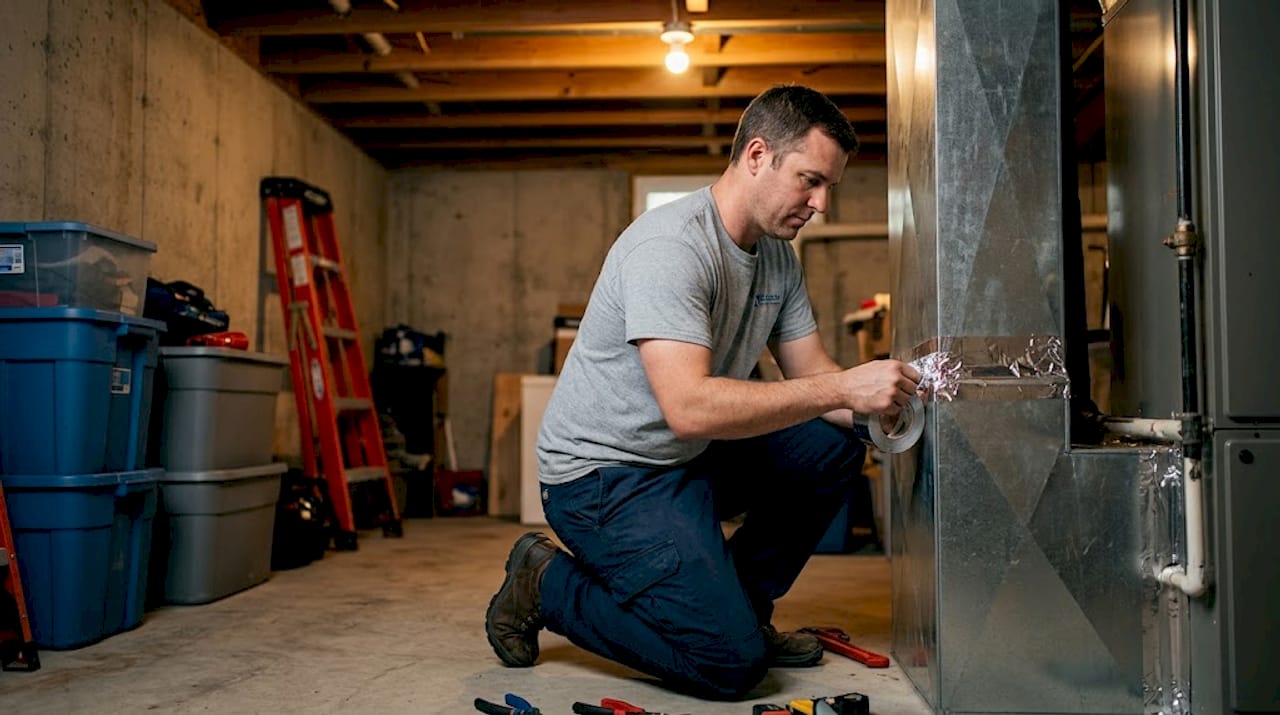
Duct leaks can cause 20 to 30% of conditioned air to escape before it ever reaches your living spaces. That air ends up in your attic, crawl space, or walls instead of your bedroom or living room.
Here is a quick comparison of DIY versus professional duct sealing:
| Approach | Cost | Effectiveness | Best for |
|---|---|---|---|
| DIY foil tape | Low | Moderate | Accessible, visible joints |
| Mastic sealant (DIY) | Low to moderate | Good | Flexible joints and gaps |
| Professional sealing | Higher upfront | Excellent | Full system, hidden ducts |
| Aeroseal technology | Moderate to high | Superior | Hard-to-reach leaks |
Signs that your ducts may be leaking include uneven temperatures between rooms, dusty air near vents, rooms that never reach the set temperature, and higher-than-expected energy bills. These are common complaints we hear from Kansas City homeowners, especially in older homes with original ductwork.
Steps to improve airflow throughout your home:
- Check that all supply and return registers are open and unobstructed
- Balance registers room by room to even out temperature distribution
- Replace filters on schedule to prevent airflow restriction
- Schedule professional duct cleaning if you notice dust buildup or reduced airflow
- Have a technician inspect duct connections in unconditioned spaces
Pro Tip: After any professional duct sealing, ask your technician to perform a post-sealing airflow test. This confirms the work was effective and gives you a measurable baseline for future comparisons.
Smart controls and regular maintenance routines
Layering in ongoing, smart management sustains HVAC performance long-term. Kansas City’s climate swings from freezing winters to sweltering summers, which means your system rarely gets a break. Smart controls and disciplined maintenance are what keep efficiency gains from fading over time.
Smart thermostats provide real, measurable savings. Basic efficiency steps like filter changes and programmable thermostats typically yield 5 to 10% savings, while advanced model predictive controls can push that to 17 to 26% with proper integration. Most Kansas City homeowners find that a mid-range smart thermostat hits a practical sweet spot between cost and savings.
Key benefits of smart thermostats and zoning for KC homes:
- Automatic scheduling adjusts temperatures when you are away or asleep
- Remote access lets you change settings from your phone before you arrive home
- Usage reports show you exactly when and how your system is running
- Zoning compatibility allows different temperatures in different areas of the home
Maintenance is just as important as the technology you install. A system that is not maintained loses efficiency steadily, regardless of how new or advanced it is.
“Consistent maintenance is the single most reliable way to protect your HVAC investment. A tune-up twice a year costs far less than an emergency repair or early replacement.”
Simple tasks you can handle yourself include changing filters every one to three months, keeping outdoor units clear of debris, and checking thermostat settings seasonally. For everything else, seasonal HVAC checkups by a licensed technician catch small issues before they become expensive problems.
A well-structured HVAC maintenance workflow covers refrigerant levels, electrical connections, blower performance, and heat exchanger integrity. These are not DIY tasks, and skipping them is where most homeowners lose efficiency gains quietly over time.
What most HVAC efficiency guides miss about Kansas City homes
Most national efficiency guides hand out the same checklist: upgrade your thermostat, change your filter, buy a high-SEER unit. That advice is not wrong, but it misses the local realities that matter most here.
Kansas City’s climate is genuinely extreme. Summers regularly push past 95°F and winters drop well below freezing. That range demands a system sized precisely for your home, not just a high-efficiency label on the box. Oversized systems short-cycle, meaning they reach the set temperature quickly, shut off, and restart repeatedly. That pattern reduces efficiency, increases wear, and creates humidity problems in summer. Undersized systems never stop running. Both scenarios waste money.
The fix is a proper load calculation before any equipment purchase. We see Kansas City homeowners skip this step regularly, trusting a contractor who sizes by square footage alone. That approach ignores insulation levels, window area, orientation, and local climate data. You can identify HVAC issues early when you know what to look for, and a load calculation gives you the data to make confident decisions. Gadgets and new systems matter, but only when the fundamentals are right.
Take your next step to a more energy-efficient home
Ready to put your efficiency plan into action? The steps in this guide work best when they are applied together, and having a trusted local team makes the process faster and more reliable.

At KC Air Control, we have been helping Kansas City homeowners improve comfort and cut energy costs for over 70 years. Whether you need a seasonal tune-up, duct sealing, a system upgrade, or guidance on available rebates, we are here to help. Explore our seasonal maintenance steps to stay ahead of every season. If something goes wrong unexpectedly, our emergency HVAC repair service is available when you need it most. Visit KC Air Control to schedule service or learn more about our full range of solutions.
Frequently asked questions
How much can energy-efficient HVAC upgrades save on KC utility bills?
With the right upgrades and maintenance, most Kansas City homes can save 17 to 30% on annual HVAC costs. The exact savings depend on your current equipment age, insulation quality, and how consistently you maintain the system.
Do smart thermostats really help with energy savings?
Yes. Smart thermostats typically trim HVAC bills by 5 to 10%, and advanced integrated controls can push savings to 26%. Even a basic programmable model pays for itself within the first year for most Kansas City households.
What are the biggest signs my HVAC system isn’t energy efficient?
High utility bills, uneven temperatures room to room, frequent on-off cycling, and visible dust near vents are all warning signs. Leaky ducts alone can account for 20 to 30% of conditioned air loss, which shows up directly on your energy bill.
Are there rebates or incentives for installing efficient HVAC in Kansas City?
Yes. KC homeowners may qualify for up to $1,200 in rebates on heat pumps and a 30% federal tax credit on qualifying central air conditioners in 2026. Local utility programs through Evergy can stack on top of federal incentives, making upgrades significantly more affordable.
Recommended
- Energy efficient HVAC: lower bills and better comfort – KC Air Control – Heating & Cooling
- Energy efficient HVAC guide: Save 20-50% in KC – KC Air Control – Heating & Cooling
- Seasonal HVAC Maintenance Steps for Home Energy Savings – Air Control
- HVAC tune-up: boost efficiency and lower costs in 2026 – KC Air Control – Heating & Cooling