
TL;DR:
- Poor airflow in home HVAC systems causes uneven temperatures, higher energy bills, and equipment wear. Addressing duct leaks, blockages, and design flaws improves comfort, efficiency, and indoor air quality. Professional assessment is essential for diagnosing and fixing underlying duct and airflow problems effectively.
Poor airflow is defined as insufficient movement of conditioned air through your home’s HVAC system, and it is one of the leading causes of comfort problems and high energy bills for homeowners. When your system cannot move air properly, rooms feel stuffy, temperatures become uneven, and your equipment works harder than it should. The industry term for this condition is “restricted airflow,” and it affects everything from your monthly utility costs to the air your family breathes. Knowing why address poor airflow matters is the first step toward a more comfortable, efficient home.
Why address poor airflow in residential HVAC systems?
Restricted airflow forces your HVAC system to run longer and work harder to reach the temperature you set on the thermostat. The result is higher energy bills, uneven comfort, and accelerated wear on equipment that was never designed to operate under that kind of strain. Up to 20% of conditioned air is lost through poorly sealed or designed ductwork. That means one in five dollars you spend heating or cooling your home may be going straight into your walls and attic instead of your living spaces.
Restricted airflow also reduces your system’s ability to optimize home comfort and energy efficiency the way it was designed to. A system fighting poor airflow runs more cycles, wears out components faster, and delivers less comfort per dollar spent. Addressing the problem protects your investment and keeps your home livable year-round.
What are the common causes of poor airflow in residential HVAC systems?
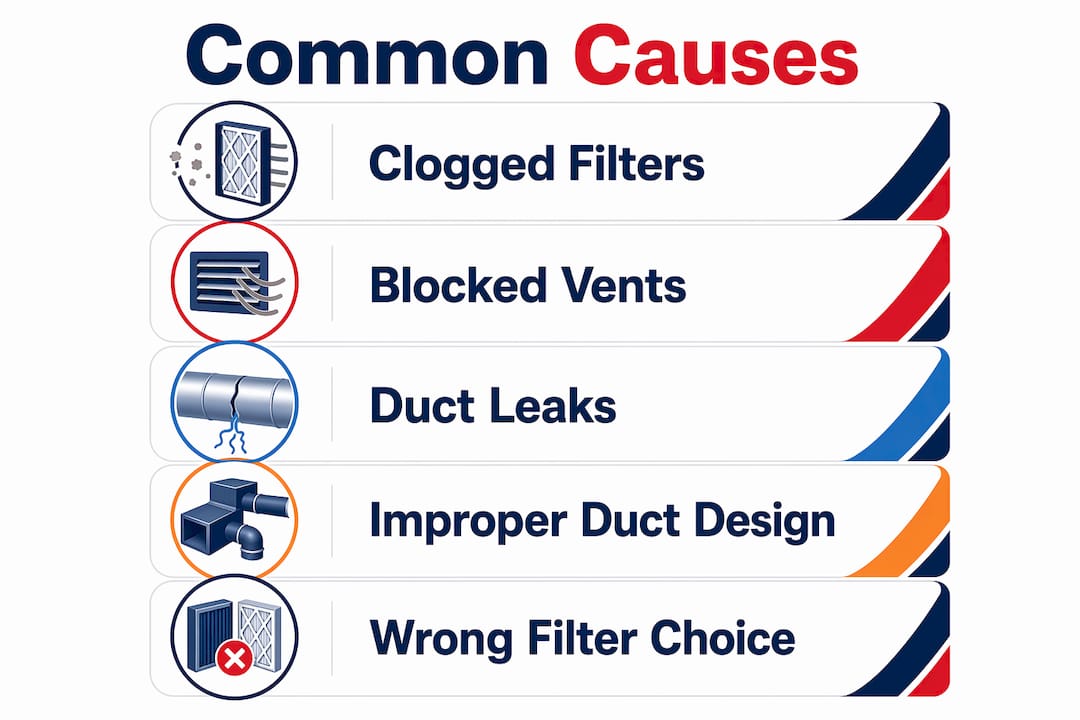
Most airflow problems trace back to one of a handful of root causes. Identifying the right one saves you time and money before calling for service.
- Dirty or clogged air filters. A filter loaded with dust and debris blocks air before it even reaches the blower. This is the most common and easiest fix.
- Blocked or closed vents. Furniture pushed against supply registers or closed dampers in unused rooms disrupt the entire system’s air balance.
- Leaky, undersized, or damaged ducts. Gaps and cracks in ductwork allow conditioned air to escape into unconditioned spaces, reducing delivery to living areas.
- Inadequate return air pathways. Blocked or undersized returns limit total airflow achievable by the system, even with a strong blower motor.
- Blower motor or fan issues. A failing motor or worn fan belt reduces the volume of air the system can move per minute.
- Improper duct design or high static pressure. Ducts that are too small for the system create resistance that slows airflow and strains equipment.
Pro Tip: Check every supply and return vent in your home before calling for service. A single blocked return grille can reduce whole-house airflow noticeably, and the fix costs nothing.
Filter selection also matters more than most homeowners realize. Using a filter too restrictive for your duct and blower design can actually worsen airflow problems. A MERV 13 filter in a system built for MERV 8 creates more resistance than the blower can overcome efficiently.
How does poor airflow affect home comfort and energy efficiency?
The effects of poor ventilation show up in ways you feel every day, not just on your utility bill. Here is how restricted airflow damages both comfort and efficiency:
- Uneven temperatures and hot or cold spots. Rooms at the end of long duct runs receive less air, creating temperature swings of several degrees between spaces.
- Longer HVAC runtimes. When air cannot circulate properly, the system runs more cycles to reach the set temperature, driving up energy consumption.
- Reduced indoor air quality. Stagnant air allows dust, allergens, and pollutants to settle and accumulate rather than being filtered out.
- Equipment wear and potential damage. A blower motor running against restricted airflow overheats faster and fails sooner than one operating within design limits.
- Higher utility costs. The 20% air loss from faulty ductwork translates directly into longer runtimes and higher monthly bills.
The energy cost impact is significant and measurable. Every hour your system runs unnecessarily because of restricted airflow adds to your annual heating and cooling expense. Over a full Kansas City winter or summer, that extra runtime adds up to real money. Addressing airflow problems is one of the highest-return improvements a homeowner can make to an existing HVAC system.
What is the relationship between airflow and indoor air quality and health?
Proper air circulation is the foundation of healthy indoor air. When airflow drops, pollutants accumulate, humidity swings out of range, and the air your family breathes becomes measurably worse.
Poor ventilation in homes can facilitate microbial growth and increase the risk of acute respiratory infections, particularly in children and older adults. That finding underscores why ventilation is not just a comfort issue. It is a health issue with real consequences for vulnerable household members.
The EPA ranks its recommended approach to improving indoor air quality in a clear order of priority:
Remove pollution sources first. Then increase ventilation. Use filtration last. Spending money on expensive air purifiers before fixing ventilation and source problems delivers far less benefit than the correct sequence.
Humidity control is directly tied to airflow performance. Maintaining indoor humidity between 30% and 50% and replacing HVAC filters every 60–90 days with MERV 11–13 rated filters balances air quality and airflow effectively. Humidity outside that range encourages mold growth below 30% and dust mite proliferation above 50%.
| Air Quality Factor | Recommended Standard | Effect of Poor Airflow |
|---|---|---|
| Indoor humidity | 30%–50% | Mold growth or dust mite increase |
| Filter replacement | Every 60–90 days | Clogged filters restrict airflow further |
| Filter rating | MERV 11–13 | Too restrictive without proper duct sizing |
| Ventilation priority | Source control first | Filtration alone cannot compensate |
Preventing pollutant buildup through ventilation and source control is more effective than purchasing expensive filtration gadgets. Good home air quality practices start with keeping air moving, not with adding equipment on top of a broken system.
How does duct design and air balancing influence airflow performance?
Duct design is the most overlooked factor in residential airflow problems. Homeowners often replace equipment or add filtration when the real issue is a duct system that was never sized correctly for the home.
- Static pressure is the key diagnostic measurement. High static pressure at the air handler signals duct or return problems that no amount of filter changing will fix.
- Undersized ducts raise blower workload. Higher static pressure from undersized ducts reduces system efficiency and creates noisy airflow in living spaces.
- Return air capacity sets the ceiling. A home’s HVAC airflow depends on balanced return and supply air. Undersized or blocked returns limit the system’s ability to move air effectively, regardless of blower power.
- Air balancing has real limits. System balancing fine-tunes airflow but cannot fix fundamental duct design flaws. Correct sizing and return air capacity are the foundation.
- Signs of ductwork problems include: rooms that never reach the set temperature, whistling or rushing sounds from vents, and visible gaps or disconnections in accessible duct runs.
Understanding why ductwork matters for your system’s performance helps you ask the right questions when a technician visits. A professional who measures static pressure and checks return air capacity is doing a real diagnostic, not just replacing parts and hoping for improvement.
Pro Tip: Ask your HVAC technician to measure total external static pressure during their visit. A reading significantly above the equipment manufacturer’s rating confirms a duct problem, not an equipment problem.
Homeowners should view their HVAC as a complete airflow loop. Problems arise when any segment, whether ducts, returns, or the blower, is inadequate or blocked. Fixing one segment without evaluating the others often produces disappointing results.
What practical steps can homeowners take to identify and improve poor airflow?
Most homeowners can take several steps on their own before calling for professional service. Routine homeowner steps like checking vents, replacing filters on schedule, and using fans can improve airflow, but persistent issues typically require professional duct sealing or adjustments for a lasting solution.
- Replace your air filter on schedule. Change it every 60–90 days, or monthly if you have pets or allergies. Use a MERV 11–13 filter unless your system specifies otherwise.
- Check every supply and return vent. Walk through your home and confirm all registers are open and unobstructed by furniture, rugs, or stored items.
- Use ceiling fans to improve circulation. Ceiling fans set to run counterclockwise in summer and clockwise in winter help distribute conditioned air without adding load to your HVAC.
- Open interior doors. Closed doors restrict return air pathways and create pressure imbalances that reduce whole-house airflow.
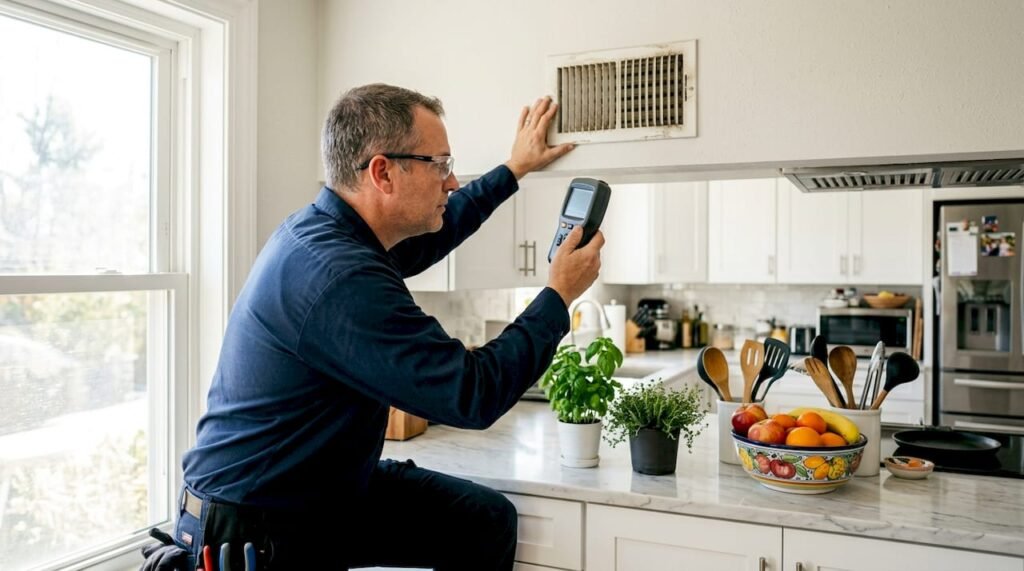
- Schedule a professional airflow assessment. If problems persist after the steps above, a technician should measure static pressure, inspect ductwork, and evaluate return air capacity.
- Request duct sealing if leaks are found. Sealing leaky ducts recovers conditioned air that would otherwise be lost to unconditioned spaces, directly improving efficiency.
Avoid the common DIY mistake of closing vents in unused rooms to “redirect” airflow. Closing vents increases static pressure throughout the system and can damage the blower motor over time. Every vent closure makes the problem worse, not better. For common HVAC problems that go beyond filter changes, professional diagnosis is the reliable path forward.
Key Takeaways
Addressing restricted airflow is the single most effective step a homeowner can take to improve HVAC efficiency, lower energy costs, and protect indoor air quality.
| Point | Details |
|---|---|
| Air loss from duct leaks | Up to 20% of conditioned air escapes faulty ductwork, raising energy costs directly. |
| Filter selection matters | A filter too restrictive for your system worsens airflow; use MERV 11–13 as a baseline. |
| Return air is the bottleneck | Undersized or blocked returns limit total airflow regardless of blower strength. |
| Duct design limits balancing | Air balancing fine-tunes performance but cannot fix fundamental sizing problems. |
| Professional assessment is key | Static pressure measurement identifies duct and return issues that DIY steps cannot resolve. |
What I’ve learned after years of watching homeowners chase the wrong fix
The most common mistake I see is homeowners spending money on the wrong solution. They buy a new air purifier, upgrade to a thicker filter, or even replace a perfectly functional furnace, all while the real problem sits in the ductwork or return air system. The equipment gets the blame, but the ducts are usually the culprit.
What surprises most people is how much a single blocked return grille can affect the entire house. I have seen homes where one furniture placement change restored airflow to three rooms. That is not a dramatic fix. It costs nothing. But it only works if someone actually looks for the problem instead of assuming the equipment is failing.
The other thing I want homeowners to understand is that air balancing is not a cure-all. It is a fine-tuning tool. If your duct system was undersized when the house was built, no amount of adjusting dampers will give you the airflow your system was rated to deliver. That requires a real design fix, and that is a conversation worth having with a qualified technician before spending money elsewhere.
Proactive maintenance, specifically filter replacement on schedule and annual professional checkups, prevents most airflow problems from becoming expensive repairs. The homeowners who call us with the worst problems are almost always the ones who deferred maintenance for two or three seasons. The ones who stay ahead of it rarely face emergency situations.
— AB
Kcaircontrol can help you diagnose and fix airflow problems

Kcaircontrol has served Kansas City homeowners for over 70 years, and airflow diagnostics are a core part of what we do. If your home has uneven temperatures, high energy bills, or rooms that never feel comfortable, the problem is almost always in the airflow, not just the equipment. Our technicians measure static pressure, inspect ductwork, and evaluate return air capacity to find the real cause, not just the most obvious one. We also offer emergency HVAC repair options when restricted airflow has pushed your system to the point of failure. Contact Kcaircontrol to schedule a diagnostic visit and get your home’s comfort back on track.
FAQ
What are the most common signs of restricted airflow?
The most common signs include rooms that are noticeably warmer or cooler than others, weak air coming from supply vents, and an HVAC system that runs constantly without reaching the set temperature.
How often should I replace my HVAC filter to maintain good airflow?
Replace your filter every 60–90 days using a MERV 11–13 rated filter. Homes with pets or allergy sufferers may need monthly replacements to prevent airflow restriction.
Can closing vents in unused rooms improve airflow elsewhere?
Closing vents increases static pressure throughout the duct system and can damage the blower motor over time. All vents should remain open to maintain balanced airflow.
Why is poor ventilation a health concern?
Poor ventilation allows pollutants, allergens, and microbial growth to accumulate indoors, increasing the risk of respiratory infections, particularly for children and older adults.
When should I call a professional instead of fixing airflow myself?
Call a professional when filter replacement, vent checks, and fan use do not resolve the problem. Persistent issues typically require static pressure measurement, duct sealing, or return air modifications that require trained technicians.
Recommended
- Common Causes of HVAC Failure Homeowners Should Know – KC Air Control – Heating & Cooling
- Why Clean Air Vents: Benefits For Home And Health
- Common HVAC problems and solutions for Kansas City homes – KC Air Control – Heating & Cooling
- Emergency HVAC Troubleshooting: Restore Home Comfort Fast – Air Control