
TL;DR:
- Thermostat calibration aligns the displayed temperature with the actual room temperature, reducing energy costs and equipment wear. Homeowners should verify calibration using a reference thermometer and make small adjustments if needed, but environmental factors or placement issues often cause false signals. Regular professional checks help ensure proper calibration, efficiency, and consistent comfort in the home.
Thermostat calibration is the process of adjusting your thermostat so its displayed temperature matches your home’s actual air temperature. When those two numbers drift apart, your HVAC system works harder than it needs to, and you pay for it. Improper calibration can raise annual heating and cooling costs by 10% to 20%. That is a significant hit on your energy bill for a problem that is often straightforward to fix. Kcaircontrol has helped Kansas City homeowners with exactly this kind of issue for over 70 years, and the guidance below reflects what actually works in real homes.
What is thermostat calibration and why does it matter?
Thermostat calibration is the technical term for aligning your thermostat’s sensor reading with the true ambient air temperature in the room. The industry also refers to this as “temperature offset correction,” particularly in digital and smart thermostat menus. When the reading is off, your HVAC system either runs too long or shuts off too early. Both outcomes waste energy and reduce comfort.
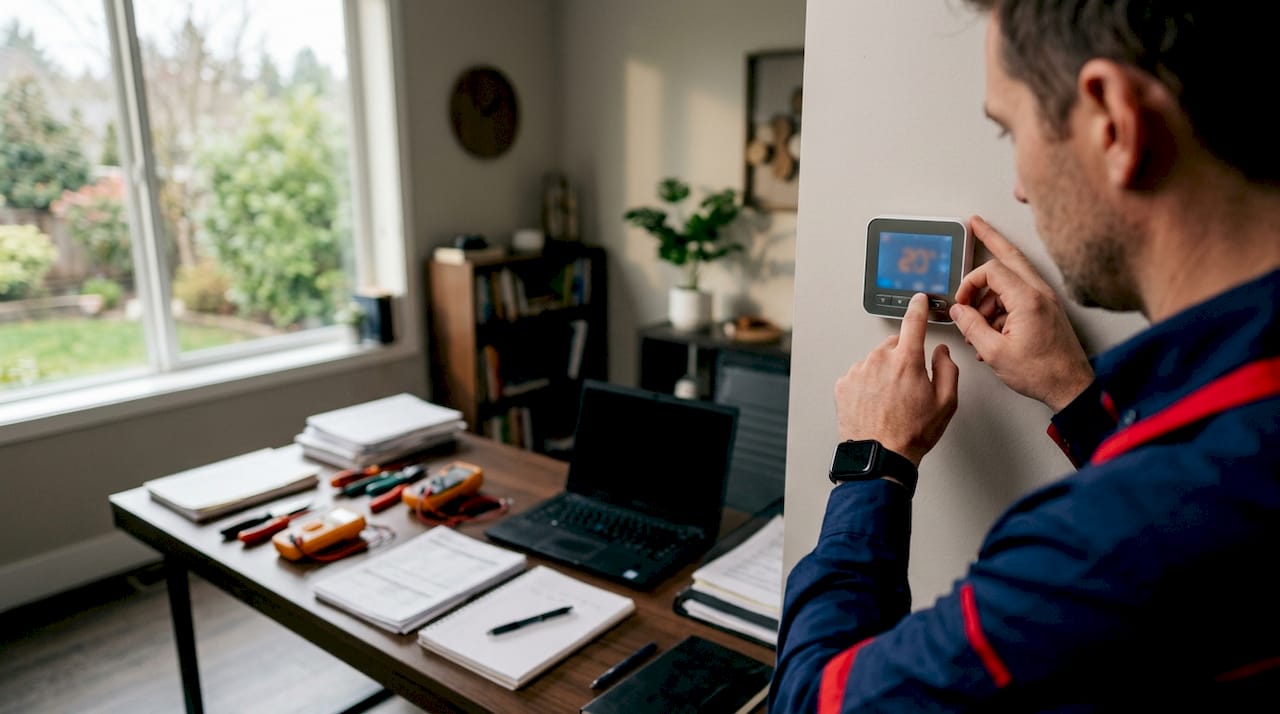
The role of your thermostat in your heating and cooling system is to act as the control center. If its temperature data is wrong, every decision the system makes is based on bad information. A thermostat reading 2°F higher than actual room temperature will tell your air conditioner to keep running long after the room is already comfortable. The result is unnecessary wear on your equipment and a higher monthly bill.
Calibration checks are a standard part of professional HVAC tune-ups. Kcaircontrol includes thermostat verification as part of its seasonal maintenance visits, because a well-calibrated thermostat is the foundation of an efficient system. Getting this right before summer or winter peak seasons protects both your comfort and your equipment.
How do you know if your thermostat needs calibration?
The most reliable way to check is to place a reference thermometer 2–6 inches from your thermostat and wait 15–20 minutes for both readings to stabilize. A variance of 1.5°F to 2.0°F or more between the two devices is the accepted threshold for taking action. Anything below that range is within normal tolerance for most residential thermostats.
Beyond the thermometer test, watch for these signs that your thermostat reading may be off:
- Uneven temperatures throughout the home. One room feels much warmer or cooler than the thermostat setting suggests.
- Short cycling. Your HVAC system turns on and off in rapid, short bursts instead of completing full heating or cooling cycles.
- Higher energy bills without a clear cause. Your usage habits have not changed, but your bill has gone up.
- The system runs constantly. It never seems to reach the set temperature, even on mild days.
Before you adjust anything, rule out environmental factors. Direct sunlight, nearby lamps, or a drafty window can all skew a thermostat’s reading. These are placement problems, not calibration problems, and adjusting the offset will not fix them.
Pro Tip: When taping a reference thermometer next to your thermostat, fold a small piece of paper towel and place it between the thermometer and the wall. This tape test method prevents the wall’s surface temperature from influencing the reading, giving you a true ambient air measurement.
How to calibrate a thermostat: steps by type
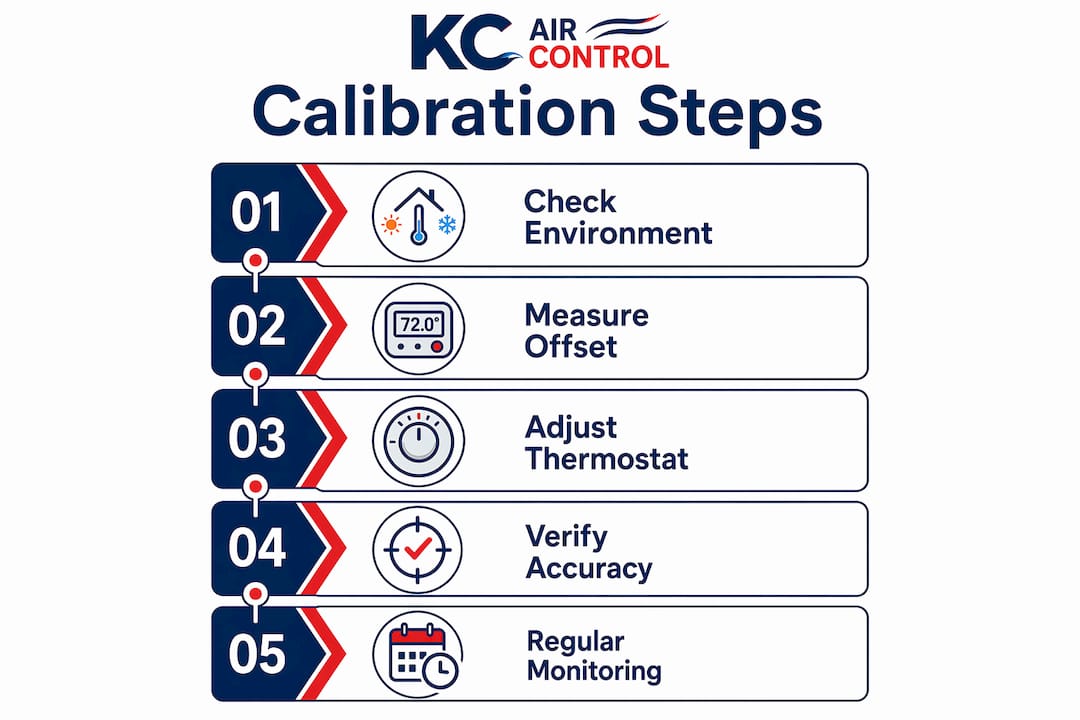
The thermostat calibration process differs depending on whether you have a mechanical, digital, or smart thermostat. Each type has its own adjustment method, and the steps below cover all three.
Mechanical thermostats
- Locate the calibration screw. Remove the thermostat cover. You will find a small screw, often near the bimetal coil or sensing element.
- Make small adjustments. Turn the screw in 1/8-turn increments only. Larger turns can overshoot the target and create a new problem.
- Run a full HVAC cycle. Let the system complete one full heating or cooling cycle before checking the reading again.
- Compare and repeat. Place your reference thermometer nearby and wait 15–20 minutes. If the variance is still above 1.5°F, make another 1/8-turn adjustment.
- Replace the cover. Once the readings align, secure the cover and monitor the system for the next 24 hours.
Digital thermostats
- Access the installer or user menu. Most digital thermostats have a hidden settings menu. Check your model’s manual for the button sequence to enter it.
- Find the offset or correction setting. This is usually labeled “temperature offset,” “calibration,” or “correction” in the menu.
- Enter the adjustment value. If your thermostat reads 2°F high, enter a correction of negative 2°F.
- Save and exit. Confirm the setting and return to the main display.
- Monitor the system. Watch for short cycling over the next few hours, which can indicate the offset was set incorrectly.
Smart thermostats
Smart thermostats often include app-based temperature correction features. Open the manufacturer’s app, navigate to the device settings, and look for a “temperature correction” or “offset” option. The process mirrors the digital thermostat steps but is done through the app interface rather than the device itself. Not all smart thermostat models offer this feature publicly; check your device’s support documentation if you cannot locate it.
Pro Tip: Never adjust settings in the installer menu beyond the temperature offset field. DIYers risk changing advanced system parameters like fan delay or compressor lockout, which can cause serious HVAC performance problems. If you are unsure what a setting does, leave it alone.
Common issues mistaken for calibration problems
Not every temperature complaint in your home points to a calibration issue. Most modern digital thermostats rarely need routine recalibration. When you find yourself adjusting the offset repeatedly, the root cause is usually something else entirely.
Here are the most common culprits that mimic calibration problems:
- Direct sunlight on the thermostat. A thermostat mounted on a south-facing wall that receives afternoon sun will read several degrees higher than the actual room temperature. No offset can fully compensate for this.
- Nearby heat sources. Lamps, televisions, and kitchen appliances all radiate heat. A thermostat within a few feet of these sources will read inaccurately regardless of calibration.
- Cold drafts from windows or exterior walls. A thermostat near a drafty window will read lower than the rest of the room, causing the system to overheat the space.
- Poor airflow around the thermostat. If the thermostat is inside a cabinet or behind a door, it cannot sample the room’s air accurately.
Large offsets of 3°F to 4°F or more almost always point to a placement or environmental problem, not a sensor issue. A software offset cannot fully correct for a thermostat that is in the wrong location. If you notice cold spots in certain rooms, the issue may extend beyond the thermostat to your heating distribution system.
Frequent recalibration needs also signal an aging thermostat. Sensors in older units drift over time, and at a certain point, replacement is more cost-effective than continued adjustment. If your thermostat is more than 10 years old and keeps falling out of calibration, talk to an HVAC technician about your options.
What are the real benefits of thermostat calibration?
A properly calibrated thermostat delivers three concrete benefits: lower energy costs, less wear on your HVAC equipment, and more consistent comfort throughout your home.
On the energy side, calibration errors can cost homeowners 10% to 20% more on annual heating and cooling bills. For a Kansas City household spending $1,500 per year on HVAC energy, that is $150 to $300 in avoidable costs. Correcting a 2°F offset pays for itself quickly. Pairing calibration with other HVAC energy saving steps compounds those savings further.
Accurate temperature readings also reduce short cycling. Short cycling occurs when the thermostat triggers the system to turn on and off too frequently, which puts stress on the compressor and heat exchanger. Monitoring HVAC cycling after any calibration adjustment is critical, because an incorrect offset can actually make short cycling worse rather than better. Properly calibrated thermostats contribute to comfort, energy efficiency, and equipment safety, aligning with quality standards applied across the HVAC industry.
Comfort is the benefit homeowners notice first. When your thermostat reads accurately, the temperature you set is the temperature you get. You stop adjusting the thermostat repeatedly throughout the day, and your home maintains a stable, predictable temperature. That consistency is what programmable thermostats are designed to deliver, but only when the underlying calibration is correct.
Pro Tip: After calibrating your thermostat, check the reading against your reference thermometer once a week for the first month. If the variance creeps back above 1.5°F within a few weeks, the problem is likely sensor drift or placement, not a calibration error you missed.
Key Takeaways
A thermostat that reads even 2°F off its true room temperature can cost you up to 20% more on annual HVAC energy bills and accelerate equipment wear through short cycling.
| Point | Details |
|---|---|
| Calibration threshold | A variance of 1.5°F to 2.0°F or more between thermostat and reference thermometer signals a need for adjustment. |
| Tape test accuracy | Place a folded paper towel behind your reference thermometer to measure ambient air, not wall temperature. |
| Adjustment by type | Mechanical thermostats use 1/8-turn screw increments; digital and smart models use offset settings in menus or apps. |
| Large offsets signal placement | Offsets of 3°F to 4°F or more usually indicate a location or environmental problem that calibration alone cannot fix. |
| Monitor after adjustment | Watch for short cycling after any offset change, as an incorrect setting can increase equipment wear. |
What I have learned from watching homeowners calibrate their own thermostats
The most common mistake I see is homeowners skipping the verification step and going straight to adjustment. They feel a temperature difference, assume the thermostat is off, and start turning screws or entering offsets without ever placing a reference thermometer. Sometimes they are right. Often, they are not, and they end up creating a new problem.
The second most common mistake is trusting a cheap thermometer. A $5 digital thermometer from a hardware store can itself be off by 2°F or more. If your reference device is inaccurate, your calibration will be inaccurate. Spend a little more on a quality indoor thermometer with a known accuracy rating. It is a one-time purchase that pays for itself the first time you use it correctly.
My honest advice: treat calibration as a diagnostic step, not a fix. If you adjust the offset and the problem comes back within a few weeks, stop adjusting and start investigating. Check the thermostat’s location. Look for heat sources nearby. Consider whether the unit is simply old. Calibration is alignment, not repair. If your thermostat needs constant realignment, something else is wrong. Pairing a calibration check with a full HVAC tune-up is the most reliable way to catch both the symptom and the cause in one visit.
— AB
Professional HVAC calibration and maintenance with Kcaircontrol
When calibration checks reveal a deeper problem, or when you would rather have a professional handle it from the start, Kcaircontrol is ready to help.

Kcaircontrol has served Kansas City homeowners for over 70 years, providing thermostat calibration, HVAC diagnostics, and full system maintenance. Our technicians verify thermostat accuracy as part of every seasonal tune-up, catching issues before they become expensive repairs. If your system is short cycling, running constantly, or producing uneven temperatures, our team can diagnose the root cause fast. Check out our emergency HVAC repair options for situations that cannot wait. Schedule your visit online and get your home back to the temperature you actually set.
FAQ
What does thermostat calibration do exactly?
Thermostat calibration aligns the temperature your thermostat displays with the actual air temperature in the room. This ensures your HVAC system runs only as long as needed, improving efficiency and comfort.
How often should you calibrate a thermostat?
Most thermostats do not need routine calibration. Check calibration if you notice a consistent temperature variance of 1.5°F or more, higher energy bills, or short cycling behavior.
Can a thermostat be too far off to calibrate?
A variance of 3°F to 4°F or more usually signals a placement or environmental problem rather than a sensor issue. Software offsets cannot fully correct for a thermostat in the wrong location.
Is thermostat calibration a DIY task or a job for a professional?
Basic calibration checks and small offset adjustments are manageable for most homeowners. If the problem persists after adjustment, or if you need to access advanced installer settings, contact a licensed HVAC technician.
Does calibrating a thermostat save money?
Correcting calibration errors can reduce annual heating and cooling costs by 10% to 20%, according to industry data. The savings depend on how far off the thermostat was and how much your system was overworking as a result.