
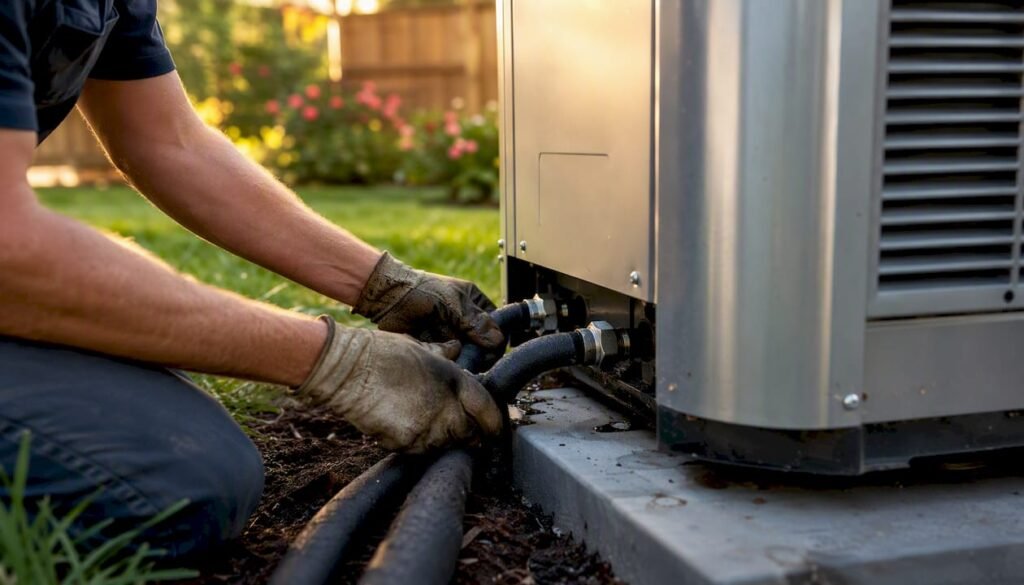
Residential ground-source heat pumps (GSHPs) in the Kansas City area typically deliver an effective heating COP of 3.0–3.8 and a cooling EER of 15–18 once installed-system factors are included, cutting space-conditioning energy use roughly 25–50% compared with air-source alternatives. As Britannica describes, a geothermal heat pump exchanges heat with the shallow earth rather than burning fuel, which is exactly why stable KC ground temperatures make these systems perform so reliably year-round.
Quick efficiency reference for KC homeowners:
| Metric | Rated range | Measured field range | KC ground temp advantage |
|---|---|---|---|
| Heating COP | 3.0–4.0 | 2.6–3.8 (steady-state) | 54–57°F EWT stabilizes winter performance |
| Cooling EER | 15–18 | 15–18 (monitored) | Moderate summer ground temps reduce compressor load |
- Replacing propane or electric resistance: strongest savings; payback often under 10 years with incentives
- Replacing natural gas: longer payback due to lower gas prices; best case is end-of-life equipment or new construction
- Quick next step: request a site-specific load calculation and loop design estimate from a local installer
Table of Contents
- Key Takeaways
- Why KC ground temperatures give geothermal a real edge here
- Kcaircontrol helps KC homeowners get accurate geothermal estimates
- Useful sources to verify ratings, field data, and incentives
Key Takeaways
Ground-source heat pumps in Kansas City deliver consistent, measurable efficiency because KC’s shallow ground temperatures hold steady in the mid-50s°F year-round, outperforming air-source systems in both heating and cooling seasons.
| Point | Details |
|---|---|
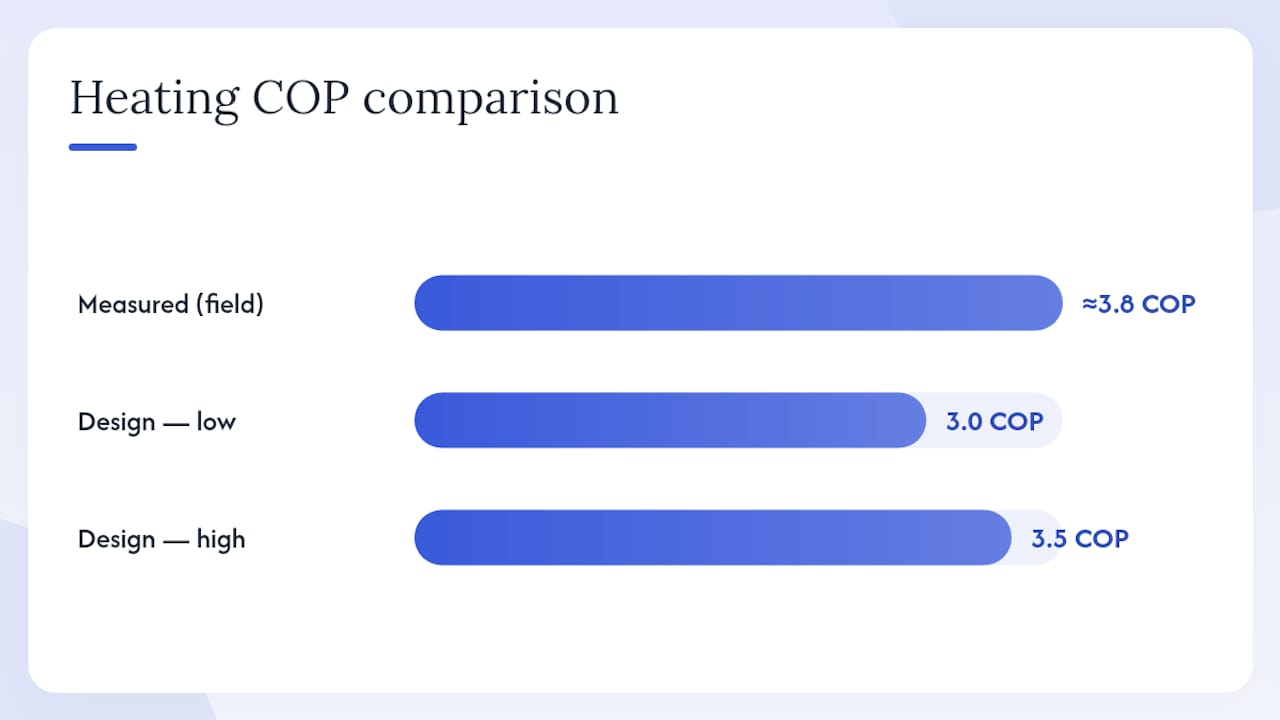
| Expect COP 3.0–3.8 in practice | Field monitoring shows corrected annual heating COP averages around 3.8; conservative KC design assumes 3.0–3.5. |
| Rated vs. measured gap matters | Building America data shows measured COPs run significantly below nameplate when pump power is excluded from rated values. |
| Savings depend on displaced fuel | Propane and electric-resistance replacements yield the strongest economics; natural-gas replacements need incentives to pencil out. |
| Request three installer documents | Ask for AHRI/ISO certificates, OEM performance at your design entering water temperature (EWT), and confirmation that loop-pump power is included in the modeled COP. |
| Federal ITC can offset 30% of cost | The 30% federal Investment Tax Credit applies to qualifying GSHP installations; confirm eligibility with a tax professional before budgeting. |
| Kcaircontrol serves KC homeowners | Kcaircontrol provides on-site load calculations, loop design, and full installation with post-install commissioning for Kansas City area homes. |
Why KC ground temperatures give geothermal a real edge here
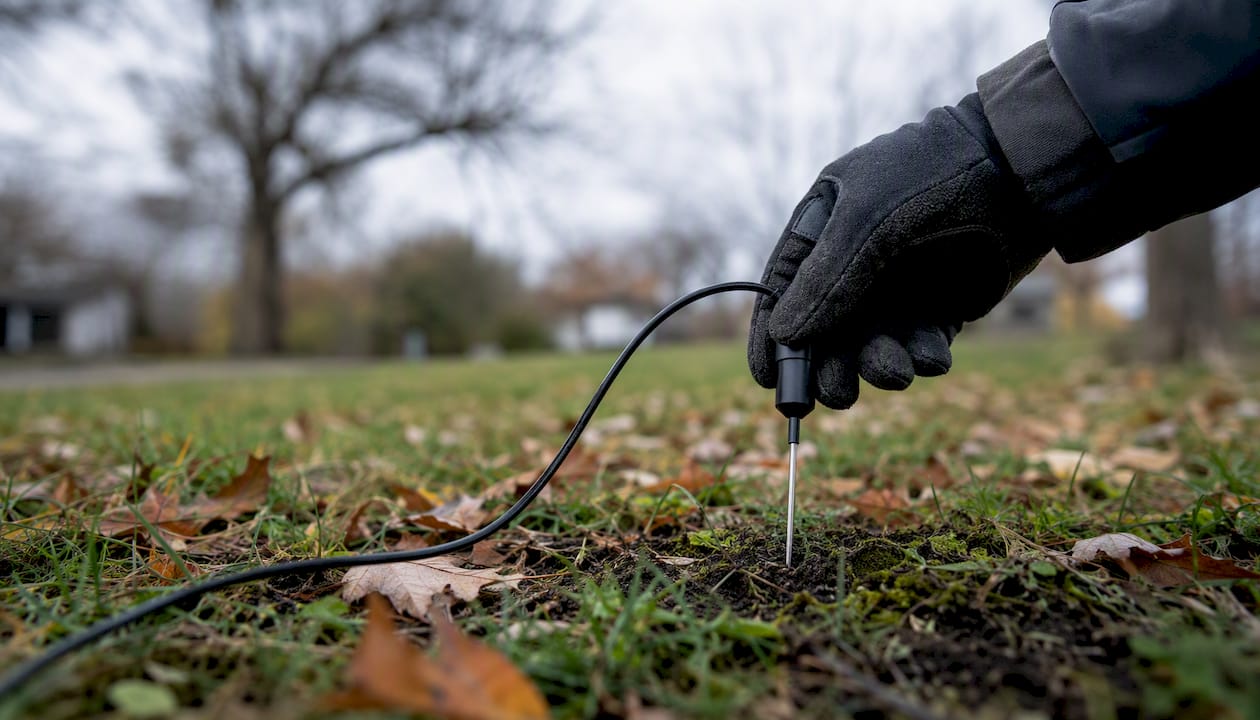
Kansas City’s shallow ground sits at roughly 54–57°F year-round, which is the single biggest local advantage for geothermal system performance. An air-source heat pump pulling heat from 10°F outdoor air in January works much harder than a ground-source unit drawing from 55°F ground. That stable entering water temperature (EWT) keeps your system’s COP in the 3.0–3.8 range even on the coldest KC days, while an air-source unit’s efficiency can drop sharply below freezing.
Cooling works the same way in reverse. Summer ground temps stay cooler than outdoor air, so your system rejects heat more easily. That is why monitored GSHPs consistently show cooling EERs of 15–18 in real installations, competitive with high-efficiency central AC. For a deeper look at how geothermal heating technology works at the homeowner level, this homeowner’s guide to geothermal heating covers the fundamentals clearly.
Practical savings examples for KC homes:
When you replace propane at roughly $2.00–$2.50/gallon, a GSHP at COP 3.2 can cut your annual heating bill significantly because propane’s combustion efficiency tops out around 95% AFUE while geothermal delivers 320% effective efficiency. Replacing electric resistance (100% efficient by definition) with COP 3.2 still cuts heating energy use by roughly two-thirds. Natural gas is the toughest case: low gas prices mean payback stretches longer, and the DOE guidance notes that rated efficiencies exclude pump power and installed-system losses, so model conservatively.
A peer-reviewed MDPI analysis places the representative GSHP COP range at 2.0–5.0 across climates, with incentives like the Inflation Reduction Act’s 30% ITC improving feasibility considerably. Installation costs typically start around $2,500 per ton for the heat-pump unit itself, plus drilling or trenching. Total installed costs vary by loop type and home size; payback ranges widely depending on displaced fuel and available incentives.
Key factors that change your system’s real-world performance:
- Loop type and soil: Vertical loops in KC’s clay-heavy soils often outperform horizontal loops in tight lots; soil thermal conductivity affects loop length requirements
- Loop-pump power: Pump energy is excluded from most rated COPs; always ask whether it is included in your installer’s modeled numbers
- Ductwork condition: Leaky ducts can erase a significant share of efficiency gains; duct cleaning and sealing before installation protects your investment
- Correct sizing: Oversizing for heating often means the system short-cycles during cooling, reducing latent performance; variable-speed compressors mitigate this
- Desuperheater: Adding a desuperheater for water heating captures waste heat and improves whole-system efficiency
The Building America Solution Center recommends using ACCA Manual J for load calculations and OEM expanded performance tables at your design EWT rather than standard AHRI factory conditions, which reflect a different operating point than your actual system will see.
Questions to bring to any KC installer:
- Can you provide AHRI or ISO performance certificates for the unit you’re proposing?
- What is the OEM-rated COP and EER at my expected entering water temperature (not just AHRI standard conditions)?
- Does your modeled annual COP include loop-pump and fan electrical loads?
- What Manual J load calculation supports your proposed system size?
- Do you have measured performance data from similar KC installations?
For context on how geothermal fits alongside other energy-efficient HVAC options in KC, the local climate and utility mix matter as much as the equipment specs.
Kcaircontrol helps KC homeowners get accurate geothermal estimates
If you want a site-specific savings estimate rather than national averages, Kcaircontrol offers on-site soil and space assessments, Manual J load calculations, loop design, and full-system proposals with modeled annual energy use and simple-payback estimates.

Kcaircontrol’s team brings decades of local Kansas City HVAC experience to every geothermal project, including AHRI/OEM performance verification, financing and incentive assistance, and turnkey installation with post-install commissioning. During a quote visit, you’ll receive a written Manual J, a loop plan, a cost breakdown, and a projected payback range specific to your home and fuel type. Financing options are available to help manage upfront costs. To request a free estimate or schedule a site visit, contact Kcaircontrol today.
This article is general information, not tax or financial advice. Confirm current ITC eligibility and rates with a qualified tax professional or the IRS.
Useful sources to verify ratings, field data, and incentives
Start with these vetted references to pull AHRI/ISO certificates, review field-monitored COP data, and confirm incentive details.
- Geothermal heat pumps — U.S. Department of Energy (EERE)
- Guide to Geothermal Heat Pumps — U.S. Department of Energy
- In-Depth Look at Ground Source Heat Pumps and Other Electric Loads in Two GreenMax Homes — Building America / UNT
- Field Monitoring: Ground Source Heat Pumps on Long Island — NYSERDA
- Comparative assessment of geothermal heat pumps and fossil-fuel heating systems — MDPI
- Ground-Source Heat Pumps — Building America Solution Center (PNNL)
- Missouri geothermal guide — Geothermal Insider
- Geothermal heat pump — Britannica
| Source | Definitions/standards | Field measurements | Regional context | Incentives |
|---|---|---|---|---|
| DOE EERE | ✓ | ✓ | ||
| DOE Guide (PDF) | ✓ | ✓ | ||
| NYSERDA | ✓ | |||
| Building America / UNT | ✓ | |||
| BASC / PNNL | ✓ | |||
| MDPI | ✓ | ✓ | ✓ | |
| Geothermal Insider MO | ✓ | ✓ | ||
| Britannica | ✓ |
Recommended
- Energy efficient HVAC guide: Save 20-50% in KC – KC Air Control – Heating & Cooling
- Energy efficient HVAC: lower bills and better comfort – KC Air Control – Heating & Cooling
- Energy efficient HVAC installation guide for KC homeowners – KC Air Control – Heating & Cooling
- HVAC trends 2026: Smarter, efficient solutions for KC homes – KC Air Control – Heating & Cooling