
TL;DR:
- A maintenance plan is a proactive strategy that ensures HVAC systems operate reliably and efficiently for years. Proper planning reduces repair costs, increases technician productivity, and extends equipment lifespan by scheduling essential tasks. Regularly reviewing and updating the plan prevents backlog, improves communication, and maintains optimal system performance.
A maintenance plan is a structured, proactive strategy that defines exactly what upkeep your HVAC system needs, when it happens, and how technicians carry it out. The role of maintenance plans goes far beyond a simple service reminder. For homeowners and property managers in Kansas City, a well-built plan is the difference between a system that runs reliably for 15-plus years and one that fails on the hottest day of summer. Preventive maintenance plans, the industry’s standard term for this approach, shift your operation from reactive firefighting to controlled, predictable reliability. This article breaks down how these plans work, what they include, and how to build one that actually protects your comfort and your budget.
How do maintenance plans improve efficiency and reduce costly repairs?
Maintenance plans cut costs by making repair expenses predictable and reducing the frequency of unplanned breakdowns. Investment in planning pays off through higher-quality repairs and faster technician response. The financial case is straightforward: a $150 annual tune-up prevents a $1,200 compressor replacement.

The productivity gains are measurable. Facilities with effective maintenance planning can increase technician wrench time to 55% or higher, compared to just 25–35% in reactive organizations. That gap exists because planned work means technicians arrive with the right parts, the right tools, and a clear procedure. No wasted trips. No waiting on parts orders.
For HVAC systems specifically, a preventive maintenance plan typically includes:
- Filter replacements every 1–3 months to maintain airflow and indoor air quality
- Coil cleaning on both evaporator and condenser coils to preserve cooling efficiency
- Refrigerant level checks to catch leaks before they damage the compressor
- Electrical connection inspections to prevent safety hazards and system failures
- Thermostat calibration to keep temperature control accurate and energy bills in check
- Blower motor and belt inspections to catch wear before it causes a breakdown
Each of these tasks is inexpensive on its own. Skipping them turns small issues into major system failures. Regular HVAC maintenance extends equipment life and keeps your energy bills from climbing unnecessarily.
Pro Tip: Schedule your HVAC tune-up in early spring for cooling systems and early fall for heating systems. You get better technician availability, and your system is ready before peak demand hits.
What are the key steps in creating effective maintenance plans?
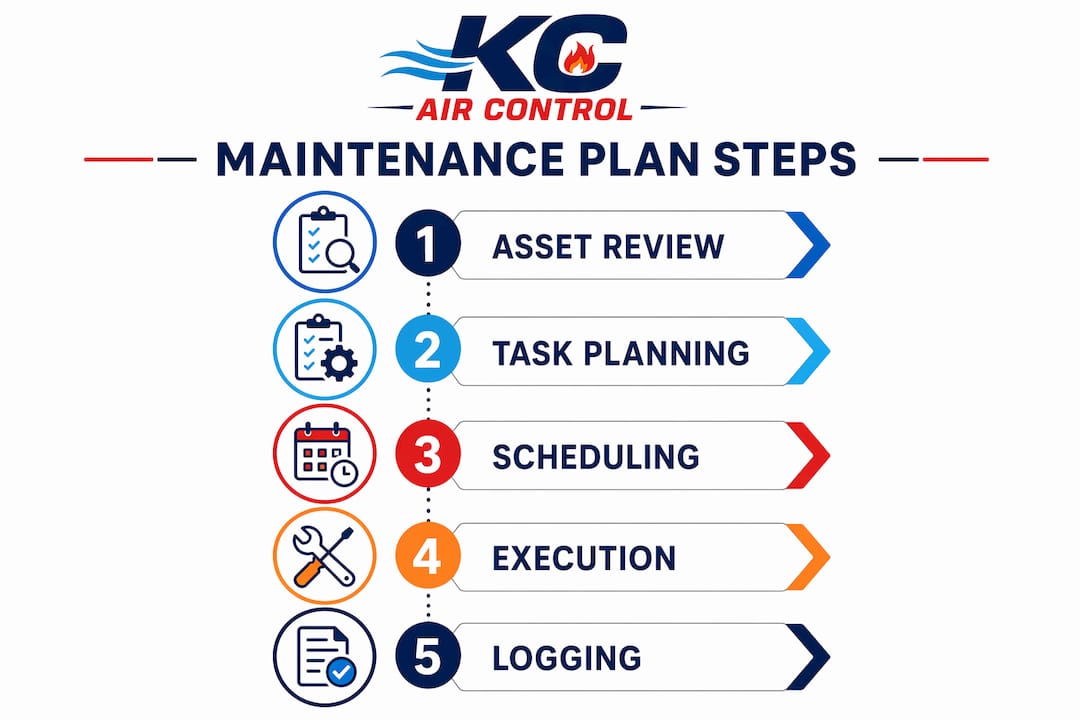
Building an effective maintenance plan requires more than listing tasks on a calendar. The process follows a structured sequence that connects your equipment’s specific needs to the resources required to service it.
Here is a practical eight-step framework drawn from preventive maintenance best practices:
- Build your asset inventory. List every piece of HVAC equipment: furnaces, air handlers, condensers, thermostats, and ductwork.
- Rank assets by criticality. Your primary furnace matters more than a secondary zone controller. Prioritize accordingly.
- Define tasks and procedures. Specify exactly what each maintenance visit covers, including parts and tools required.
- Set task frequencies. Assign intervals based on manufacturer recommendations and actual usage patterns.
- Assign roles. Decide who handles each task: your HVAC contractor, a property manager, or the homeowner.
- Deploy the plan. Schedule work orders and communicate them to everyone involved.
- Train all parties. Make sure technicians and property managers understand the plan’s scope and expectations.
- Track, review, and update. Use performance data to refine the plan over time.
Asset criticality analysis is the step most homeowners skip. Applying the same maintenance frequency to every component wastes money and misses the point. Your primary heating system deserves more attention than a bathroom exhaust fan.
A Computerized Maintenance Management System (CMMS) is the standard tool professionals use to track work orders, parts inventory, and maintenance history. For residential property managers overseeing multiple units, a CMMS like UpKeep or Limble CMMS makes tracking far more manageable than spreadsheets.
Pro Tip: Keep a maintenance log for each HVAC unit. When a technician visits, document what was done, what parts were used, and any observations about system condition. That history becomes your most valuable diagnostic tool.
How do maintenance plans fit into property management?
For property managers, maintenance plans are not optional. They are a core part of protecting asset value, meeting regulatory requirements, and keeping tenants comfortable. A well-documented plan also creates a paper trail that matters during lease disputes or insurance claims.
The benefits for property managers specifically include:
- Regulatory compliance. Many jurisdictions require documented HVAC maintenance records for rental properties. A formal plan satisfies that requirement automatically.
- Reduced tenant complaints. Scheduled maintenance prevents the surprise breakdowns that generate emergency calls at 11 p.m.
- Contractor coordination. A plan gives your HVAC contractor clear scope and timing, which reduces miscommunication and callback visits.
- Indoor air quality protection. Clean filters and coils directly affect the air your tenants breathe. Poor indoor air quality is a health issue, not just a comfort issue.
- Documentation for insurance. Insurers increasingly require proof of regular maintenance before covering HVAC-related claims.
Maintenance scheduling coordinates resources and timing to execute planned work efficiently, minimizing downtime and supporting operational goals. For a property manager running 10 units, that coordination means grouping service visits by building to reduce contractor travel time and cost. The Kcaircontrol landlord HVAC maintenance checklist is a practical starting point for property managers building their first formal plan.
What is the difference between maintenance planning and scheduling?
Planning and scheduling are two distinct functions that work together. Confusing them is one of the most common reasons maintenance programs underperform.
| Function | Defines | Owned By |
|---|---|---|
| Planning | What tasks are needed and how to perform them | Maintenance planner or HVAC contractor |
| Scheduling | When tasks happen and who performs them | Property manager or service coordinator |
Maintenance planning specifies “what” and “how” while scheduling determines “when” and “who.” Planning defines scope and resources. Scheduling manages timing and task assignment. Both functions must work together or the system breaks down.
A real-world example: your HVAC contractor plans a coil cleaning procedure, specifying the cleaning solution, tools, and safety steps. Your property manager then schedules that task for a Tuesday morning in april when the unit is vacant. If the planner skips the procedure detail, the technician improvises. If the scheduler books the visit without confirming parts availability, the technician arrives unprepared. Either failure wastes time and money.
Separating planning from execution allows planners to prepare detailed work orders, verify parts availability, and eliminate pre-job delays. This separation is what drives the productivity gains mentioned earlier.
Scheduling flexibility also matters. Rigid schedules that cannot adapt to unexpected equipment issues cause missed priorities and workflow disruptions. Build in buffer time for reactive work so scheduled tasks do not get bumped when something breaks unexpectedly.
Pro Tip: Review your maintenance schedule quarterly, not annually. HVAC systems behave differently across seasons, and a schedule built in January may not reflect what your system actually needs by July.
What common mistakes should homeowners and property managers avoid?
Most maintenance plan failures trace back to a small set of predictable mistakes. Knowing them in advance saves you significant time and money.
- Treating the plan as static. A static maintenance plan leads to backlog accumulation, loss of technician trust, and poor adherence. Review and update your plan based on actual system performance data at least twice a year.
- Applying uniform maintenance intervals. Not every component needs the same attention. Prioritize your most critical equipment and adjust frequencies based on age, usage, and manufacturer guidance.
- Ignoring backlog. When scheduled tasks pile up, teams start skipping them. A growing backlog is a warning sign that your plan is too ambitious or your resources are too thin. Scale back and focus on critical assets first.
- Poor communication between parties. Property managers, HVAC contractors, and tenants all need to know what is planned and when. Miscommunication leads to missed appointments and incomplete work.
- Skipping post-visit documentation. Every service visit should generate a written record. Without documentation, you cannot identify patterns, prove compliance, or make informed decisions about equipment replacement.
Preventive maintenance programs fail when treated as compliance exercises rather than reliability initiatives. The goal is not to check a box. The goal is to keep your system running at peak performance for as long as possible.
Pro Tip: Ask your HVAC contractor to provide a written summary after every visit. If they do not offer one, request it. That document is your maintenance history and your best tool for catching recurring problems early.
Key takeaways
A structured preventive maintenance plan is the single most effective way to extend HVAC system life, reduce repair costs, and maintain reliable home comfort year-round.
| Point | Details |
|---|---|
| Planning vs. scheduling | Planning defines what tasks are needed; scheduling sets when and who performs them. |
| Technician productivity | Effective planning can raise technician wrench time from 25% to 55%, cutting wasted labor. |
| Asset criticality matters | Prioritize high-impact equipment like your primary furnace over lower-risk components. |
| Dynamic plans outperform static ones | Review and update your plan at least twice a year based on real system performance data. |
| Documentation protects you | Written maintenance records support insurance claims, compliance, and smarter repair decisions. |
Why most homeowners underestimate what a maintenance plan actually does
After years of working with homeowners and property managers across Kansas City, the pattern is consistent. People think a maintenance plan is a reminder to change their filter. It is not. A real preventive maintenance plan is a management system for one of the most expensive pieces of equipment in your home.
The homeowners who get the most value from their HVAC systems are not the ones with the newest equipment. They are the ones with the most consistent service history. A 12-year-old furnace with documented annual tune-ups will outperform a 5-year-old system that has never been serviced. That is not an opinion. That is what the data from service calls shows repeatedly.
The mistake I see most often is treating the plan as a one-time setup. You build it, file it, and forget it. Then two years later, the system fails and the plan has not been touched since installation. The benefits of scheduled maintenance only materialize when the plan stays current and the work actually gets done.
My honest advice: partner with an HVAC contractor who brings a written plan to every visit, not just a checklist. The difference between a checklist and a plan is accountability. A plan tells you what was done, what was found, and what comes next. That is the standard you should expect.
— AB
How Kcaircontrol helps you build a maintenance plan that works
Kcaircontrol has served Kansas City homeowners and property managers for over 70 years, and a structured maintenance plan is at the center of every service relationship we build.

Whether you need a routine furnace tune-up before winter or a full HVAC maintenance program for a multi-unit property, our team arrives prepared with the right parts, the right tools, and a clear procedure. We document every visit and give you a written summary so your maintenance history stays current. When something unexpected comes up, our emergency HVAC repair options get your system back online fast. Contact Kcaircontrol today to schedule your first maintenance visit and start protecting your comfort and your investment.
FAQ
What does a maintenance plan include for HVAC systems?
A standard HVAC maintenance plan covers filter replacements, coil cleaning, refrigerant checks, electrical inspections, thermostat calibration, and blower motor assessments. These tasks are scheduled at defined intervals based on equipment type and usage.
How often should HVAC maintenance be scheduled?
Most HVAC systems require at least two service visits per year: one in spring before cooling season and one in fall before heating season. High-use systems or older equipment may benefit from quarterly inspections.
What is the difference between preventive and reactive maintenance?
Preventive maintenance is scheduled proactively to prevent failures before they occur. Reactive maintenance responds to breakdowns after they happen. Reactive organizations see technician productivity of just 25–35%, compared to 55% or higher with planned maintenance.
Can property managers handle HVAC maintenance without a contractor?
Property managers can handle basic tasks like filter changes, but coil cleaning, refrigerant checks, and electrical inspections require a licensed HVAC technician. A formal plan should assign each task to the appropriate party based on skill and licensing requirements.
What happens if a maintenance plan is not updated regularly?
A static plan leads to backlog accumulation, missed tasks, and reduced system reliability. Plans that are not updated lose crew trust and fail to reflect actual equipment conditions, which defeats the purpose of having a plan at all.