
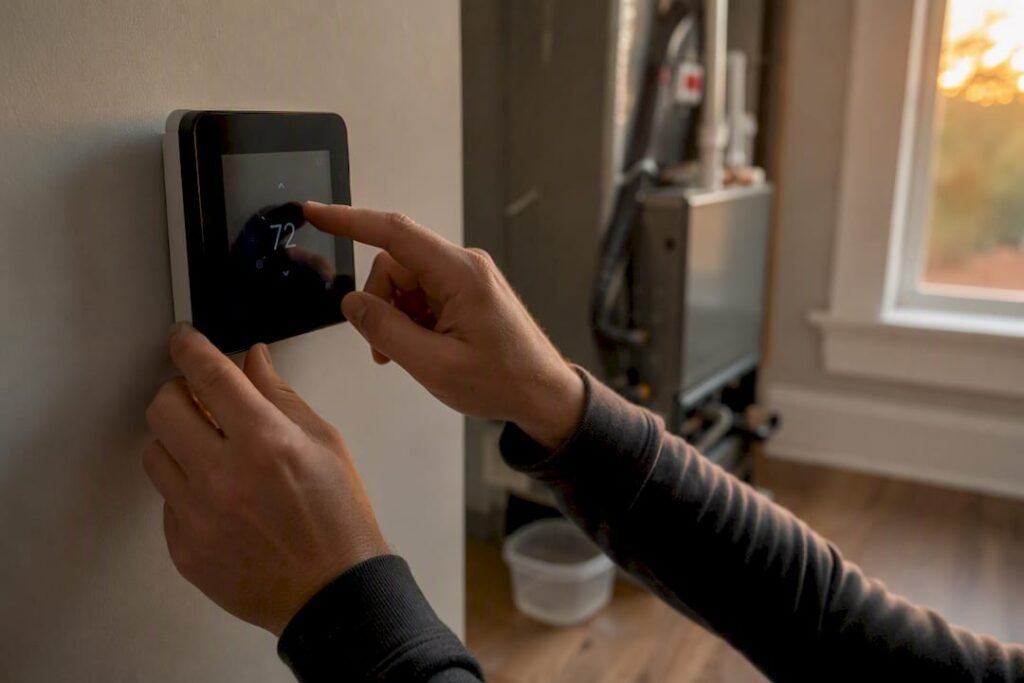
If your air conditioner is freezing up, turn the cooling off at the thermostat right now and switch the fan setting to ON. Don’t run the compressor while ice is on the coil or lines. This one move stops the damage from getting worse and lets warm air circulate to melt the ice while you work through a few quick checks.
Here’s what to do in the next ten minutes:
- Set the thermostat mode to “off” so the compressor stops running.
- Switch the fan setting to “on” so air keeps moving across the coil.
- Pull the air filter and check it. If it’s gray, clogged, or hasn’t been changed in over 90 days, replace it.
- Walk the house and open any closed supply registers, and clear furniture or rugs blocking return vents.
- Check the condensate drain line and pan for standing water before the ice melts and overflows it.
Pro Tip: Head outside to the condenser unit and touch both copper lines. The larger, insulated suction line should feel cool. The thinner liquid line should feel warm to the touch. If the liquid line is cold or icy, that points to a serious restriction, not a simple airflow problem, and it’s a sign you need a professional rather than a filter swap.
Key Takeaways
A frozen AC needs an immediate shutdown and fan-only thaw, and repeat freezing within 24 hours signals a mechanical or refrigerant problem that requires an EPA-certified technician.
| Point | Details |
|---|---|
| Shut it down first | Turn cooling off and set the fan to ON the moment you see ice, before doing anything else. |
| Check the two lines | A cold or icy liquid line, not just the suction line, points to a severe restriction needing a pro. |
| Give it time to thaw | Light ice clears in 1 to 3 hours; heavy buildup can take up to 24 hours with the fan running. |
| Never run it frozen | Continuing to cool while iced over risks liquid slugging and catastrophic compressor damage. |
| Refreezing means call a pro | If ice returns within 24 hours after a filter change, get an emergency inspection from Kcaircontrol. |
Table of Contents
- Why Is My AC Freezing Up? The Common Causes
- How Do You Troubleshoot a Frozen Air Conditioner Yourself?
- How to Thaw a Frozen AC Safely
- What Happens If You Keep Running a Frozen AC?
- When Should You Call an HVAC Technician?
- How Can You Prevent Your AC From Freezing Again?
- How Long Should You Leave a Frozen AC Off?
- Frequently Asked Questions
- Sources
Why Is My AC Freezing Up? The Common Causes
An evaporator coil freezes when it gets too cold for too long, and that almost always traces back to one of two families of problems: not enough air moving across the coil, or not enough refrigerant inside it. Trane identifies the most frequent culprits as dirty or clogged air filters, restricted airflow from blocked returns or closed vents, dirty evaporator coils, blower motor problems, and low refrigerant.
Here’s how each one leads to ice:
- Dirty air filter: Chokes airflow across the coil, so the coil can’t absorb enough heat and drops below freezing.
- Blocked or closed vents/returns: Same effect as a dirty filter. Less air movement means colder coil temperatures.
- Dirty evaporator coil: A layer of dust acts like insulation, trapping cold against the metal instead of letting it transfer to passing air.
- Failing blower motor: Weak or no airflow starves the coil the same way a clogged filter does.
- Low refrigerant from a leak: Drops system pressure, and lower pressure means a colder coil surface, even with good airflow.
- Faulty metering device: Meters too much refrigerant into the coil, overcooling one section until it ices over.
Cool overnight temperatures in spring and fall, combined with high indoor humidity, push a marginal system over the edge even when nothing has technically broken yet.
How Do You Troubleshoot a Frozen Air Conditioner Yourself?
Work through these steps in order before you call anyone:
- Turn the thermostat to off, then set the fan to ON so warm air melts the ice.
- Replace the air filter, regardless of how it looks. It takes two minutes and rules out the most common cause instantly.
- Open every supply register in the house and clear anything blocking a return grille.
- Walk out to the outdoor condenser and check for grass clippings, leaves, or a mulch bed grown up against the fins.
- Touch the two refrigerant lines at the outdoor unit. Cold suction line and warm liquid line is normal for a system recovering from a freeze. A cold or icy liquid line signals a severe restriction, like a clogged filter drier or kinked line.
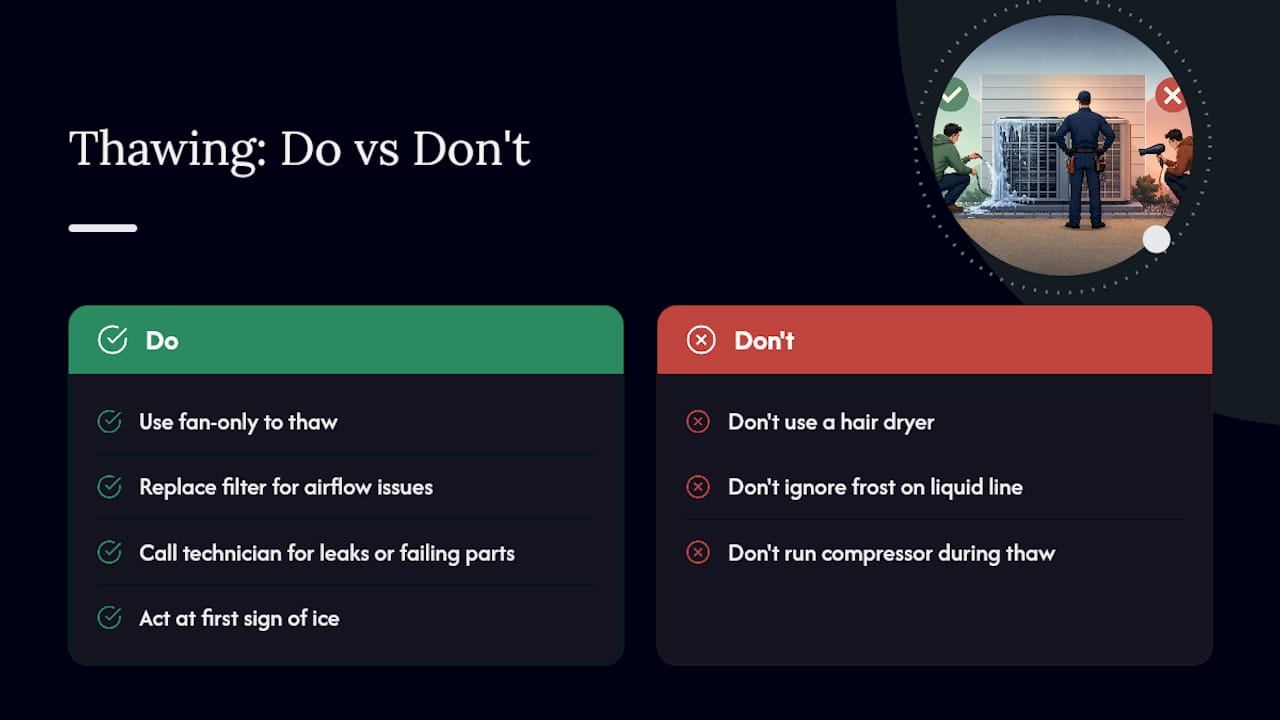
A few firm safety rules apply here. Never chip or scrape ice off the coil or lines. Never pour hot or boiling water on a frozen coil. Don’t open sealed refrigerant panels or access ports yourself. Those steps risk puncturing coils, cracking components with sudden temperature shock, or releasing refrigerant that needs specialized handling.
Pro Tip: While you wait for the thaw, slide a towel or a shallow pan under the indoor air handler’s drain pan area. Melting ice often produces more water than the condensate line was built to carry in one burst, and a little prep now saves you a soaked closet floor later.
How to Thaw a Frozen AC Safely
Leave the thermostat off and the fan on. A light coating of ice on the coil typically clears in one to three hours; a heavier, thicker buildup covering the lines and cabinet can take up to 24 hours.
What to do:
- Keep the fan running the entire time, even overnight if needed.
- Lay towels near the air handler and check the condensate pan periodically.
- Give it the full window before restarting cooling.
What not to do:
- Don’t chip, pick, or pry at the ice.
- Don’t pour boiling water on the coil or lines.
- Don’t restart the compressor while any ice remains.
If a full 24 hours passes and ice is still there, or it comes right back once you restart, that’s not a slow thaw problem anymore. It’s a sign of a mechanical issue or a refrigerant leak that needs a technician.
What Happens If You Keep Running a Frozen AC?
Running a frozen system doesn’t just delay the fix. It can destroy the compressor. When ice blocks proper refrigerant flow, liquid refrigerant can return to the compressor instead of vaporizing first, a condition technicians call slugging. Compressors are built to pump gas, not liquid, and liquid slugging can damage valves, bend connecting rods, and burn out motor windings in a matter of minutes.
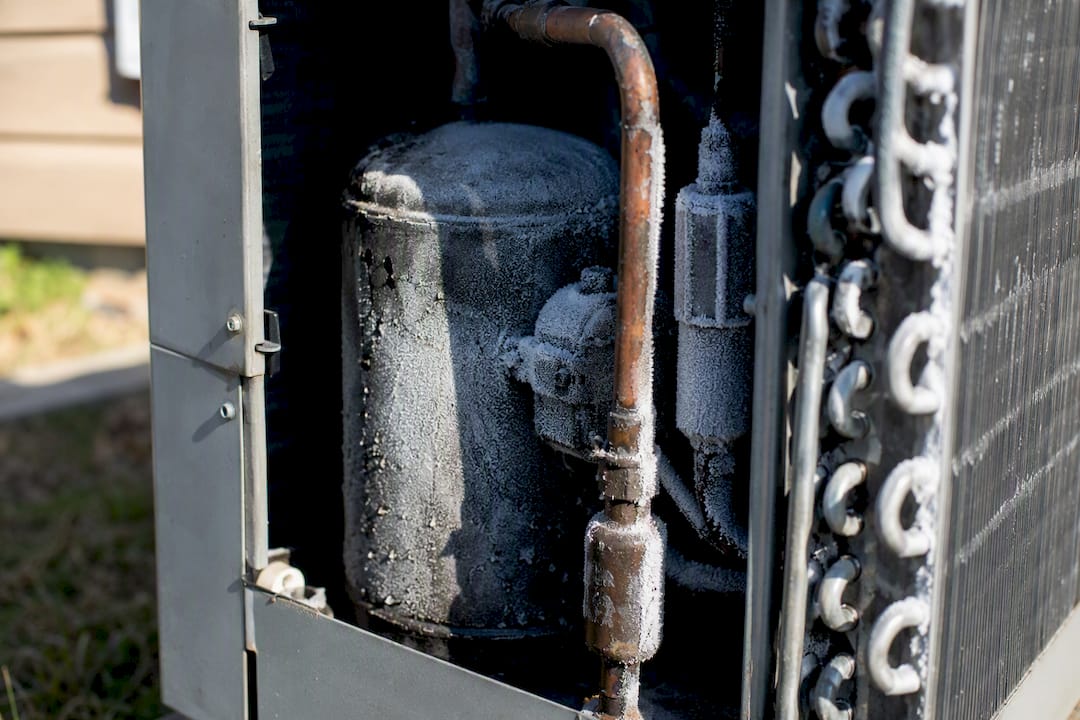
The stakes are real: a frozen AC will not resolve itself by running longer, and forcing the compressor to work against a blockage is one of the fastest ways to turn a $200 repair into a compressor replacement costing thousands.
Pro Tip: If your system freezes, thaws, and freezes again within the same week, stop cycling it on and off yourself. Repeated freeze/thaw cycles put mechanical stress on the compressor with every restart, and that pattern is exactly when homeowners should stop troubleshooting and book emergency service.
When Should You Call an HVAC Technician?
Some signs mean it’s time to stop DIY troubleshooting and get a licensed technician on the phone. Watch for:
- The system refreezes within 24 hours after a filter change and full thaw.
- Ice specifically on the liquid line, not just the suction line.
- Hissing sounds or an oily residue anywhere on the lines or coil, both signs of a refrigerant leak.
- Unusual grinding, clicking, or straining noises from the outdoor compressor.
- Water damage or a soaked drain pan area that suggests repeated overflow.
Research on frozen-coil calls suggests that if a thaw and filter swap don’t stop refreezing within about a day, there’s roughly a 90% chance the root cause is mechanical or a refrigerant leak, not something you can fix with a filter.
A technician’s visit typically includes refrigerant pressure readings, electronic leak detection, a check of the blower motor and blower wheel, an inspection of the metering device or filter drier, and static pressure testing on the ductwork. Refrigerant is a regulated substance, so any recharge or leak repair should only be done by an EPA-certified technician. Simply topping off refrigerant without finding the leak is a short-term patch that lets the same problem freeze the coil again in weeks.
How Can You Prevent Your AC From Freezing Again?
A few habits stop most freeze-ups before they start:
- Change the air filter every 30 to 90 days depending on your home and pets.
- Keep furniture, curtains, and rugs clear of supply and return vents.
- Schedule a professional tune-up and coil cleaning once a year, ideally before peak summer demand.
- Check the condensate drain line for clogs each spring.
- Keep at least two feet of clearance around the outdoor condenser.
A simple monthly rhythm:
- Glance at the filter and hold it up to a light. Replace if you can’t see through it.
- Confirm all vents are open and unobstructed.
- Listen for anything unusual when the system cycles on.
Pro Tip: During your walk-through, feel the air coming out of a supply vent. It should be noticeably cool and steady. Weak, warm, or inconsistent airflow is often the earliest warning sign of a freeze-up building weeks before ice actually shows up on the coil. Routine filter changes and coil cleaning remain the single most effective prevention against this whole cycle repeating.
How Long Should You Leave a Frozen AC Off?
Give it one to three hours with the fan on for light ice, and up to 24 hours for a heavy, thick freeze covering the lines. Don’t restart cooling until every trace of ice is gone.
- Filter replacement: Inexpensive, DIY, and often the whole fix.
- Coil cleaning or minor blower repair: Low to moderate cost, usually a single visit.
- Refrigerant leak repair and recharge: Moderate cost, requires leak detection and an EPA-certified technician.
- Compressor replacement: The highest cost outcome, and often avoidable with prompt attention.
If the system refreezes or the liquid line stays cold after a full thaw, that’s an emergency-level call, not a next-business-day one.
Local pro perspective: why early action matters
Most of the frozen systems we get called out for started as a $15 filter problem that got run for another week. Homeowners mean well, they just don’t realize a frozen coil is a stop-now signal, not a keep-cooling-and-see problem. Catching it early is almost always the difference between a quick repair and a new compressor.
How KC Air Control Gets Your Cooling Back Fast
A frozen coil rarely fixes itself with a wait-and-see approach, and Kcaircontrol built its process around that reality. Our technicians handle emergency AC repair, refrigerant leak detection and repair, blower motor service, coil cleaning, and condensate drain clearing, the exact list of causes behind most freeze-ups.

When you call, expect a fast response window, EPA-certified refrigerant handling on every job, and a diagnostic process that checks pressures, airflow, and the coil before any part gets replaced, not guessed at. If your system has refrozen after a filter change or the liquid line is staying cold, that’s the signal to stop troubleshooting and book emergency service with a technician who can pinpoint the cause the same day.
Frequently Asked Questions
Why does my AC keep freezing up even after I changed the filter?
A fresh filter only fixes airflow-related freezing. If ice keeps coming back within a day, the cause is usually low refrigerant from a leak, a failing blower motor, or a restricted metering device, all of which need a technician’s diagnosis.
Is it normal for AC lines to have some frost on them?
Light frost on the larger suction line during heavy use can happen occasionally, but ice on the smaller liquid line is never normal and points to a serious restriction.
Can I use a hair dryer to speed up thawing my AC coil?
No. Direct heat risks cracking coil fins or damaging insulation. Let the fan-only airflow do the work over the recommended one to 24 hour window instead.
Will running my AC on fan-only damage anything?
No. Fan-only mode is the safest setting during a thaw because it moves air without engaging the compressor, which is exactly what a frozen coil needs to recover.
How much does it typically cost to fix a frozen AC?
It depends entirely on the cause. A filter swap costs very little, coil cleaning or blower repairs run low to moderate, refrigerant leak repairs cost more due to leak detection and recharge, and compressor replacement is the most expensive outcome, one worth avoiding by acting at the first sign of ice.
Sources
For deeper technical detail, Energy Saver covers maintenance basics, Carrier explains compressor risk and refrigerant leak repair, Trane ranks common freeze causes, and homeowners dealing with winter water damage risk can check this partner guide on preventing frozen-pipe damage. Always use an EPA-certified technician for any refrigerant work.
- Will frozen AC fix itself? – Carrier
- Top 5 Causes of Frozen AC Coils and How to Fix Them – Trane®
- Why Is My AC Line Freezing Up? Suction Line vs. Liquid Line Ice and What It Means – DebraBernier