

Keep your indoor relative humidity between 30% and 50%, according to ENERGY STAR and Consumer Reports. This band protects your health, keeps your home’s wood and drywall intact, and stops mold before it starts. Two things to do right now:
- Check a hygrometer—an inexpensive device—in your main living area.
- If the reading is outside 30% to 50%, adjust your humidistat, run a dehumidifier, or add a humidifier.
If you live somewhere with harsh winters, aim for the lower end, closer to 30%, once outdoor temperatures drop well below freezing. That keeps window condensation from forming and seeping into your sills and drywall.
Key Takeaways
| Point | Details |
|---|---|
| Target the 30 to 50% band | This range balances dry-air symptoms against mold and dust mite growth, per ENERGY STAR and Consumer Reports. |
| Adjust for winter cold | Drop toward 25 to 30% RH when outdoor temps are near or below freezing to avoid window condensation. |
| Measure before you buy equipment | Place a hygrometer at breathing height, away from windows and bathrooms, and check weekly. |
| Match the device to the problem | Use portable dehumidifiers for one damp room, whole-home units for persistent house-wide humidity, and humidifiers for dry winter air. |
| Call a pro for stubborn cases | Kcaircontrol can size a whole-home dehumidifier or humidifier correctly and inspect ducts for hidden moisture sources. |
Table of Contents
- What Happens When Your Home’s Air Is Too Dry?
- What Happens When Your House Is Too Humid?
- What Should Your Humidity Be by Season?
- What Raises or Lowers Humidity in Your Home?
- How Do You Measure Indoor Humidity Correctly?
- How Do You Fix Humidity Problems Right Now?
- How Do You Choose the Right Humidifier or Dehumidifier?
- When Should You Call an HVAC Professional?
- Why Do Experts Agree on the 30% to 50% Band?
- Get a Professional Humidity Assessment for Your Home
- Sources
What Happens When Your Home’s Air Is Too Dry?
Dry air below 30% relative humidity pulls moisture straight out of your skin, throat, and sinuses. You will notice it fastest in winter, when furnaces run constantly and outdoor air holds barely any moisture to begin with.
- Cracked lips, itchy skin, and static shocks off doorknobs and carpet.
- Sore throat and dry nasal passages, especially overnight.
- Shrinking wood trim, gapping hardwood floors, and cracking furniture joints.
Mayo Clinic notes that a humidifier can relieve these dry-air symptoms, but running one without a humidistat risks overshooting into damp territory. Pro tip: Start with source control, weatherstripping drafty windows and doors, before you buy a humidifier. Sealing air leaks often raises indoor humidity on its own.
What Happens When Your House Is Too Humid?
Push past 50% relative humidity and you invite a different set of problems, ones that tend to compound quietly behind walls and under sinks before you notice them.
- Mold and mildew on bathroom ceilings, closet walls, and window frames.
- Dust mites thriving in bedding and carpet, a major trigger for allergy sufferers.
- Condensation beading on windows and cold pipes, which soaks into wood and drywall.
- Musty odors, peeling paint, and warped cabinetry over time.
Building Science’s ASHRAE-based research identifies 70% surface relative humidity as the threshold where mold and decay take hold, which is why a whole-house reading in the mid-50s can already mean damp corners are crossing that line. If your hygrometer reads above the mid-50s, run a dehumidifier and check for the leak or ventilation gap that’s likely driving it.
What Should Your Humidity Be by Season?
A single year-round number does not work for most climates. Cold air holds less moisture, so pumping your home up to 50% in January just fogs your windows and rots your sills.
- Winter: Target 30% to 40%. Carrier’s guidance backs this range for comfort without condensation risk.
- Summer: Stay under 45% to keep humid outdoor air from pushing your home into mold territory.
- Sleeping: The same 30% to 50% band applies, though many people sleep better closer to 40%, when it’s neither drying out sinuses nor feeling stuffy.
EPA guidance recommends dropping indoor RH as low as 20% to 35% when outdoor temperatures fall well below freezing, specifically to keep condensation off cold window glass. For homes with infants, elderly residents, or allergy sufferers, aim for the middle of the band, around 40% to 45%, and loop in a pediatrician or physician for any specific respiratory concerns.
What Raises or Lowers Humidity in Your Home?
Your home’s humidity swings based on a handful of everyday factors: outdoor climate, how tightly your house is sealed, HVAC runtime, and daily habits like cooking, showering, and drying laundry indoors. Basements and crawlspaces add moisture from the ground up, while houseplants and aquariums contribute more than most homeowners expect.
- Newer, tightly sealed homes trap moisture more than older, drafty ones.
- Multi-level homes often run drier upstairs and damper in basements.
Pro tip: Bathroom exhaust fans that vent into the attic instead of outdoors are a common hidden moisture source, and they can quietly feed attic mold affecting indoor air quality."}]} } Confirm yours vents outside.
How Do You Measure Indoor Humidity Correctly?
A hygrometer measures current RH, a humidistat controls a device based on a target RH, and many smart thermostats now include built-in sensors that do both.
- Place it at breathing height in a main living area, roughly 3 to 5 feet up.
- Keep it away from windows, exterior doors, and direct sunlight.
- Avoid placing it right next to bathrooms or the kitchen, where readings spike temporarily.
- In multi-level homes, check the basement and upper floors separately since readings often differ.
Check readings weekly during season changes, and more often if you’re actively running a humidifier or dehumidifier to dial in the setting.
How Do You Fix Humidity Problems Right Now?
Start with the cheap, obvious fixes before spending money on equipment.
- Fix any plumbing leaks or foundation cracks letting outside moisture in.
- Run bathroom and range exhaust fans during and after showers or cooking.
- Vent your clothes dryer outdoors, never into a crawlspace or attic.
- Match the device to the problem: a portable dehumidifier for one damp room, a whole-home dehumidifier for persistent house-wide humidity, and a humidifier for dry winter air.
Appliance experts at Tom’s Guide point out that a dedicated dehumidifier usually outperforms an air conditioner for humidity control specifically, since AC units are built to cool air, not dry it.
Maintenance matters too. Clean or replace filters on schedule, check that condensate drains aren’t clogged, and connect a portable dehumidifier’s auto-drain hose to a floor drain so it never stops mid-cycle from a full bucket. Seasonal HVAC tune-ups catch these small failures before they turn into bigger humidity swings.
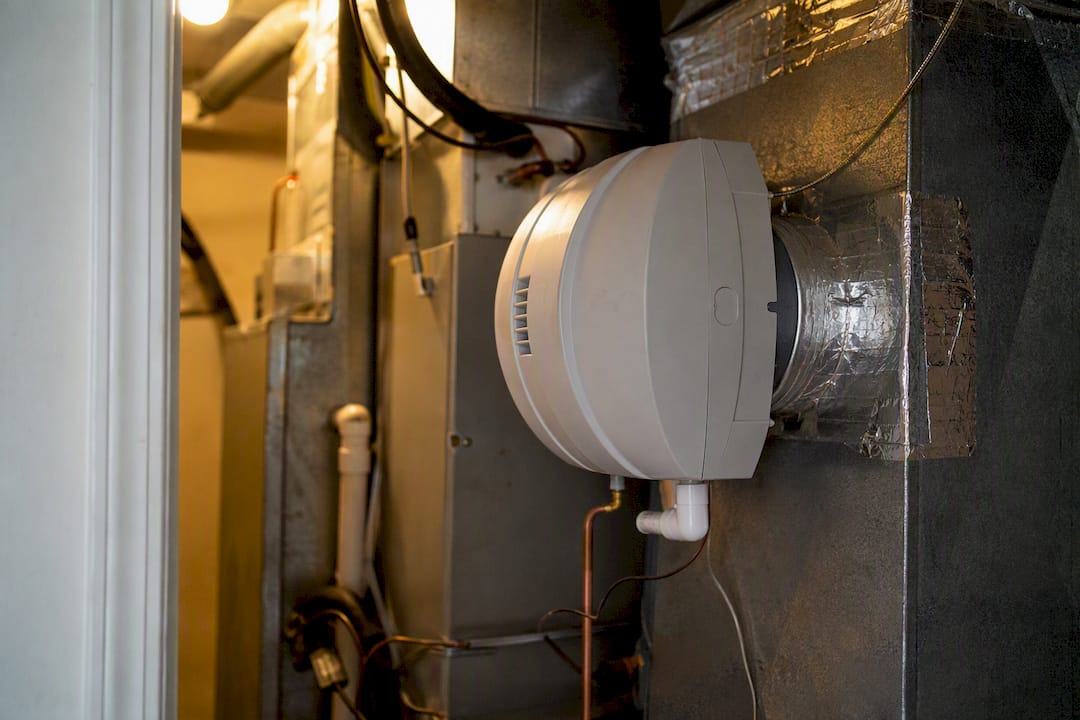
Pro tip: A dehumidifier without a hard-piped drain will eventually stop working when nobody’s around to empty the bucket. If you’re dealing with a basement or laundry room with a floor drain nearby, a hard-piped setup solves that reliability gap for good.
How Do You Choose the Right Humidifier or Dehumidifier?
Sizing depends on room size and how damp the space actually is. ENERGY STAR’s capacity guidelines break dehumidifiers into categories based on square footage and dampness level:
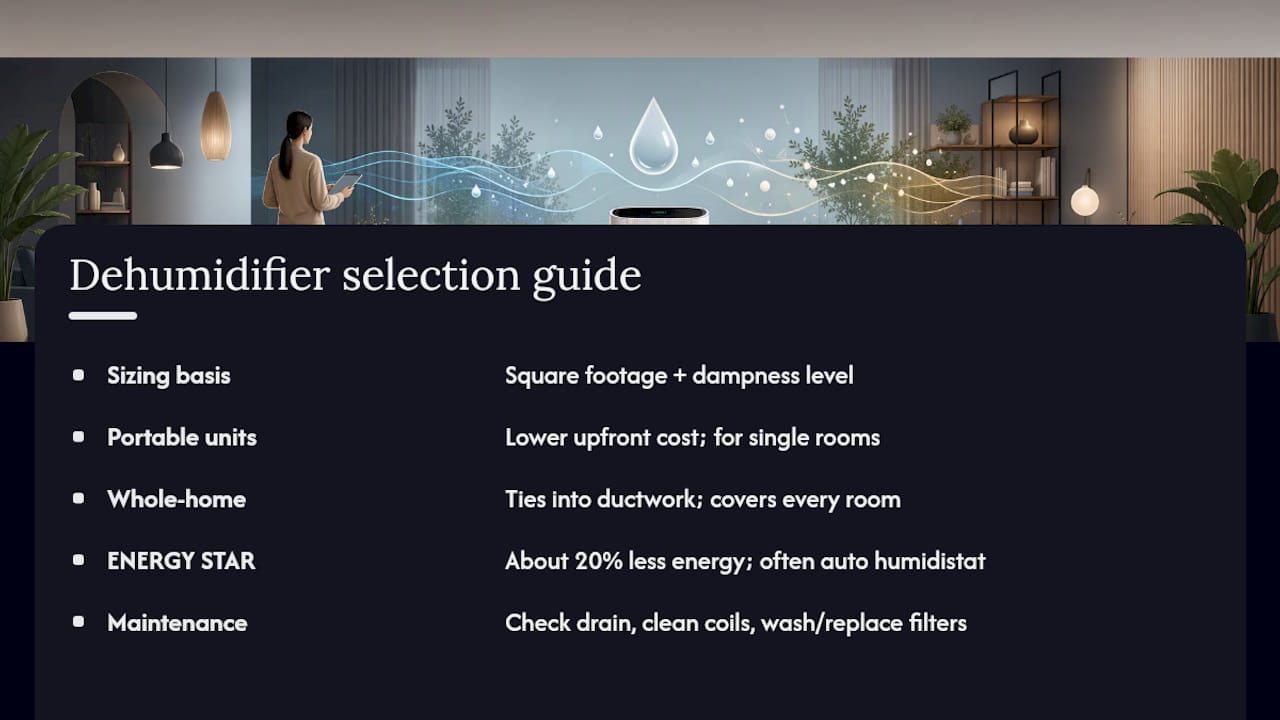
Portable units cost less upfront and work well for a single damp basement or laundry room, but you’re stuck emptying tanks and moving them between rooms. A whole-home system ties into your ductwork, covers every room automatically, and needs far less hands-on attention, though it costs more to install.
ENERGY STAR certified dehumidifiers use about 20% less energy than non-certified models and often include a built-in humidistat that shuts the unit off automatically once it hits your target. Check the drain line, clean the coils, and replace or wash filters on the manufacturer’s recommended schedule, whatever unit you choose.
When Should You Call an HVAC Professional?
Some humidity problems go beyond what a store-bought hygrometer and dehumidifier can fix.
- Whole-house RH staying above 55% to 60% no matter what you try.
- Recurring condensation or visible mold that keeps coming back after cleaning.
- Water intrusion, musty basement odors, or equipment that’s leaking or unusually loud.
- Humidity that spikes worse when your HVAC system runs, a sign of duct or sizing issues.
Before you call, jot down recent hygrometer readings, which rooms are affected, any visible damage, and whether your exhaust fans actually vent outside. Ask the technician about proper load sizing, ENERGY STAR whole-home options, expected costs, and what ongoing maintenance the system needs.
Why Do Experts Agree on the 30% to 50% Band?
Surface relative humidity at or above 70% is the point where mold, decay, and corrosion take hold, which is why whole-house guidance stays conservative even though that 70% threshold sounds far off from a 50% household reading.
That gap matters because corners, closets, and window frames often run several points more humid than your living room. Building Science’s ASHRAE-informed research recommends staying well under that surface threshold, while the lower bound near 30% protects against the dry-air symptoms Mayo Clinic and EPA both flag. The middle of that range is where comfort, indoor air quality, and home protection all overlap.
A Local HVAC Provider’s Take
We tell homeowners the same thing every time: measure first, control second, and fix the moisture source before you buy anything. Skipping proper sizing or installation on a humidifier or dehumidifier almost always causes bigger problems a year down the road.
Get a Professional Humidity Assessment for Your Home
Ask a technician for an on-site humidity assessment, an ENERGY STAR whole-home dehumidifier evaluation, and proper humidistat calibration if you’re adding a humidifier.

Kcaircontrol handles the two things that separate a lasting fix from a bucket you’ll forget to empty: accurate load sizing based on your home’s square footage and construction, and hard-piped drain or duct integration so the system runs without daily attention. A duct inspection often turns up the hidden leak or venting issue driving your readings in the first place. If your Kansas City area home has been stuck outside the ideal range, schedule an assessment online and get a straight answer on what your system actually needs.
Sources
- EPA — What are the main ways to control moisture in your home?
- Mayo Clinic — Humidifiers
- Consumer Reports — Why the right home humidity matters