
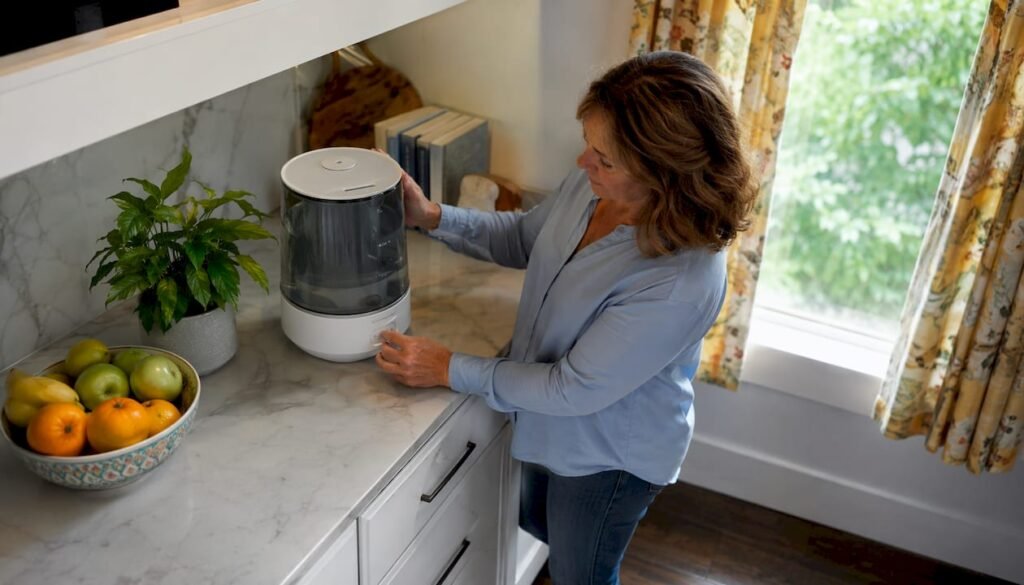
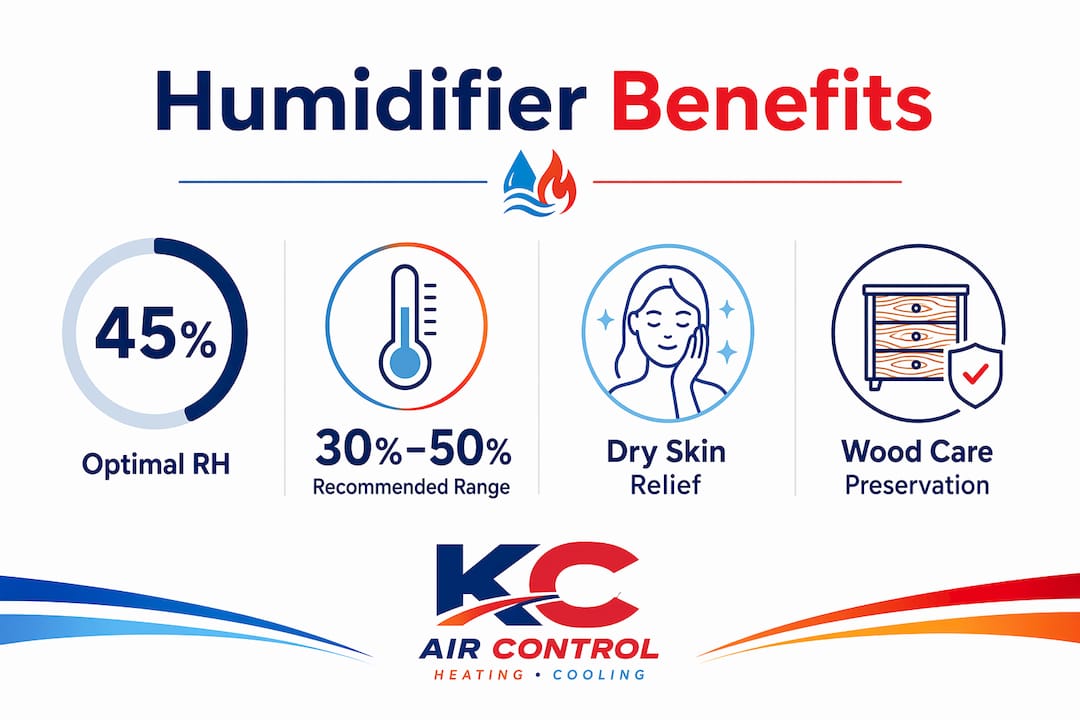
Humidifiers add controlled moisture to indoor air to relieve dry-air symptoms, protect wood floors and furnishings, and improve overall comfort. The EPA recommends keeping indoor relative humidity (RH) between 30%–50% for safe, effective operation. Staying below 50% matters: higher levels encourage mold growth and dust-mite activity. The benefits are real, but they depend entirely on correct sizing, consistent operation, and regular cleaning.
Table of Contents
- How humidifiers benefit your health and home
- What type of humidifier fits your home?
- What’s the right indoor humidity level, and how do you measure it?
- Risks you need to know before running a humidifier
- Cleaning and maintenance checklist to keep your humidifier safe
- When should you call an HVAC professional?
- Key Takeaways
- What HVAC experience tells us about humidity in the home
- Kcaircontrol helps Kansas City homeowners get humidity right
How humidifiers benefit your health and home
The role of humidifiers in homes covers two distinct areas: your body and your house itself. Both matter, and both respond quickly to changes in indoor moisture.
Health benefits you’ll notice:
- Relief from dry, irritated sinuses and scratchy throats
- Fewer nosebleeds caused by dry nasal passages
- Softer, less cracked skin and lips during winter months
- Easier mucus clearance when you have a cold or the flu, since humidified air helps loosen congestion
- Reduced snoring for some people, as moist airways vibrate less
Some research suggests that keeping humidity at or above 40% may reduce the infectiousness of certain viruses, though evidence on this remains mixed. Humidifiers are comfort tools, not medical treatments. Anyone managing a chronic respiratory condition should check with their clinician before relying on one.
Home and comfort benefits:
- Wood floors, furniture, and trim stay stable. Low humidity causes wood to shrink, split, and warp over time.
- Wallpaper and paint hold up better when moisture levels stay consistent.
- Static electricity drops noticeably in properly humidified rooms.
- A room at 40% RH feels warmer than the same room at 20% RH, which can reduce heating costs slightly during winter.
The 30%–50% RH target applies year-round. A baby’s nursery, a home with hardwood floors, or a house in a dry climate like the Southwest all benefit from staying within this range consistently.
Scenario examples: a nursery in a Kansas City winter (furnace-heated air drops to 15%–20% RH without help), a home office with a wood desk and bookshelves, or any room where you wake up with a dry throat every morning.
What type of humidifier fits your home?
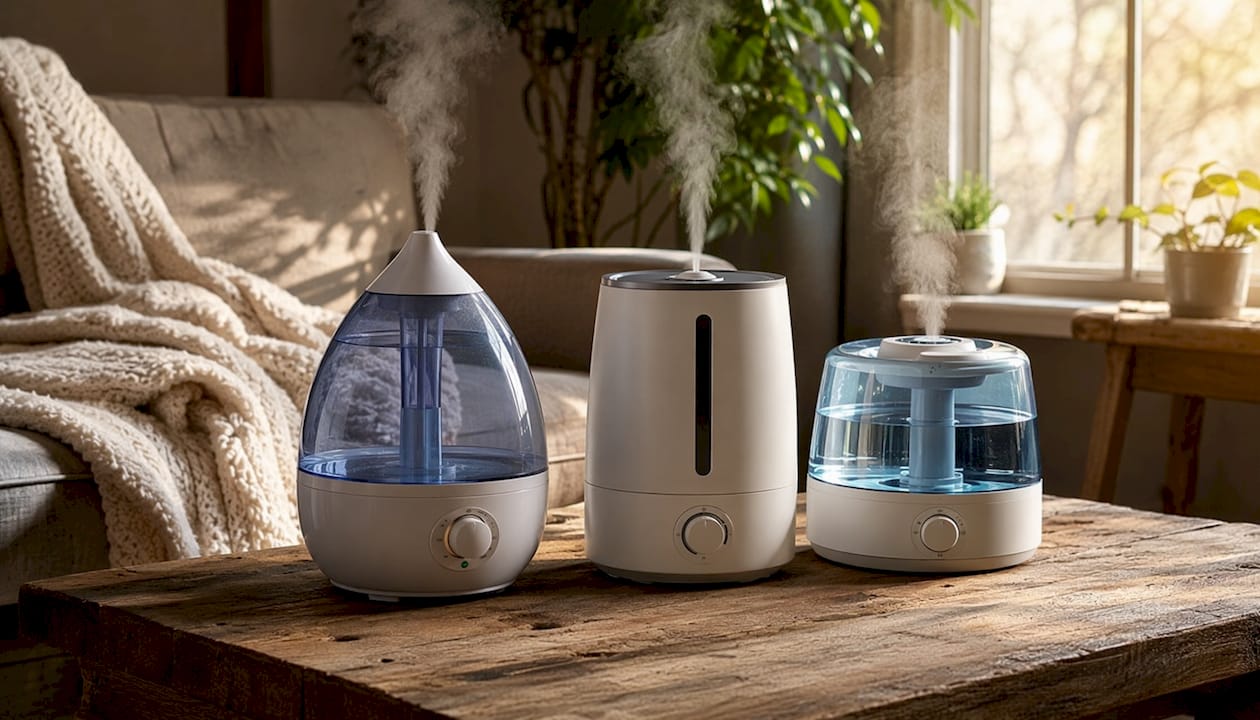
Choosing the right unit starts with understanding how each type works and where it falls short.
| Type | How it works | Best for | Key drawbacks |
|---|---|---|---|
| Ultrasonic (cool mist) | Vibrating plate breaks water into fine droplets | Quiet bedrooms, nurseries | White dust from tap water; needs distilled water |
| Evaporative (wick/filter) | Fan blows air through a wet wick or pad | Medium-sized rooms, allergy-sensitive homes | Filter replacements; fan noise |
| Warm mist / steam vaporizer | Boils water to release steam | Sinus relief, cold season | Hot surface — keep away from children and pets |
| Whole-house / furnace-mounted | Connects to HVAC system, humidifies entire home | Large homes, consistent whole-home control | Professional installation required; annual pad replacement |
A few practical notes on sizing: manufacturers’ square-footage claims for portable units are optimistic. Consumer Reports advises treating those numbers with skepticism, since real-world performance varies with ceiling height, air-change rate, and how drafty the space is. When in doubt, size up or consider a whole-house solution.
Warm-mist and steam models carry a burn risk. Place them on a high shelf or a stable surface well out of reach of children and pets, and never leave them running unattended in a child’s room.
What’s the right indoor humidity level, and how do you measure it?

The standard target is 30%–50% RH. Some sources cautiously allow up to 60%, but the EPA advises staying below 50% to prevent mold and dust-mite growth. That 50% ceiling is the number to keep in mind.
A hygrometer is the only reliable way to know where you actually stand. Inexpensive digital models (under $20 at most hardware stores) are accurate enough for home use. Place yours:
- In the center of the living space, not near a window or exterior wall
- Away from HVAC registers, which skew readings
- At breathing height, roughly 3–5 feet off the floor
| RH Level | What it means for health and home |
|---|---|
| Below 30% | Dry skin, irritated airways, static, wood shrinkage |
| 30%–50% | Recommended range: comfortable and safe |
| Above 50% | Mold and dust-mite risk rises; high risk of condensation, mold growth, and structural damage |
Quick troubleshooting: Condensation forming on windows is a clear sign humidity is too high. Lower the humidifier setting or move the unit to a smaller space. If your hygrometer consistently reads below 30% despite running a portable unit on high, the unit is undersized for the room, or you need a whole-house approach.
Risks you need to know before running a humidifier
The benefits of humidifiers in homes disappear fast if the unit isn’t maintained. A dirty humidifier doesn’t just stop helping — it actively harms air quality.
- Microbial growth: Standing water in the tank breeds mold and bacteria. When the unit runs, it disperses those organisms as aerosol. Breathing that mist has been linked to lung inflammation.
- White dust: Ultrasonic and impeller models used with tap water release mineral deposits into the air. That white dust settles on furniture and can irritate airways, especially for people with asthma.
- Excessive humidity: Running a humidifier too long or at too high a setting pushes RH above 50%, creating ideal conditions for mold and dust mites throughout the home.
- Mold and allergy concerns: People with mold allergies or certain asthma profiles should be especially careful. If symptoms worsen after starting a humidifier, stop use and consult a clinician.
Energy use is worth factoring in, too. Portable units run continuously in dry climates and add to your electricity bill. In arid regions, extended runtime makes water quality and scale management more critical, and fan-powered whole-house models tend to be more efficient over the long run.
Pro Tip: Use distilled or demineralized water in ultrasonic and impeller humidifiers. It eliminates white dust, reduces mineral scale inside the unit, and extends the life of the machine.
Pairing a humidifier with an air purifier is a smart combination for overall indoor air quality. The purifier handles particulates and allergens; the humidifier manages moisture. They don’t interfere with each other when both are properly maintained.
Cleaning and maintenance checklist to keep your humidifier safe
A humidifier that isn’t cleaned regularly becomes a health hazard. The EPA recommends emptying and refilling portable unit tanks daily and cleaning every three days during active use. Here’s a practical schedule:
- Daily: Empty the tank completely, rinse it with fresh water, and refill before each use. Never let water sit in the tank between uses.
- Every 3 days: Disinfect the tank and base with a diluted white vinegar solution or a 3% hydrogen peroxide solution. Rinse thoroughly before refilling.
- Weekly: Wipe down the exterior, check the wick or filter for discoloration or mineral buildup, and inspect the mist outlet for scale.
- Monthly: Descale internal components using undiluted white vinegar. Let it soak for 20–30 minutes, then scrub and rinse.
- Per manufacturer schedule: Replace wicks, pads, and filters on the timeline the manufacturer specifies. A clogged wick reduces output and traps bacteria.
- End of season: Drain completely, disinfect, dry all parts thoroughly, and store in a clean, dry location. Never store a unit with water remaining inside.
- Warm-mist models: Place on a stable, elevated surface away from children. Never leave running unattended in a room where a child sleeps. Unplug before cleaning.
- Water type: Use distilled or demineralized water whenever possible, particularly in ultrasonic units. In hard-water areas, a demineralization cartridge is a practical alternative.
- Documentation: Keep a simple log of cleaning dates and filter replacements. It takes 30 seconds and tells you immediately when maintenance is overdue.
When should you call an HVAC professional?
Portable units work well for single rooms, but there are clear signs that a whole-house solution makes more sense.
Consider a whole-house humidifier if:
- Your hygrometer reads below 30% RH in multiple rooms despite running portable units
- You’re replacing or refilling portable units constantly during winter
- You have hardwood floors, a large instrument collection, or antique furniture that’s showing stress from dry air
- You want automated humidity control integrated with your thermostat
- You live in a dry climate and need consistent output over long periods
Call an HVAC professional when:
- You notice condensation inside ductwork or on duct surfaces (a sign of humidity imbalance that can cause mold in the system)
- Visible mold appears near vents or on walls despite normal RH readings
- A furnace-mounted humidifier hasn’t had its water panel replaced in over a year
- You’re unsure whether your current HVAC system can support a whole-house humidifier
Whole-house, furnace-mounted systems provide steadier control for large homes and are a more reliable long-term solution than portable units. They do require professional installation and annual maintenance, specifically water panel and pad replacement. Skipping that annual service allows scale and biological growth to build up, which reverses the air-quality benefit entirely.
Pro Tip: A whole-house humidifier offers steadier, more consistent control across every room, but it needs annual professional service to stay effective. Portable units cost less upfront and are easier to move, but they demand more frequent hands-on maintenance from you.
For Kansas City homeowners dealing with dry winters and forced-air heating, a furnace-mounted system is often the most practical long-term answer. A professional assessment takes the guesswork out of sizing and placement.
Key Takeaways
Humidifiers improve health, comfort, and home durability when kept within the 30%–50% RH range and cleaned on a consistent schedule.
| Point | Details |
|---|---|
| Target RH range | Keep indoor humidity between 30%–50%; above 50% raises mold and dust-mite risk. |
| Clean every 3 days | Empty tanks daily and disinfect portable units every three days to prevent microbial growth. |
| Use distilled water | Distilled or demineralized water prevents white dust and extends unit life in ultrasonic models. |
| Know when to upgrade | Persistent low RH across multiple rooms signals the need for a whole-house humidifier. |
| Kcaircontrol can help | Kcaircontrol offers professional sizing, installation, and maintenance for whole-house humidity systems in the Kansas City area. |
What HVAC experience tells us about humidity in the home
Most homeowners either ignore indoor humidity entirely or overcorrect after one bad winter. Both approaches cause problems. The people who get the most out of a humidifier are the ones who treat it like any other home system: they measure first, size appropriately, and maintain it on a schedule.
The single most overlooked step is the hygrometer. You cannot manage what you don’t measure. A $15 digital hygrometer placed in your main living area tells you more about your home’s air quality than any symptom you might notice weeks later. Start there, before you buy anything else.
The second mistake is assuming a portable unit is “good enough” for a whole house. Manufacturers’ square-footage ratings are generous. A unit rated for 500 square feet may struggle in a 300-square-foot room with high ceilings and poor sealing. If you’ve been running a portable unit on maximum all winter and your RH still reads 22%, the unit isn’t failing — it’s just undersized for the job.
Whole-house systems solve that problem, but they introduce a new one: out of sight, out of mind. An unmaintained furnace-mounted humidifier with a calcified water panel does nothing useful and can introduce contaminants into your air supply. Annual service isn’t optional — it’s what makes the investment worthwhile.
Kcaircontrol helps Kansas City homeowners get humidity right
Getting the right humidity level in your home isn’t complicated, but it does require the right equipment, proper sizing, and consistent upkeep. Kcaircontrol brings over 70 years of HVAC experience to exactly this kind of work: sizing and installing whole-house humidifiers, integrating them with your existing furnace, and keeping them running efficiently year after year.

If your home runs dry every winter, your wood floors are showing stress, or you’ve been fighting portable units that can’t keep up, a professional assessment is the practical next step. Kcaircontrol serves homeowners throughout the Kansas City area with indoor air quality solutions that include humidity control, duct cleaning, and full HVAC maintenance. Flexible financing options are available for new system installations. Schedule your assessment at kcaircontrol.com and get a clear answer on what your home actually needs.
Useful sources and further reading
- Use and Care of Home Humidifiers — U.S. EPA: Cleaning schedules, water type guidance, and safe RH targets
- Humidifiers: Ease skin, breathing symptoms — Mayo Clinic: Health benefits and clinical cautions
- Why the right home humidity matters — Consumer Reports: Sizing guidance and home-protection context
- Humidifiers and health — MedlinePlus Medical Encyclopedia: Plain-language overview of humidifier health effects
- The Best Humidifiers — Wirecutter: Portable and whole-house product comparisons
- Your device’s owner manual: Always follow the manufacturer’s specific cleaning and maintenance schedule for your model
- Kcaircontrol: Contact us for an in-home assessment when whole-house humidification is under consideration
This article provides general information about indoor humidity and humidifier use. It is not medical advice. Consult a qualified clinician for guidance specific to your health situation, and verify current product and installation requirements with a licensed HVAC professional.