

TL;DR:
- SEER measures home cooling efficiency over a season based on energy output and consumption.
- Installing a properly rated SEER2 system with professional sizing and duct sealing maximizes energy savings and performance.
The seasonal energy efficiency ratio (SEER) measures how efficiently a central air conditioner or heat pump cools your home over an entire season. It’s calculated by dividing total seasonal cooling output (in British thermal units, or Btu) by total seasonal electrical input (in watt-hours). The higher the number, the less electricity the system uses to deliver the same cooling. Since January 1, 2023, the U.S. Department of Energy has required new equipment to be rated under the updated SEER2 standard, so that’s the number you’ll see on labels today.
Table of Contents
- What is the seasonal energy efficiency ratio and how is it calculated?
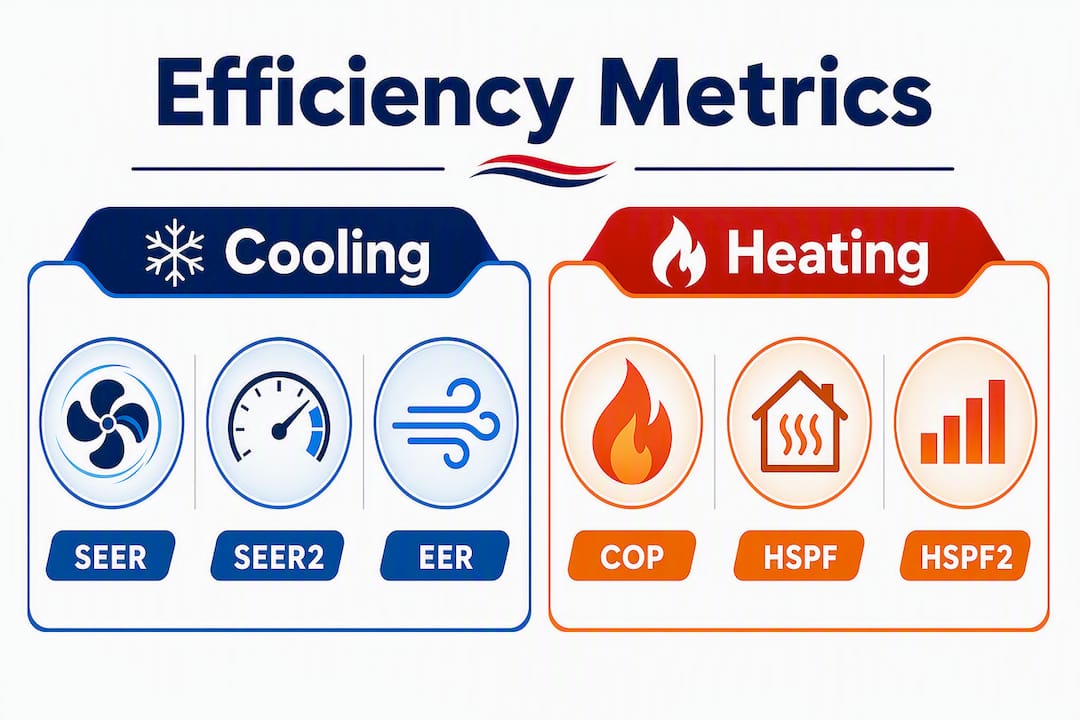
- How do SEER, SEER2, EER, and COP compare?
- What are the U.S. DOE minimum efficiency standards and when did SEER2 take effect?
- How do you estimate operating cost and payback from SEER ratings?
- How does SEER2 apply to heat pumps, and what is HSPF2?
- What SEER doesn’t tell you: common misconceptions
- What questions should you ask when shopping for a new AC or heat pump?
- What SEER2 range makes sense for your climate?
- Key Takeaways
- The SEER2 number is only half the story
- Ready to find the right SEER2 system for your Kansas City home?
- Useful sources and further reading
What is the seasonal energy efficiency ratio and how is it calculated?
SEER is defined by the Air-Conditioning, Heating, and Refrigeration Institute (AHRI) as:
SEER = Total seasonal cooling output (Btu) ÷ Total seasonal electrical input (watt-hours)
A “season” in testing covers a range of outdoor temperatures from 65°F to 104°F, weighted across multiple operating conditions. This makes SEER a realistic seasonal average rather than a single-point snapshot.
Breaking down the units:
- Btu (British thermal unit): the standard measure of heat energy; one Btu is roughly the heat from a single match
- Watt-hour: electrical energy consumed; 1,000 watt-hours = 1 kilowatt-hour (kWh)
- kWh: what your utility bill charges you for
Worked example:
Suppose your 3-ton AC delivers 36,000,000 Btu of cooling over a season and consumes 2,400,000 watt-hours of electricity.
SEER = 36,000,000 ÷ 2,400,000 = 15 SEER
To estimate operating cost, convert watt-hours to kWh: 2,400,000 ÷ 1,000 = 2,400 kWh. At a national average of roughly $0.16 per kWh, that season costs about $384. A 20 SEER unit delivering the same cooling would use only 1,800 kWh, cutting the bill to roughly $288 — a $96 seasonal difference.
Modern residential systems typically range from 13 SEER to 24 SEER, so there’s meaningful room to save depending on what you’re replacing.
How do SEER, SEER2, EER, and COP compare?
These four metrics measure efficiency in different ways, and mixing them up leads to bad purchasing decisions.
- SEER (legacy): seasonal average across 65°F–104°F outdoor temperatures; the standard before 2023
- SEER2: same seasonal concept, but tested under the updated AHRI M1 procedure, which increases external static pressure to better simulate real ductwork resistance; SEER2 ratings often look lower than legacy SEER on the same equipment because the test is harder, not because the unit is less efficient
- EER / EER2: efficiency at a single peak-condition point, typically 95°F outdoors; useful for sizing and worst-case performance checks, but not a season-long billing estimate
- COP (coefficient of performance): a unit-less ratio used mainly for heat pumps and heating performance; a COP of 3.0 means the system delivers 3 units of heat energy per unit of electricity consumed
SEER2 averages performance across many outdoor temperatures, while EER measures a single point at 95°F. Think of SEER2 like a car’s combined fuel-economy rating across city and highway driving, while EER is the highway-only number. Both have their place: use SEER2 for annual bill estimates and EER2 when checking peak-load performance.
The key conversion to remember: a typical EER is roughly 0.875 × SEER for the same equipment, so SEER is always the higher number. Never compare a SEER2 rating directly to an older SEER rating without accounting for the testing difference.

What are the U.S. DOE minimum efficiency standards and when did SEER2 take effect?
The DOE has raised minimum efficiency floors several times over the past two decades. The 2023 update was the most significant change in methodology, not just the minimum number.
| Effective Date | Standard | Minimum (South/Southwest) | Minimum (North) | Notes |
|---|---|---|---|---|
| — | SEER | 13 SEER | 13 SEER | First federal minimum |
| — | SEER | 14 SEER | 13 SEER | Regional split introduced |
| January 1, 2023 | SEER2 | 15.2 SEER2 | 14.3 SEER2 | M1 test procedure; new labeling |
The 2023 shift matters: DOE mandated the SEER2 metric using M1 test procedures that increase external static pressure by a factor of five compared to the legacy test. Any equipment manufactured after January 1, 2023 carries a SEER2 rating, not a legacy SEER rating.
ENERGY STAR sets its own certification thresholds above the DOE minimums. For central air conditioners, ENERGY STAR currently requires at least 15.2 SEER2 in the South and 14.5 SEER2 in the North. Checking the ENERGY STAR qualified product list or the AHRI certified product directory gives you verified, matched-system performance data rather than relying on a nameplate alone.
How do you estimate operating cost and payback from SEER ratings?
The formula is straightforward once you have the SEER2 rating and your local electricity rate.
Annual energy cost formula:
Annual kWh = (Seasonal Btu load ÷ SEER2) ÷ 1,000
Annual cost = Annual kWh × electricity rate ($/kWh)
Side-by-side comparison:
| Scenario | SEER2 Rating | Annual kWh (36M Btu load) | Annual Cost at $0.16/kWh |
|---|---|---|---|
| Older unit | 10 SEER | 3,600 kWh | $576 |
| New standard unit | 15 SEER2 | 2,400 kWh | $384 |
| High-efficiency unit | 20 SEER2 | 1,800 kWh | $288 |
Upgrading from a 10 SEER unit to a 15 SEER2 unit saves roughly $192 per year in this example. If the higher-efficiency system costs $1,500 more upfront, simple payback is about 8 years. A 13 SEER unit uses about 23% less energy than a 10 SEER unit, which gives you a useful benchmark for scaling those savings estimates.
- Get your seasonal Btu load from a Manual J calculation, not a rule-of-thumb tonnage estimate.
- Divide by the SEER2 rating of the unit you’re evaluating, then divide by 1,000 to get kWh.
- Multiply by your actual electricity rate from your utility bill (not a national average).
- Compare annual costs between your current unit and the proposed replacement.
- Divide the price premium of the higher-efficiency unit by the annual savings to get simple payback years.
Real-world factors that change these estimates: duct leakage can waste 20–30% of conditioned air before it reaches living spaces, improper sizing causes short-cycling that inflates energy use, and thermostat setpoints shift consumption significantly. Installation quality, proper sizing, and ductwork integrity have large impacts on realized seasonal efficiency, often more than a two-point SEER2 difference.
Pro Tip: Ask your installer to run a Manual J load calculation and share the manufacturer’s seasonal performance table for the specific matched system. AHRI-certified matched-system data gives you a far more accurate payback estimate than the nameplate SEER2 alone.
How does SEER2 apply to heat pumps, and what is HSPF2?
Air-source heat pumps carry two efficiency ratings because they do two jobs.
Cooling season: rated by SEER2, exactly as described above. A heat pump’s SEER2 is directly comparable to a central AC’s SEER2.
Heating season: rated by the Heating Seasonal Performance Factor (HSPF or HSPF2). HSPF is calculated as total seasonal heating output (Btu) divided by total seasonal electrical input (watt-hours), measured across a range of winter outdoor temperatures. HSPF2 uses the same updated M1 testing conditions as SEER2, so the numbers shifted downward in the same way when the standard changed in 2023.
A typical heat-pump label today shows both: for example, 15 SEER2 / 8.5 HSPF2. The SEER2 tells you cooling efficiency; the HSPF2 tells you heating efficiency. COP appears less often on residential labels but is sometimes listed in manufacturer spec sheets as a point-in-time heating efficiency figure at a specific outdoor temperature (commonly 47°F or 17°F).
When comparing heat pumps, check both numbers. A unit with a strong SEER2 but a weak HSPF2 may cost more to run in a climate like Kansas City’s, where heating loads are substantial from November through March.
What SEER doesn’t tell you: common misconceptions
SEER is a useful benchmark, but it has real limits that homeowners often overlook.
- It’s a lab number, not a home guarantee. SEER is derived from standardized test conditions. Your actual seasonal efficiency depends on your duct system, home insulation, local climate, and how the unit was installed.
- “Up to” claims are marketing, not promises. A manufacturer saying a unit achieves “up to 20 SEER2” means it hit that number under optimal lab conditions. Installed in a home with leaky ducts and an oversized load calculation, it may perform significantly lower.
- SEER2 numbers look lower than legacy SEER. The SEER2 transition caused confusion because a new 15 SEER2 unit might have been rated 16 SEER under the old test. That doesn’t mean it’s less efficient. The test changed; the equipment didn’t get worse.
- Higher SEER doesn’t fix a bad installation. A 20 SEER2 variable-speed system installed with leaky ducts and no load calculation will underperform a properly installed 16 SEER2 unit. High-SEER variable-speed systems also require more specialized maintenance and trained technicians to keep them near rated efficiency.
- SEER and EER aren’t interchangeable. Using EER where SEER is expected (or vice versa) produces a misleading comparison. Always confirm which metric a quote or spec sheet is using.
What questions should you ask when shopping for a new AC or heat pump?
Bring this checklist to every estimate. It separates knowledgeable installers from those cutting corners.
- Ask for SEER2, EER2, and HSPF2 values on every unit being quoted, not legacy SEER numbers.
- Request the AHRI certificate number for the specific matched system (outdoor unit + indoor coil + air handler). Matched-system ratings can differ from component ratings.
- Ask for a Manual J load calculation report. Any installer who skips this is guessing at sizing.
- Request a duct assessment. Duct leakage is one of the biggest efficiency killers in real homes; a good installer will measure it.
- Verify ENERGY STAR certification on the ENERGY STAR qualified product list at energystar.gov.
- Check the AHRI product directory at ahrinet.org to confirm the matched-system SEER2 rating before signing.
Red flags in a quote: no mention of Manual J, no duct inspection, SEER ratings listed without specifying SEER2 vs. legacy SEER, or seasonal-performance claims with no AHRI reference number. These are signs the estimate is based on guesswork rather than engineering.
What SEER2 range makes sense for your climate?
The right SEER2 target depends on how many cooling hours your home accumulates each year and what the upfront premium buys you in annual savings.

Cooler climates (14–16 SEER2): Homes in the northern U.S. with short cooling seasons see modest annual savings from very high SEER2 ratings. The payback period on a 20+ SEER2 premium can stretch well beyond 10 years, making a mid-range unit the financially sound choice.
Mixed climates (16–18 SEER2): For many homes, 16–18 SEER2 balances cost and efficiency well. Kansas City sits squarely in this zone. Summers here are hot and humid, with cooling seasons running May through September, but winters are cold enough that heating costs matter too. A 16–18 SEER2 system paired with a strong HSPF2 heat pump often delivers the best overall annual savings.
Hot climates (18–22+ SEER2): In Texas, Florida, and the Southwest, cooling runs nearly year-round. The annual savings from a 20+ SEER2 variable-speed system are large enough that payback periods shorten considerably, and the comfort benefits of variable-speed operation (better humidity control, quieter operation) add real value.
For Kansas City homeowners specifically: a 16 SEER2 system is the practical minimum for a new installation today. Moving to 18 SEER2 adds a modest upfront cost but reduces cooling bills meaningfully over a 15-year equipment life. Going above 20 SEER2 makes sense if you run the AC heavily or plan to stay in the home long-term. In every case, energy efficient HVAC savings depend as much on proper installation and duct sealing as on the rating itself.
Key Takeaways
SEER2 is the current U.S. efficiency metric for central air conditioners and heat pumps, replacing legacy SEER in 2023 under DOE’s updated M1 testing standard, and installation quality determines whether a system actually delivers its rated efficiency.
| Point | Details |
|---|---|
| SEER2 is the current standard | DOE mandated SEER2 ratings using M1 test procedures starting January 1, 2023. |
| Lower SEER2 ≠ worse efficiency | SEER2 numbers look lower than legacy SEER because the test is harder, not because equipment regressed. |
| Installation drives real-world results | Manual J sizing, duct sealing, and quality installation often matter more than a two-point SEER2 difference. |
| Climate shapes the right SEER2 target | Mixed climates like Kansas City typically benefit most from 16–18 SEER2; hot climates from 18–22+ SEER2. |
| Kcaircontrol for local guidance | Kcaircontrol serves Kansas City homeowners with load calculations, SEER2 comparisons, and professional installation. |
The SEER2 number is only half the story
Most homeowners focus on the SEER2 rating when comparing quotes, and that’s understandable. It’s the number on the label, it’s easy to compare, and manufacturers promote it prominently. But after years of working with Kansas City homeowners on system replacements and efficiency upgrades, the pattern is clear: the rating on the box matters less than what happens during installation.
A 20 SEER2 system installed without a Manual J calculation, in a home with leaky ducts and an undersized return, will not deliver 20 SEER2 performance. Meanwhile, a properly installed 16 SEER2 system in a well-sealed duct system often outperforms the higher-rated unit in real-world billing. The SEER2 rating sets the ceiling. Installation quality determines how close you get to it.
The other thing worth saying plainly: the SEER2 transition confused a lot of people, and some contractors took advantage of that confusion. If a salesperson is quoting you legacy SEER numbers on new equipment or can’t produce an AHRI certificate number for the matched system, that’s a problem. Ask for SEER2, ask for the AHRI reference, and ask for Manual J. Those three requests will tell you everything you need to know about whether an installer is doing the job right.
Ready to find the right SEER2 system for your Kansas City home?
Understanding SEER2 is the first step. Getting the right system installed correctly is what actually lowers your energy bills.

Kcaircontrol has served Kansas City homeowners for over 70 years, and we know that the difference between a good installation and a great one shows up on your utility bill every month. Whether you need a SEER2 comparison for a new system, a professional AC tune-up to restore your current unit’s efficiency, or a full AC repair assessment to diagnose a performance drop, we’re ready to help. We run Manual J calculations, assess duct conditions, and match you with AHRI-certified equipment that fits your home and budget. Contact Kcaircontrol today to schedule your efficiency assessment or request a free quote.
Useful sources and further reading
These primary and authoritative sources are the best places to verify dates, test procedures, and certified product data:
- U.S. Department of Energy (DOE) — official SEER2 mandate, effective dates, and energy conservation standards for central air conditioners and heat pumps
- Federal Register — DOE SEER2 Final Rule — the full regulatory text for the M1 test procedure update
- AHRI — Seasonal Energy Efficiency Ratio — AHRI’s definition of SEER, SEER2, and the AHRI 210/240 standard; includes the certified product directory for matched-system lookups
- ENERGY STAR — ENERGY STAR certification thresholds for central air conditioners and heat pumps; searchable qualified product list
- Wikipedia — Seasonal energy efficiency ratio — technical overview of SEER, EER, COP, and the AHRI 210/240 standard with formula derivations
- Oklahoma State University Extension — Understanding Energy Efficiency Measures — plain-language explanation of SEER savings percentages for homeowners
- NY Engineers — Updated efficiency ratings (SEER2, EER2, HSPF2) — technical detail on the M1 procedure and how static pressure changes affect ratings