

TL;DR:
- HVAC financing allows homeowners to pay for heating and cooling upgrades over time through various loan options. Proper preparation, including checking credit scores and gathering necessary documents, streamlines the application process. Choosing the right loan depends on credit, home equity, speed needs, and project size, with careful review of contract terms essential for avoiding costly mistakes.
HVAC financing is a structured loan or payment plan that lets homeowners spread the cost of heating and cooling repairs or installations over time instead of paying upfront. This step-by-step HVAC loan guide covers every stage of the process, from checking your credit score to signing the final contract. The most common options include contractor financing through programs like GreenSky, manufacturer promotional plans, home equity lines of credit (HELOC), personal loans, utility on-bill financing, and PACE (Property Assessed Clean Energy) loans. Homeowners typically choose from these seven paths based on credit profile, home equity, and how fast they need the money. Knowing which path fits your situation before you apply saves time, protects your credit, and prevents costly contract surprises.
What you need before starting the HVAC financing process
Preparation is the single biggest factor in a smooth HVAC loan application. Lenders and contractors evaluate three things above all else: your credit score, your home equity, and your documented income.
Credit score benchmarks that matter
Your credit score directly controls which loan products you can access and at what interest rate. Most personal loan lenders require a minimum score of 620, while HELOC lenders typically want 680 or higher. Contractor financing programs like GreenSky often approve scores in the 600s, but at higher interest rates. The best financing choice depends on your creditworthiness, the loan amount, and your available home equity. Pull your free credit report from AnnualCreditReport.com before you apply so there are no surprises.
Home equity and its role in loan options
Home equity unlocks lower interest rates through a HELOC or a home equity loan. If you owe $150,000 on a home worth $250,000, you have $100,000 in equity to potentially borrow against. A home equity loan for HVAC typically carries a lower rate than an unsecured personal loan because the home secures the debt. The trade-off is time. HELOCs can take 30–45 days to fund, which is too slow for an emergency repair.
Documents to gather before applying
| Document | Why It’s Needed |
|---|---|
| Recent pay stubs or tax returns | Proves income to the lender |
| Contractor written estimate | Confirms exact project cost |
| Mortgage statement | Shows current home equity position |
| Government-issued ID | Standard identity verification |
| Utility bills (for on-bill financing) | Confirms account eligibility |
Pro Tip: Get at least two written estimates from licensed contractors before applying. Lenders want a specific dollar amount, and a second quote gives you negotiating power on the project cost itself.
How to choose the right HVAC financing option
Choosing the right loan type comes down to four variables: your credit score, how much equity you have, how fast you need the money, and the total project cost. Each financing type performs differently across those four factors.
Comparing the main financing types
| Financing Type | Best For | Typical Speed | Key Risk |
|---|---|---|---|
| Contractor financing (GreenSky) | Fair credit, fast approval | 1–3 days | Deferred-interest traps |
| Manufacturer promo (0% for 18 months) | Good credit, new systems | 1–3 days | Retroactive interest if unpaid |
| HELOC / Home equity loan | Large projects, good equity | 30–45 days | Home as collateral |
| Personal loan | No equity, fast need | 1–5 days | Higher interest rates |
| Utility on-bill financing | Energy-efficient upgrades | 1–2 weeks | Limited to utility customers |
| PACE financing | No credit score required | 1–2 weeks | Tied to property tax bill |
The most important distinction in this table is between true 0% APR and deferred-interest promotions. Deferred-interest HVAC promotions require you to pay the full balance before the promotional period ends. If you carry even one dollar past the deadline, the lender charges retroactive interest on the original balance at the full APR, which is often 26–29%. That is not a 0% loan. It is a delayed penalty.
Utility on-bill financing is one of the most overlooked options. Programs like GVEA’s REDUCE program offer low-interest loans for energy-efficient equipment, repaid directly through your monthly utility bill. You need to confirm loan amounts, qualifying equipment, and documentation requirements with your specific utility provider.
Pro Tip: Before signing any contractor financing agreement, ask the lender directly: “Is this true 0% APR or deferred interest?” The answer changes your entire payoff strategy.
For a deeper look at HVAC financing options for KC homes, Kcaircontrol has put together a local-focused breakdown worth reviewing before you commit to a path.
Step-by-step HVAC loan application walkthrough
The HVAC financing process follows a predictable sequence. Skipping steps creates delays, denials, and contract regrets.
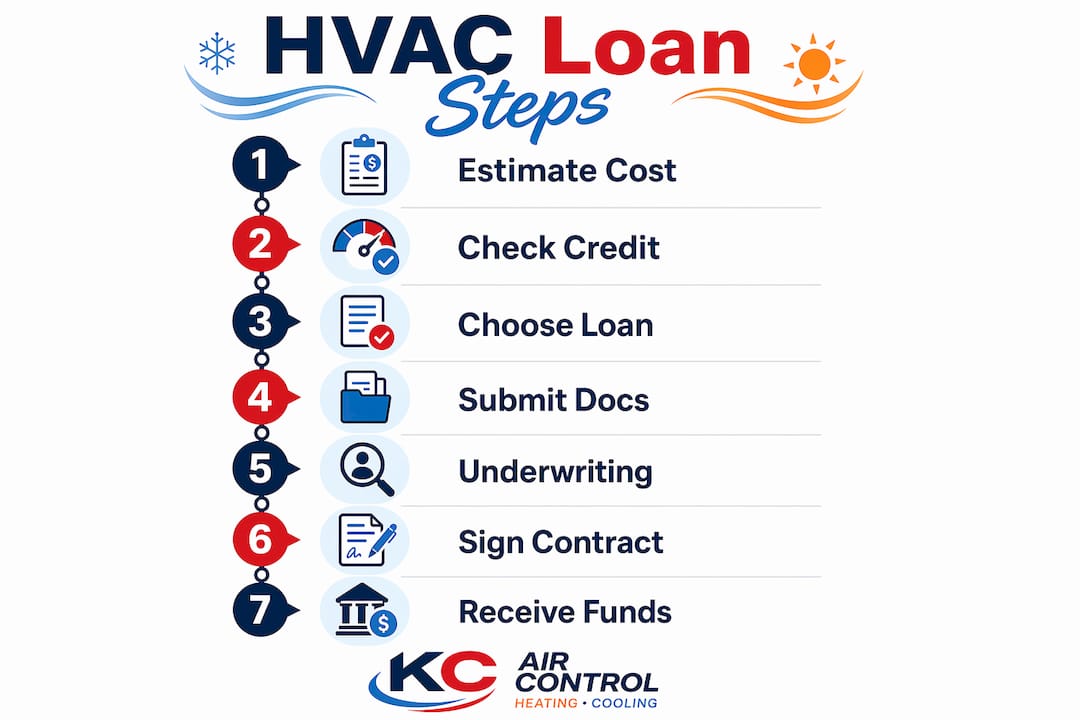
Step 1: Calculate your total project cost.
Get written estimates from at least two licensed HVAC contractors. Include equipment, labor, permits, and any disposal fees. This number is your loan target.

Step 2: Check your credit without hurting your score.
Use a soft-pull pre-qualification tool from lenders like SoFi, LightStream, or your contractor’s financing partner. Soft pulls do not affect your credit score. This step tells you which loan products you realistically qualify for before you formally apply.
Step 3: Match the loan type to your situation.
Use the comparison table above. If you have strong equity and time, a HELOC offers the lowest rate. If you need the system running within a week, contractor financing or a personal loan is faster. Shopping competitive rates and comparing timelines is the key step most homeowners skip.
Step 4: Gather your documents and submit the application.
Collect pay stubs, tax returns, the contractor estimate, and your mortgage statement. Submit the formal application through the lender’s portal or with your contractor’s financing representative.
Step 5: Understand the underwriting process.
Personal loans and contractor financing typically use a credit-score-based review completed in hours. PACE financing now requires significantly more documentation. Starting March 1, 2026, PACE loans must meet ability-to-repay rules under CFPB amendments to TILA. Lenders must verify income, existing payment obligations, and simultaneous loans. Expect a process closer to a mortgage review than a simple credit check.
Step 6: Read the loan contract carefully before signing.
Confirm the APR, the promotional period end date, the payoff amount, and whether interest is deferred or waived. Deferred-interest plans require confirmed receipt of full payoff before the promo ends. A scheduled payment is not enough. The lender must receive and post the funds before the deadline.
Step 7: Receive funds and schedule installation.
Once approved, coordinate the installation date with your contractor. If your equipment qualifies for any remaining state or local rebates, confirm the installation date meets program requirements. The federal heat pump tax credit under IRC Section 25C expired after December 31, 2025, so installations in 2026 generally do not qualify for that federal credit. Check current rebate programs to see what is still available.
Common mistakes that derail HVAC financing
Most financing problems are preventable. The same errors show up repeatedly, and knowing them in advance puts you ahead.
- Misreading deferred-interest promotions. Many homeowners assume “no interest for 18 months” means interest is waived. It is not. Only confirmed full payoff before the deadline avoids retroactive charges.
- Ignoring PACE underwriting requirements. PACE financing now requires expanded repayment ability proofs beyond credit scores, including escrow payments and concurrent loan obligations. Applying without this documentation causes delays.
- Rushing the contract review. Signing the same day you receive the contract is a common mistake. Take 24 hours to read every line, especially the APR, the promotional end date, and the penalty clauses.
- Missing tax credit and rebate deadlines. Financing and installation timing must align with program eligibility windows. A one-week delay in scheduling can cost you hundreds in available rebates.
- Failing to document payments. For deferred-interest plans, save every payment confirmation. Calendar discipline and receipts confirming full payoff before the promo end date are your only protection against retroactive interest.
If your application is denied, ask the lender for the specific reason in writing. A denial based on debt-to-income ratio has a different fix than one based on credit score. Knowing the exact cause tells you whether to pay down debt, dispute a credit error, or simply apply through a different lender with looser requirements.
Pro Tip: Set a calendar reminder 60 days before any promotional period ends. That gives you time to make a final lump-sum payment and confirm the lender has posted it before the deadline.
Key takeaways
Securing HVAC financing requires matching your credit profile and home equity to the right loan type before you apply, then reading every contract term before you sign.
| Point | Details |
|---|---|
| Credit score drives options | Scores below 620 limit you to contractor financing; 680+ unlocks HELOC rates. |
| Deferred interest is not 0% APR | Full balance must be confirmed received by the lender before the promo deadline. |
| PACE rules changed in 2026 | Expect mortgage-level documentation for PACE loans under new CFPB ability-to-repay rules. |
| Tax credit window has closed | The federal 25C heat pump credit expired December 31, 2025; check state and utility rebates instead. |
| Preparation shortens approval time | Two contractor estimates, income docs, and a soft-pull pre-qualification speed up every loan type. |
What i’ve learned after watching homeowners finance HVAC systems
The single most expensive mistake I see is homeowners treating a deferred-interest promotion like a true 0% loan. They make minimum payments for 17 months, assume they are fine, and then get hit with retroactive interest on the original balance in month 18. That charge can add hundreds of dollars to a project that was supposed to be interest-free. The fix is simple: pay the balance off in month 15, not month 18, and call the lender to confirm the payoff posted.
The second pattern I see is homeowners applying for the first financing option their contractor offers without checking alternatives. Contractor financing is convenient, but it is rarely the cheapest. If you have a 700+ credit score and two weeks before you need the system running, a personal loan from SoFi or LightStream will almost always carry a lower APR than point-of-sale contractor financing.
My honest recommendation: start the financing research before your system fails. Emergency decisions made in July heat or January cold are almost always more expensive than decisions made with time to compare. Know your credit score, know your equity, and have a preferred lender in mind before you ever call a contractor for an estimate. That preparation turns a stressful situation into a straightforward transaction.
— AB
How Kcaircontrol helps kansas city homeowners finance HVAC services
Kcaircontrol has served Kansas City homeowners for over 70 years, and financing is a core part of how we make reliable HVAC service accessible. We work with homeowners at every credit level to find a payment plan that fits the project and the budget.

Whether you need an emergency repair or a full system replacement, our team walks you through available financing options before any work begins. We believe you should understand exactly what you are paying and when before you sign anything. If your system needs attention now, explore our emergency HVAC repair options or contact us directly to schedule a financing consultation. We make the process clear, honest, and as comfortable as the home we are helping you heat or cool.
FAQ
What credit score do i need for HVAC financing?
Most contractor financing programs approve scores starting at 600, while HELOC lenders typically require 680 or higher. A higher score gives you access to lower interest rates and more loan types.
What is the difference between deferred interest and 0% APR?
True 0% APR means no interest accrues during the promotional period. Deferred interest means interest accrues but is waived only if you pay the full balance before the deadline. Missing that deadline triggers retroactive charges on the original loan amount.
How do PACE loans work for HVAC financing?
PACE loans are repaid through your property tax bill rather than a monthly lender payment. Starting March 1, 2026, PACE lenders must verify your ability to repay under new CFPB rules, so expect a documentation process similar to a mortgage application.
Can i still get a federal tax credit for a new heat pump in 2026?
No. The federal heat pump tax credit under IRC Section 25C expired after December 31, 2025. Installations completed in 2026 do not qualify. Check your state energy office and local utility for available rebate programs.
How long does HVAC loan approval take?
Contractor financing and personal loans typically approve within 1–3 business days. HELOC applications take 30–45 days. PACE financing under the new 2026 rules may take 1–2 weeks depending on documentation review.
Recommended
- Home Equity Loan for HVAC: What Homeowners Need to Know – KC Air Control Heating & Cooling – Expert HVAC Services – Kansas City, MO
- How to Apply for HVAC Financing: Kansas City Guide – KC Air Control – Heating & Cooling
- How HVAC financing works: smart options for KC homes – KC Air Control – Heating & Cooling
- How to Install HVAC System for Home Comfort – Air Control