
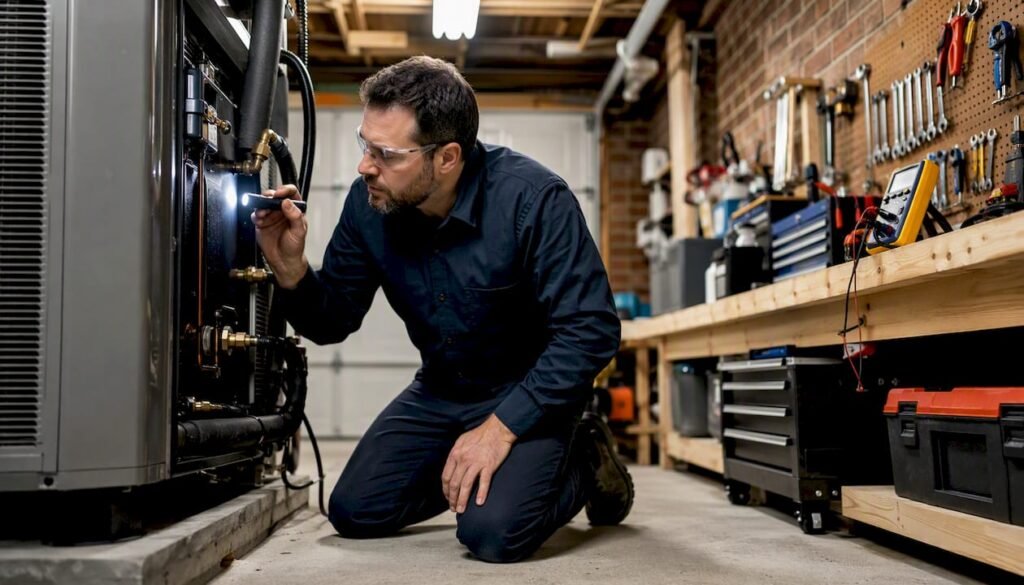
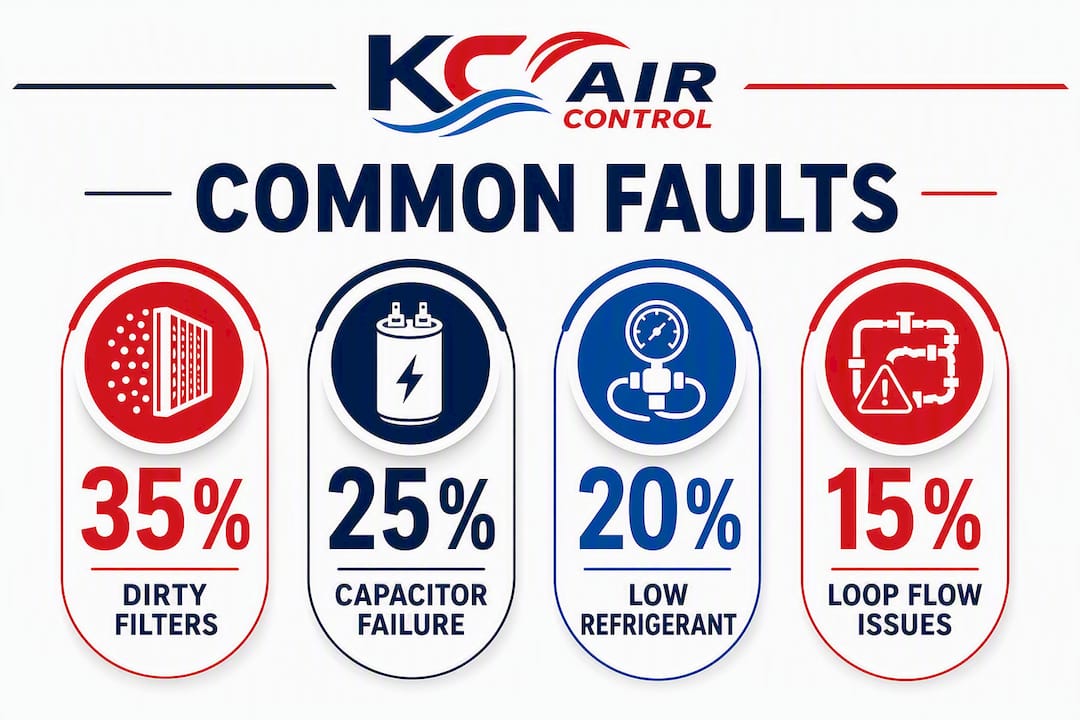
Most problems with geothermal systems trace back to a handful of causes: a clogged air filter, a failed capacitor or contactor, low refrigerant, or loop-side issues like low antifreeze concentration or mineral scaling. Before you call anyone, run these three checks right now:
- Check your breaker and thermostat. Reset any tripped breaker and confirm the thermostat is set at least 3°F above room temperature.
- Inspect your air filter. A clogged filter is the single most common reason a ground-source heat pump loses capacity.
- Look at your system display for FP1 or FP2 fault codes. FP1 triggers when entering water temperature drops below 30°F; FP2 is a hard lockout below 25°F and requires immediate professional diagnosis.
Stop and call a pro if you see: ice forming on refrigerant lines, or water pooling near the flow center. Both signal conditions that can cause compressor damage if the system keeps running.
IGSHPA-certified technicians are specifically trained to separate loop-side faults from heat-pump faults, which matters because loop issues like mineral deposits and biological fouling cause many efficiency problems that generic HVAC techs misdiagnose as refrigerant or electrical failures. Kcaircontrol and Geothermal Finder both recommend annual professional service to catch slow leaks and scaling before they become compressor replacements.

Pro Tip: If your system is running but your home isn’t reaching temperature, check the auxiliary heat indicator on your thermostat. If aux heat is running constantly, that’s a loop-side or refrigerant problem, not a thermostat issue.
Table of Contents
- What safe DIY checks can you do before calling a technician?
- Key Takeaways
- What the pros actually look at during a geothermal service call
- Kcaircontrol keeps KC geothermal systems running year-round
- Useful sources for KC geothermal homeowners
What safe DIY checks can you do before calling a technician?
A few checks are genuinely safe for homeowners. None of them involve opening the refrigerant circuit or touching electrical components beyond the breaker panel.
Air-side checks (do these first):
- Replace or clean the air filter. A 1-inch filter typically needs monthly checks; a 4-inch media filter every 3–6 months.
- Clear supply and return vents of furniture or debris blocking airflow.
- Check the condensate drain line for clogs. A blocked drain can trigger a safety shutoff.
- Confirm the thermostat batteries are fresh and settings are correct.
Loop-side visual checks:
- Look at the flow center (usually in the mechanical room). Listen for the circulation pump running. No pump noise during a call for heating or cooling points to a pump or electrical fault.
- Check the pressure gauge on the flow center. Static loop pressure should read 30–50 PSI; a reading below that range warrants a call.
Warranty caution: Do not operate the system if you see an FP2 lockout or ice on lines. Running a frozen system voids most manufacturer warranties and risks compressor failure. Review your common heating system problems checklist before assuming the fault is geothermal-specific.
For heat pump service in the broader metro region, Ricotta Heating and Air covers Jefferson County and surrounding areas if you’re outside Kcaircontrol’s service zone.
Key Takeaways
Most residential geothermal faults are cabinet-level repairs costing $150–$1,500; genuine loop excavation is rare and warrants a documented pressure test before any digging.
| Point | Details |
|---|---|
| Top fault causes | Dirty filter, failed capacitor, low refrigerant, or loop flow issues. |
| FP2 = call immediately | A hard lockout below 25°F entering water temp risks compressor damage; don’t restart manually. |
| Loop leaks are rare | Genuine loop failures account for roughly 1–2% of service calls over a 25-year system life. |
| Annual service matters | Skipping yearly checkups lets minor scaling or refrigerant loss grow into compressor replacements. |
| Kcaircontrol | With decades of local KC experience, Kcaircontrol diagnoses both air-side and loop-side faults and offers annual geothermal maintenance plans. |
What the pros actually look at during a geothermal service call
When Kcaircontrol technicians arrive at a KC home, the diagnostic sequence follows a deliberate order: air-side first, then loop-side, then refrigerant. That order matters because the refrigerant circuit is typically the most reliable component. Resolving a water-side issue first avoids unnecessary refrigerant work on most residential calls.
Here’s what a qualified technician works through:
- Breaker, filter, and controls check — confirms no simple lockout is masking the real fault.
- EWT/LWT delta-T measurement — entering and leaving water temperatures should show a 5–10°F split in heating mode. A narrow split points to low loop flow or antifreeze dilution.
- Loop flow and pressure test — static pressure (30–50 PSI) and dynamic pressure (up to ~60–65 PSI under pump load). A drop of more than 3 PSI overnight suggests an active leak.
- Antifreeze chemistry sampling — closed-loop fluid should be lab-tested every 3–5 years to verify freeze protection and inhibitor concentration. Open-loop systems need annual water chemistry testing.
- Refrigerant and electrical checks — capacitor, contactor, and filter-drier inspection once water-side results are clear.
Before your technician arrives, gather your last two electric bills, note when symptoms started, and make sure the indoor unit and flow center are accessible. If any recent landscaping or drilling happened near your loop field, mention it. Ask specifically for an IGSHPA-certified technician and request a written pressure-test report. Any recommendation for loop excavation without documented pressure-test results warrants a second opinion.
Kcaircontrol keeps KC geothermal systems running year-round
Seventy-plus years of Kansas City HVAC experience means Kcaircontrol’s technicians know the local ground conditions, water chemistry, and seasonal demands that affect loop performance here. When basic checks don’t resolve your geothermal problem, a diagnostic visit covers EWT/LWT measurement, loop pressure testing, antifreeze sampling, and a full electrical inspection, with a written estimate before any repair begins.

Annual geothermal maintenance plans include a loop pressure check, filter service, refrigerant verification, and controls calibration. Most common repairs, including capacitor and contactor replacements, are completed same-day from truck stock. Compressor replacements typically run $1,500–$3,500 and are scheduled within a few business days.
Schedule online or call Kcaircontrol directly. Technicians arrive with ID, truck-stocked parts for the most common faults, and clear safety protocols. If your system is in FP2 lockout or showing ice, don’t restart it. Call first.
Useful sources for KC geothermal homeowners
Save these before your next service call. They cover the technical standards and cost benchmarks referenced throughout this guide.
- Geothermal Heat Pump Maintenance — Geothermal Finder: Covers annual service tasks, antifreeze sampling schedules, and why skipping maintenance leads to compressor failures.
- Geothermal Heat Pump Repair Costs — Geothermal Finder: Lists typical repair price ranges and explains when to request a pressure test before approving excavation.
- Geothermal Troubleshooting Guide — Geothermal Insider: Detailed FP1/FP2 threshold tables, loop pressure norms, and step-by-step fault isolation.
- Troubleshooting Geothermal Systems — ACHR News: Explains why loop-side faults are frequently misdiagnosed and how specialists approach water-side checks first.
- IGSHPA Technician Certification — HVAC Database: Explains what IGSHPA training covers and why it matters for EWT/LWT and loop pressure interpretation.
- GSHP O&M Best Practices — PNNL: Pacific Northwest National Laboratory’s operations and maintenance guidance for ground-source heat pumps.
- ClimateMaster Packaged Geothermal Troubleshooting Guide: Manufacturer-level fault codes, desuperheater pump checks, and flow alarm diagnostics for residential units.
| Quick Reference | Value |
|---|---|
| Static loop pressure (normal) | 30–50 PSI |
| Dynamic loop pressure (pump running) | up to ~60–65 PSI under load |
| Overnight pressure drop (leak threshold) | more than 3 PSI overnight suggests an active leak |
| Antifreeze test interval (closed loop) | Every 3–5 years |
| Water chemistry test interval (open loop) | Annually |
| FP1 lockout threshold | Below 30°F entering water temp |
| FP2 hard lockout threshold | Below 25°F entering water temp |
| Capacitor replacement cost | $200–$400 |
| Contactor replacement cost | $250–$450 |
| Refrigerant top-off cost | $150–$400 |
| Compressor replacement cost | $1,500–$3,500 |
| Loop excavation cost (rare) | $2,500–$6,000+ |
Request a copy of any pressure-test report produced during your service visit and keep it with your system records. That documentation protects you if a future technician recommends excavation.
This article provides general information for homeowners. Confirm current repair costs, refrigerant regulations, and warranty terms with a qualified technician or your system manufacturer.