

Consider a ductless mini split when you need efficient, zoned heating and cooling without ductwork, or when you’re dealing with persistent hot and cold spots that your existing system can’t fix. These systems pair an outdoor compressor with one or more indoor air handlers connected by refrigerant lines, bypassing ducts entirely. According to ENERGY STAR, duct losses alone can account for a significant share of a home’s energy use for space conditioning, and a mini split eliminates that waste by delivering conditioned air directly to the room. The U.S. Department of Energy recommends them for additions, older homes without ducts, and targeted zone control. If you’re in the Kansas City area, Kcaircontrol can walk you through whether a mini split fits your home before you commit to anything.
The short version: mini splits are an excellent fit for specific situations and a poor fit for others. The main benefit is direct-room conditioning with precise zoning. The main trade-off is a higher upfront cost, especially for multi-zone installs, plus visible indoor units that some homeowners dislike. The practical next step is to get a professional load calculation and at least two itemized quotes before deciding.
Table of Contents
- Quick pros and cons: is a mini split right for you?
- How does a ductless mini split system actually work?
- Where mini splits outperform other heating and cooling options
- What are the real trade-offs and drawbacks?
- Which homes and rooms benefit most from mini splits?
- How efficient are mini splits, and how do they perform in cold climates?
- What do mini splits cost, and what does installation involve?
- How do you maintain a mini split, and how long will it last?
- What should you ask a contractor before buying?
- What do government and ENERGY STAR data say about mini split efficiency?
- Key Takeaways
- A local installer’s perspective on mini splits in Kansas City
- Kcaircontrol installs and services mini splits in Kansas City
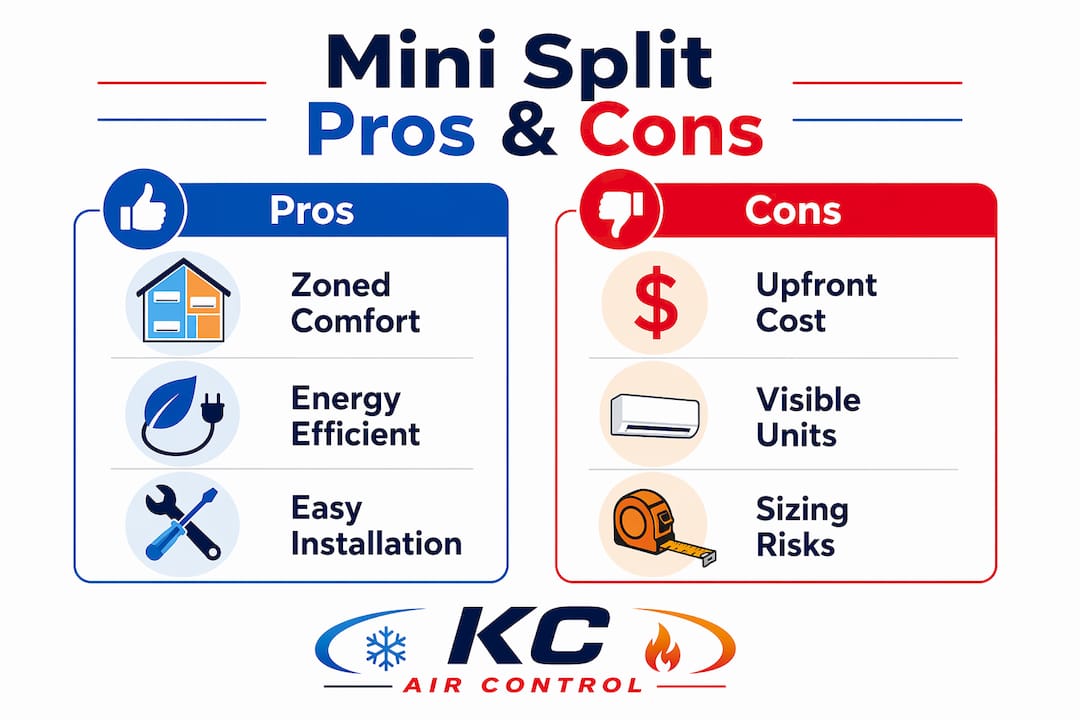
Quick pros and cons: is a mini split right for you?
Pros:
- Energy efficiency: Avoids duct losses that typically waste more than 30% of conditioned air in ducted homes.
- Zoned comfort: Each indoor unit controls its own room, so you heat or cool only the spaces in use.
- Quiet operation: Many indoor units operate as low as 19 dB, quieter than most refrigerators.
- Improved indoor air quality: Washable filters trap dust, pollen, and other airborne particles without the buildup that accumulates inside ductwork.
- Quick, low-invasive installation: Most installs require only a small 3-inch wall penetration and can be completed in a single day.
- Heating and cooling in one unit: Mini split heat pumps reverse cycle to provide both functions year-round.
Cons:
- Higher upfront cost: Multi-zone whole-home setups cost significantly more than a comparable central system (excluding ductwork).
- Visible indoor units: Wall-mounted heads are noticeable; they don’t blend in the way a ceiling register does.
- Cold-weather limits: Standard units lose efficiency in extreme cold; you need to verify low-ambient performance ratings for Kansas City winters.
- Sizing risk: Improper sizing leads to short cycling, poor dehumidification, and premature wear.
Best for: Homeowners adding a room, living in an older home without ducts, correcting hot and cold spots, or wanting independent temperature control in different rooms.
Pro Tip: If you only need to condition one room or a new addition, a single-zone mini split is almost always the most cost-effective choice. Multi-zone systems make sense when you need three or more rooms covered and want to avoid running separate outdoor units for each.
How does a ductless mini split system actually work?
A ductless mini split is a heat-pump-based system with two main components: an outdoor compressor/condenser unit and one or more indoor air handlers, connected by a set of refrigerant lines that pass through a small hole in the wall. No ductwork is involved at any point.
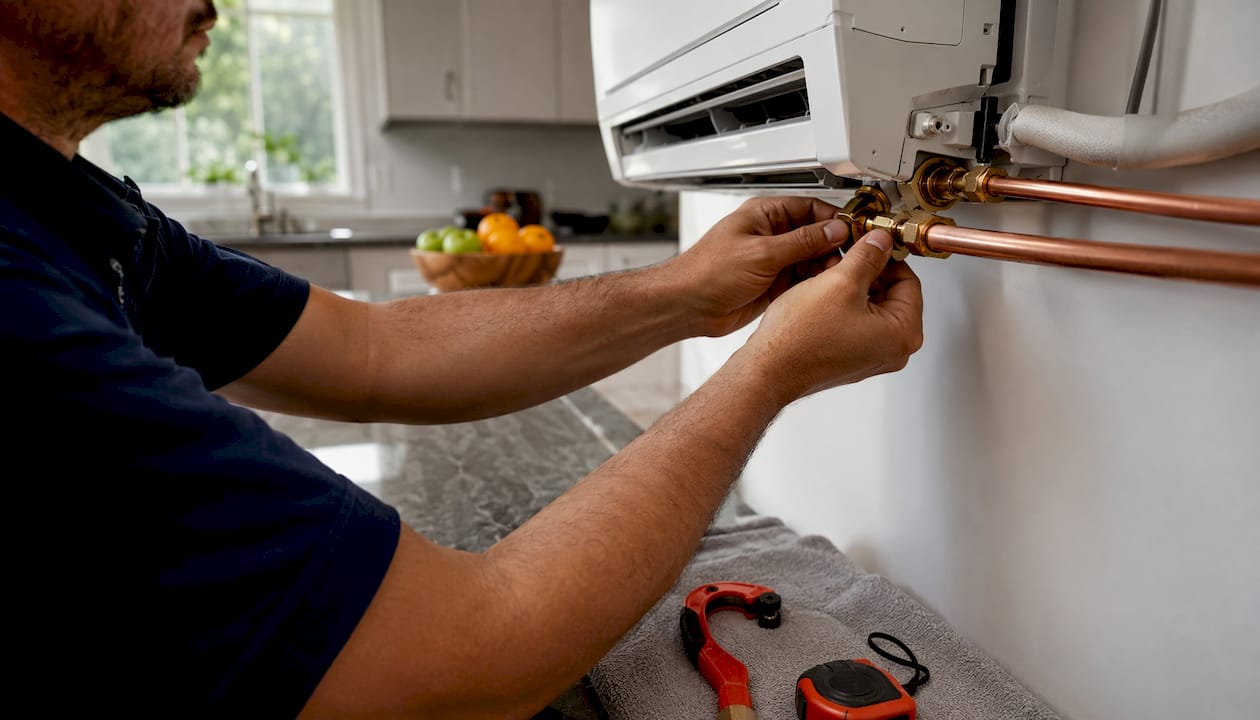
The outdoor unit extracts heat from the air (even in cold weather) and transfers it via refrigerant to the indoor head, which then releases that heat into the room. In summer, the process reverses: the indoor unit absorbs heat from the room air and sends it outside, delivering cool air in the process. A single outdoor unit can support multiple indoor heads, with multi-zone systems commonly supporting up to five or more indoor units depending on system architecture.
Indoor air handlers come in several styles: wall-mounted units (the most common), floor-standing units, ceiling cassettes that recess into a drop ceiling, and concealed ducted handlers that feed short insulated runs to registers for a more traditional look. That last option gives you the appearance of a ducted system with many of the efficiency benefits of ductless.
Three terms worth knowing:
- Inverter compressor: Adjusts its speed continuously rather than cycling on and off, which saves energy and maintains steadier temperatures.
- SEER (Seasonal Energy Efficiency Ratio): Measures cooling efficiency over a season; higher is better.
- HSPF (Heating Seasonal Performance Factor): Measures heating efficiency; again, higher means lower operating costs.
Where mini splits outperform other heating and cooling options
The primary advantage of a ductless system is direct-room conditioning that eliminates duct losses and gives you precise zone control, two things a standard central system simply cannot do.
Here’s where that plays out in practice:
- Energy efficiency and duct-loss avoidance: Central forced-air systems lose more than 30% of conditioned air through leaky or poorly insulated ducts. A mini split delivers refrigerant directly to the indoor unit, so none of that energy disappears into an attic or crawlspace. For a remodeled addition where running new ductwork would require tearing into finished walls, this is especially valuable.
- Zoned comfort: Each indoor unit has its own thermostat, so a household where one person runs warm and another runs cold can finally stop arguing about the thermostat. Bedrooms, a home office, and a living room can each hold a different temperature simultaneously.
- Superior dehumidification: Many mini split models offer a dedicated reheat/dehumidify mode that removes moisture without overcooling the space. During Kansas City’s humid spring and fall transition seasons, this is a genuine comfort advantage over central systems that often overcool just to pull humidity down.
- Quieter indoor operation: With the compressor outside and a low-speed fan inside, indoor units run at noise levels that rarely disturb sleep or conversation.
- Faster, less invasive installation: A 3-inch wall penetration is all that’s needed for the line set, and the outdoor unit can be placed up to 50 feet from the indoor head. Most single-zone installs wrap up in one day with no major demolition.
Pro Tip: The biggest utility savings come from turning off zones in unoccupied rooms and pairing your mini split with a smart control or app. Conditioning only the rooms you’re actually using is where the energy efficiency gains really add up.
What are the real trade-offs and drawbacks?
The biggest trade-off with ductless systems is upfront cost, particularly when you need to condition an entire home with multiple indoor units. That’s the honest starting point.

Cost scaling with zones. A single-zone system is relatively affordable. Add three, four, or five indoor heads, and the equipment and labor costs climb quickly. For a large home where you’d need six or more zones, a ducted heat pump with air-sealing work on the existing duct system may actually be more cost-effective. Get quotes for both before committing.
Visible indoor units. Wall-mounted heads are not subtle. They sit on the wall, have a return-air grille, and are clearly visible in the room. If that bothers you, concealed ducted air handlers are an option, though they add cost and require a small amount of ductwork. Ceiling cassettes offer a middle ground, recessing into a drop ceiling for a cleaner look.
Cold-weather performance. Most modern mini splits handle cold weather well, but not all units perform equally at very low temperatures. If your home regularly sees temperatures below 0°F, you need to specifically verify the unit’s low-ambient heating rating and ask your installer whether a supplemental heat source makes sense as a backup.
Sizing risks. The U.S. Department of Energy warns that rule-of-thumb sizing often leads to short cycling or underperformance. An undersized system runs constantly and still fails to dehumidify properly. An oversized system short-cycles, wearing out components faster. Neither is acceptable, and both are avoidable with a proper on-site load calculation.
When a mini split is probably not the right fit: If your goal is whole-house replacement on a tight budget, and your home is large and poorly insulated, a ducted heat pump paired with air-sealing and insulation work will likely deliver better value. Mini splits shine in targeted applications, not as a budget whole-home solution for leaky homes.
Which homes and rooms benefit most from mini splits?
Mini splits are the strongest fit for additions, older homes without existing ductwork, rooms with persistent hot or cold spots, and multi-occupant households where different people want different temperatures.
- Single-room solution. A sunroom, converted garage, or bonus room that your central system can’t reach is the classic mini split application. One outdoor unit, one indoor head, and the problem is solved without touching the rest of your HVAC.
- Multi-zone retrofit in an older home. Homes built with radiators or baseboard heat often have no ductwork at all. Running new ducts through finished walls is expensive and disruptive. A multi-zone mini split covers the whole house with refrigerant lines instead, preserving walls and ceilings.
- Home additions. Extending existing ductwork to a new addition is often impractical and expensive. A dedicated mini split for the addition is almost always the cleaner, faster solution.
- Basements and garages. These spaces are frequently too far from the main system to condition well. A floor-standing or wall-mounted mini split head handles them independently without taxing the central system.
- Bedrooms and nurseries. Quiet operation and precise temperature control make mini splits particularly well-suited to sleeping spaces where noise and comfort matter most.
When not to choose a mini split: If you want a single whole-house replacement for a large, leaky home and your budget is limited, a ducted heat pump with duct repair is likely more cost-effective than a six-zone ductless system.
How efficient are mini splits, and how do they perform in cold climates?
Mini splits consistently outperform electric resistance heat and window units on efficiency, and they avoid the duct losses that drag down central forced-air systems. That’s the short verdict.
Key figure: Duct losses account for more than 30% of a home’s space-conditioning energy in homes with ducts. ENERGY STAR certified mini splits use up to 60% less energy than standard electric baseboard heaters and can reduce total heating and cooling costs by up to approximately 30% compared to the system being replaced.
For cold-climate performance, the picture has improved significantly with modern inverter-driven compressors and advanced refrigerants. Many ENERGY STAR certified models now maintain effective heating output well below freezing. That said, performance does taper at extreme low temperatures, so you need to ask the right questions before buying.
Cold-climate checklist to review with your installer:
- What is the unit’s rated heating capacity at 17°F and at 5°F?
- Does the system have a defrost cycle, and how does it manage that cycle without leaving the home cold?
- At what outdoor temperature does the unit’s output drop below your home’s heating load?
- Is supplemental electric resistance heat built into the indoor unit, and when does it activate?
On dehumidification: mini splits with a dedicated dehumidify mode remove moisture while holding a moderate temperature, unlike central systems that must overcool to dehumidify. During humid transition seasons, this keeps your home comfortable without the clammy overcooled feeling. For more on when a standalone dehumidifier is still worth adding, the role of dehumidifiers in home comfort is worth reviewing alongside your mini split decision. You can also find practical guidance on dehumidification and mold prevention if moisture control is a priority in your home.
What do mini splits cost, and what does installation involve?
A single-zone mini split installation is relatively affordable; a whole-home multi-zone system is a meaningful investment that should be compared carefully against ducted alternatives.
Single-zone systems (one outdoor unit, one indoor head) typically run in the range of $3,000–$5,000 installed, depending on the unit’s capacity, line-set length, and local labor rates. Multi-zone systems covering three to five rooms can range from $8,000 to $15,000 or more, with cost driven primarily by the number of indoor heads, total line-set footage, whether concealment or ceiling cassettes are needed, and local permit requirements.
The installation process itself is far less invasive than a full duct retrofit. The installer drills a single small hole (roughly 3 inches) through an exterior wall for the refrigerant lines, electrical conduit, and condensate drain. The outdoor unit mounts on a pad or wall bracket, and the indoor head mounts on the interior wall. The outdoor unit can be located up to 50 feet from the indoor unit, giving installers flexibility in placement. Most single-zone installs finish in one day; multi-zone systems may take two days depending on complexity.
What to ask for in your quote:
- Itemized equipment and labor costs
- Permit fees and who pulls the permit
- Line-set length and any concealment costs
- Warranty terms on both equipment and labor
- Load calculation documentation
Rebates and financing. ENERGY STAR certified mini split heat pumps qualify for a federal tax credit covering 30% of the project cost, up to $2,000, available through December 31, 2032. Many utilities also offer their own rebates on top of that. Check the ENERGY STAR rebate finder at energystar.gov/rebatefinder, and ask your installer whether they offer financing options.
How do you maintain a mini split, and how long will it last?
A well-maintained mini split typically lasts 15–20 years, and the most important maintenance task is one any homeowner can handle: cleaning the indoor filters.
Indoor filters are washable and user-accessible on virtually every mini split model. Rinsing them under a faucet every one to three months prevents airflow restriction and keeps efficiency from dropping. Neglecting this is the most common cause of sudden performance loss, and it’s entirely avoidable.
Routine maintenance checklist:
- Monthly to quarterly: Remove and rinse indoor unit filters; let them dry fully before reinstalling.
- Seasonally: Clear debris, leaves, and vegetation from around the outdoor unit; maintain at least 12 inches of clearance on all sides.
- Annually: Schedule a professional inspection that includes coil cleaning (both indoor and outdoor), refrigerant level check, electrical connection inspection, and condensate drain clearing.
- As needed: Watch for ice buildup on the outdoor unit outside of normal defrost cycles, unusual noises, or a drop in heating or cooling output, all of which warrant a service call.
Common service events over a system’s life include fan motor replacement, electronic control board issues, and, less frequently, compressor replacement. Proper sizing and a quality installation dramatically reduce the likelihood of premature failures. An oversized or undersized system works harder than it should, and that stress shortens component life.
What should you ask a contractor before buying?
The single most important factor in a successful mini split installation is proper on-site sizing using a Manual J load calculation. Everything else follows from getting that right.
Selection and evaluation checklist:
- Ask for a Manual J load calculation. Any contractor who quotes a system size without visiting your home and measuring room dimensions, insulation levels, window area, and local climate data is guessing. Guessing leads to the sizing problems described above.
- Ask about low-ambient performance. Request the unit’s rated heating capacity at 17°F and 5°F, not just the nominal capacity.
- Confirm indoor unit locations before signing. Placement affects airflow distribution, aesthetics, and line-set length. Walk through each room with the installer.
- Discuss concealment options. If visible wall units concern you, ask about ceiling cassettes or concealed ducted handlers and get the cost difference in writing.
- Request warranty details. Manufacturer warranties on mini splits typically cover the compressor for 5–10 years and parts for 5 years; labor warranty varies by contractor.
- Ask for an itemized quote. Equipment, labor, permits, line-set materials, and any electrical upgrades should be listed separately.
- Verify licensing and certification. Your contractor should be licensed in Missouri or Kansas (depending on your location), pull the required permits, and ideally hold manufacturer certification for the brand they’re installing.
Red flags to watch for: A quote with no load calculation, vague line-set allowances (“we’ll figure it out on install day”), or a price that’s dramatically lower than other bids with no explanation. A low price that excludes permits or uses undersized equipment costs more in the long run.
What do government and ENERGY STAR data say about mini split efficiency?
Government and ENERGY STAR statistics consistently back the efficiency and emissions claims made for certified mini split heat pumps.
By the numbers: Duct losses account for more than 30% of space-conditioning energy in homes with ducts. ENERGY STAR certified mini splits use up to 60% less energy than standard electric baseboard heaters. Over their lifespan, ENERGY STAR certified systems used in a whole-house setting avoid more than 17,100 lbs of greenhouse gas emissions on average compared to standard systems.
| Metric | Figure | Source |
|---|---|---|
| Duct energy loss in ducted homes | More than 30% of space-conditioning energy | ENERGY STAR / U.S. DOE |
| Energy savings vs. electric baseboard | Up to 60% less energy | ENERGY STAR |
| Lifetime greenhouse gas emissions avoided (whole-house use) | More than 17,100 lbs on average | ENERGY STAR |
The Department of Energy also flags improper sizing as the primary technical risk, noting that rule-of-thumb estimates regularly produce systems that short-cycle or underperform. These figures are not marketing claims; they come from independent certification and government energy research. When a contractor cites efficiency numbers, ask whether the unit carries the ENERGY STAR label, since that’s the independent verification that the figures actually apply.
Key Takeaways
Ductless mini splits deliver the strongest value when installed in the right application with proper sizing: they eliminate duct losses, enable room-by-room control, and can cut heating costs by up to 60% compared to electric baseboard heat.
| Point | Details |
|---|---|
| Best-fit applications | Additions, older homes without ducts, hot/cold spots, and multi-occupant households needing different temperatures. |
| Duct loss avoided | Duct losses account for more than 30% of space-conditioning energy; mini splits eliminate this entirely. |
| Main trade-off | Higher upfront cost for multi-zone installs and visible indoor units; concealed handlers are available at added cost. |
| Sizing is critical | Always require a Manual J load calculation; improper sizing causes short cycling, poor dehumidification, and early failures. |
| Kcaircontrol next step | Kcaircontrol provides in-home evaluations and mini split installation in the Kansas City area; get at least two itemized quotes before deciding. |
A local installer’s perspective on mini splits in Kansas City
Mini splits are genuinely one of the most versatile tools in residential HVAC, but the gap between a well-installed system and a poorly sized one is enormous. In the Kansas City area, the most common scenario we see is a homeowner who added a room or finished a basement and now has a space the central system simply can’t reach. A single-zone mini split solves that cleanly, without touching the existing system. The second most common scenario is an older home with radiators and no ductwork at all, where a multi-zone mini split is often the only practical path to central cooling.
What’s underappreciated is how much Kansas City’s humidity affects the value of a mini split’s dehumidification capability. During spring and fall, when temperatures are mild but humidity is high, a mini split in dehumidify mode keeps a room comfortable without the overcooling that a central system produces when you force it to run just to pull moisture out. That’s a real quality-of-life difference for homeowners who spend a lot of time in those transitional months.
The advice we give every homeowner: don’t skip the load calculation, and don’t let anyone size a system by square footage alone. The difference between a correctly sized unit and an oversized one shows up in your comfort and your utility bill every single month.
Kcaircontrol installs and services mini splits in Kansas City
Kcaircontrol brings over 70 years of HVAC experience to every mini split evaluation, installation, and service call in the Kansas City area. When you schedule an in-home estimate, a licensed technician visits your home, measures each space, reviews your existing heating and cooling setup, and provides a written recommendation with equipment options and itemized pricing. There’s no guesswork and no pressure.

Kcaircontrol offers flexible financing options so upfront cost doesn’t have to be a barrier, and every installation includes a clear warranty on both equipment and labor. Whether you need a single-zone solution for a new addition or a multi-zone system for an older home without ducts, the team handles permits, placement, and startup from start to finish. If your existing system needs attention alongside a new mini split, Kcaircontrol’s HVAC repair services cover the full range of heating and cooling needs under one roof. Schedule your in-home evaluation today and get a clear, honest answer on whether a mini split is the right fit for your home.
Useful sources and further reading
- ENERGY STAR: Ductless Heating and Cooling — certified product listings, rebate finder, and efficiency guidance
- U.S. Department of Energy: Ductless Mini-Split Air Conditioners — technical overview, sizing guidance, and application recommendations
- ENERGY STAR Tax Credits — current federal tax credit details (30% up to $2,000, through December 31, 2032)
- ENERGY STAR Rebate Finder — search utility and state rebates by ZIP code
- Rewiring America: What Is a Mini-Split — plain-language explanation of how mini splits work and where they fit
Verify current incentive eligibility and local permitting requirements with your utility and the Kansas City area building department before finalizing any installation plan, since rebate programs and permit requirements change regularly.
This article is general information for homeowners and is not a substitute for a professional on-site evaluation. Confirm current incentive eligibility, local code requirements, and system specifications with a licensed HVAC contractor for your specific situation.