
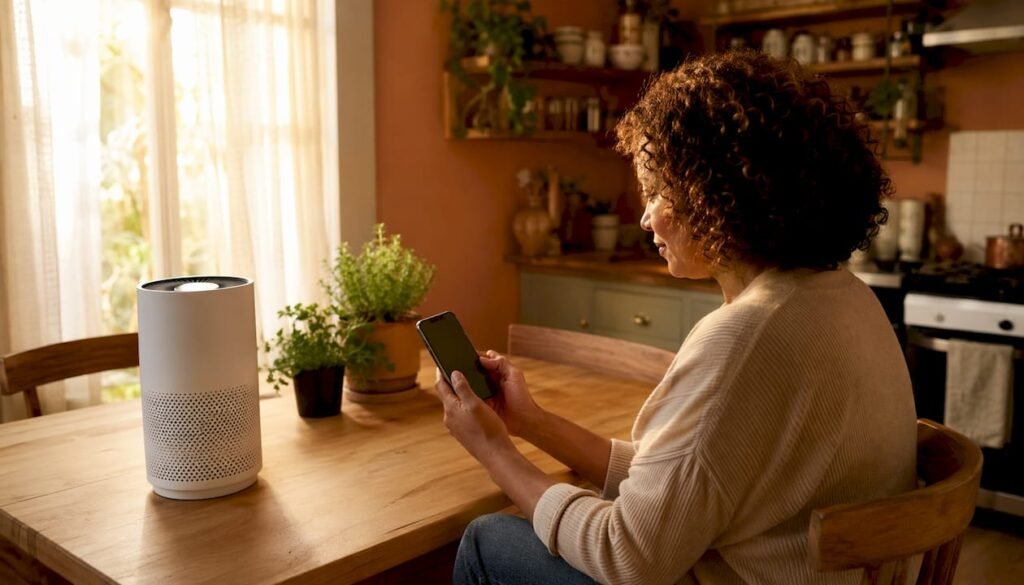
For most homeowners dealing with allergies, asthma, wildfire smoke, pets, or heavy traffic nearby, a portable HEPA air purifier is a worthwhile purchase. The EPA’s residential air cleaner guidance confirms that HEPA units can meaningfully reduce indoor particle concentrations, and Harvard Health recommends placing them in living rooms and bedrooms where you spend the most time. If your home has unresolved structural mold, active smoking indoors, or serious ventilation gaps, a purifier alone won’t fix the problem.
Who typically benefits:
- Allergy and asthma sufferers, especially during peak pollen seasons
- Households with cats, dogs, or other pets
- Homes near busy roads or industrial sources of outdoor PM2.5
- Anyone dealing with wildfire smoke events
Who usually won’t see much return:
- Homes with active structural mold (source removal comes first)
- Households where the primary pollutant is gaseous, like carbon monoxide or radon
Pro Tip: Place your purifier in the room where you sleep, not a central hallway. Breathing filtered air for seven or eight hours overnight delivers more consistent relief than running a unit in a large living room intermittently.
Table of Contents
- Why invest in air purifiers: the core benefits for your home
- How air purifiers actually remove contaminants from your air
- When an air purifier is most likely to be worth the cost
- Where air purifiers have limited value
- How to choose and use an air purifier: a practical checklist
- What the research actually says about air purifier health benefits
- Portable units vs. whole-house filtration: which fits your situation?
- Key Takeaways
- An HVAC pro’s honest perspective on air purifiers
- Kcaircontrol can assess and upgrade your home’s indoor air quality
- Useful sources and further reading
Why invest in air purifiers: the core benefits for your home
Air purifiers deliver real, measurable improvements for the right household. Here’s what the evidence actually supports:
- Allergy and asthma symptom reduction. Evidence syntheses report typical improvements of roughly 7%–25% for allergy and asthma outcomes when HEPA filtration is used consistently.
- Fine particle (PM2.5) removal. HEPA cleaners in treated rooms reduce indoor PM2.5 by approximately 50% or more in intervention studies.
- Smoke reduction. During wildfire events, a HEPA unit with an activated carbon layer cuts both particles and some smoke odor compounds.
- Reduced virus-laden particle load. HEPA filters capture airborne particles in the size range that carries respiratory viruses, lowering concentration in treated rooms.
- Dust and pet dander reduction. Consistent runtime noticeably reduces airborne dander and dust, which also means cleaner surfaces over time.
- Odor and VOC reduction. Only units with an activated carbon stage address gases and odors. HEPA alone does not capture VOCs.
- Potential cardiovascular markers. Some randomized controlled trials show short-term improvements in blood pressure and vascular function markers, though certainty is low and effect sizes are modest.
Statistic to know: HEPA air cleaners in treated rooms often cut indoor PM2.5 concentrations by approximately 50% or more, according to intervention studies reviewed by Healthline and the OSTI evidence synthesis.
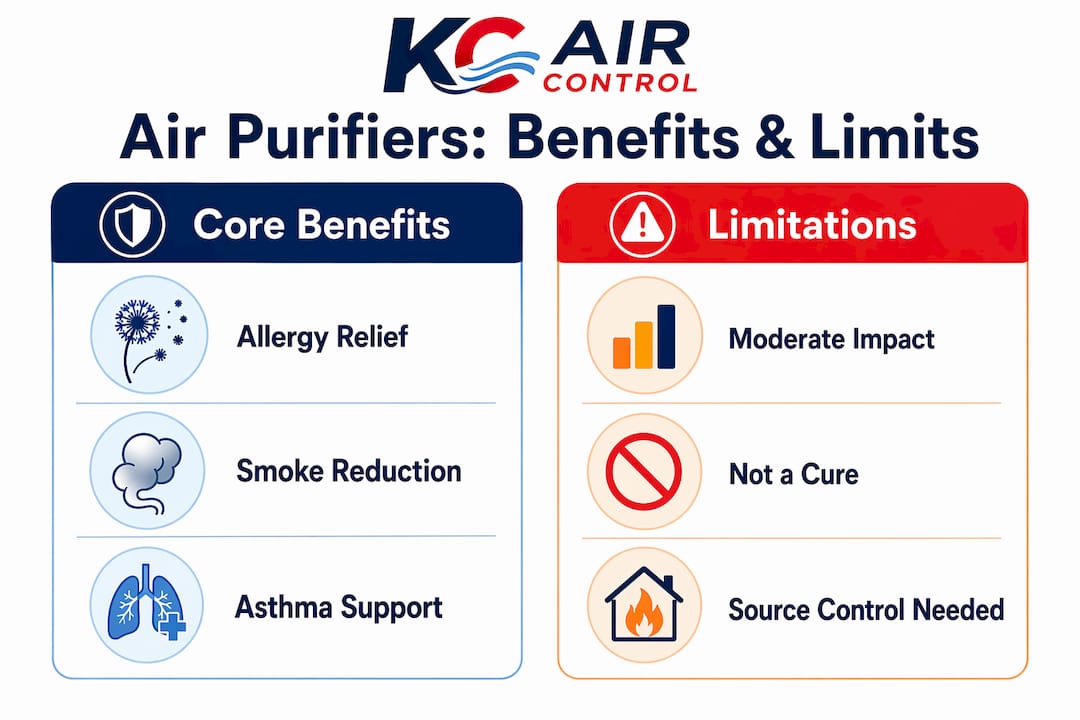
Benefits are real but moderate. Think “meaningful relief,” not a complete cure. Combining a purifier with source control and good ventilation is what produces the strongest results, which is why the importance of air quality extends well beyond any single device.
How air purifiers actually remove contaminants from your air
Understanding the technology helps you read product labels without getting misled by marketing language.
HEPA filtration is the gold standard for particles. A true HEPA filter captures at least 99.97% of particles at 0.3 microns in diameter, the hardest size to trap. That covers dust, pollen, mold spores, pet dander, and most airborne virus-carrying particles. “HEPA-type” or “HEPA-style” filters are not the same standard and often perform significantly worse.
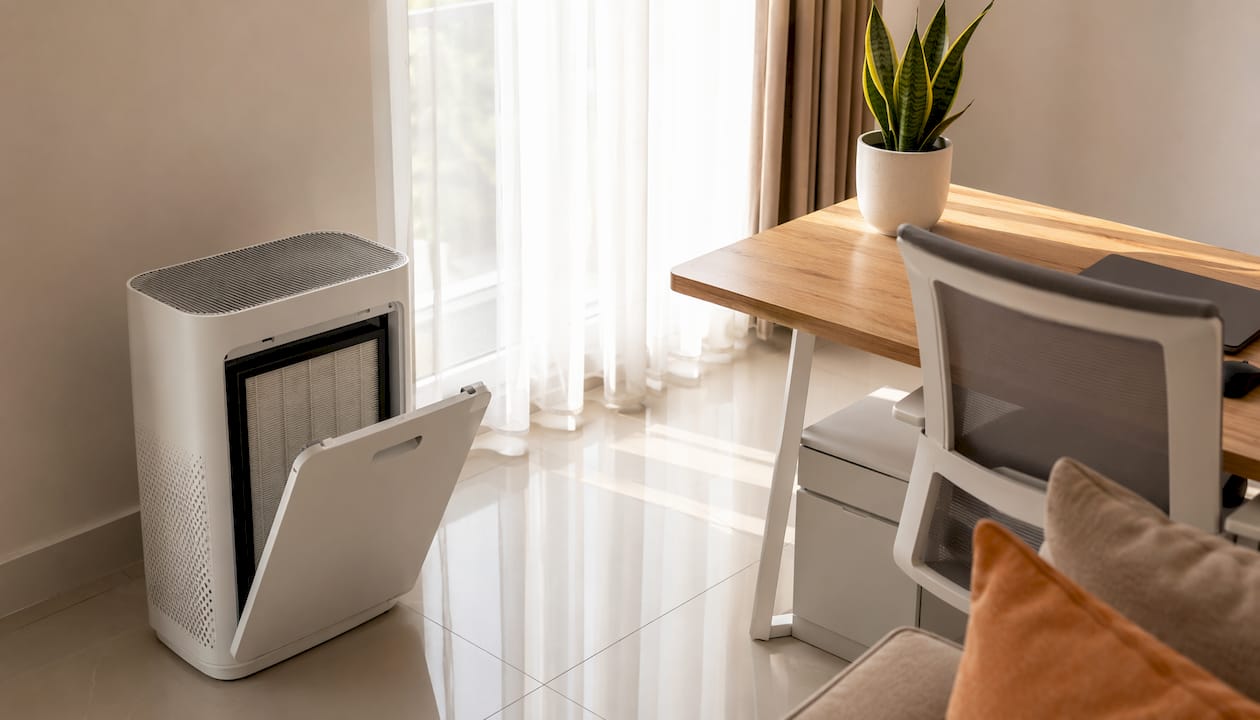
Activated carbon handles gases and odors. It adsorbs VOCs, smoke compounds, and cooking smells that HEPA physically cannot capture. The carbon bed has a finite capacity and needs replacement on schedule.
CADR (Clean Air Delivery Rate) is the most useful single number on a spec sheet. It measures the volume of filtered air a unit delivers per minute at a given fan speed, expressed in cubic feet per minute (CFM). A higher CADR means the unit cleans more air, faster.
CADR defined: CADR tells you how many cubic feet of clean air a purifier delivers per minute. EPA guidance, summarized by Healthline, suggests your purifier’s CADR should equal at least two-thirds of the room’s square footage.
ACH (Air Changes per Hour) describes how many times the unit cycles all the air in a room each hour. For allergy or asthma households, targeting 4–5 ACH in the sleeping room is a reasonable goal. That means running the unit continuously, not just at night.
Pro Tip: When comparing units, check the CADR at the fan speed you’ll actually use. A purifier rated for a 400-square-foot room at maximum speed may only cover 200 square feet at the quieter setting you’ll run it on overnight.
When an air purifier is most likely to be worth the cost
Not every home needs one equally. These are the situations where purifiers consistently deliver value:
- Allergy season. Spring pollen and fall ragweed drive indoor particle counts up, especially when windows are open. A HEPA unit in the bedroom during peak season can reduce nighttime symptoms.
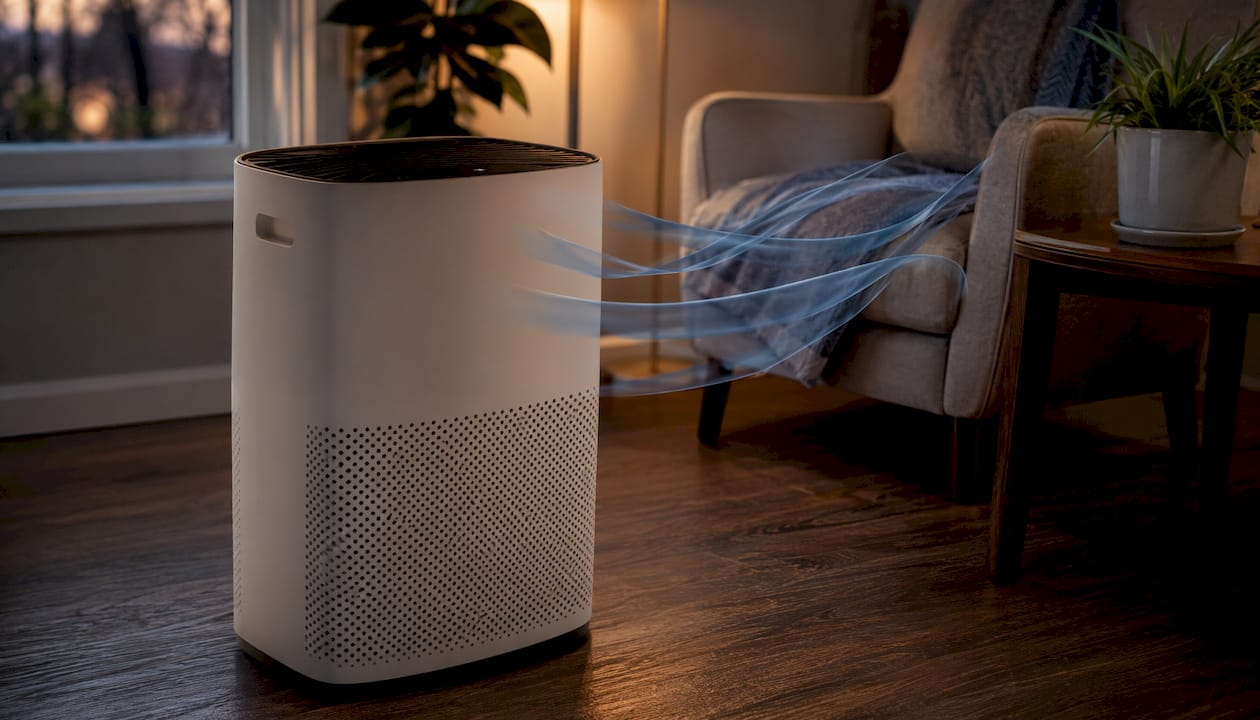
- Asthma households. Placing a unit near the sleeping breathing zone is the approach most consistently supported by evidence. Running it overnight matters more than placement in a common area.
- Wildfire or regional smoke events. During smoke advisories, a HEPA unit with carbon is one of the fastest ways to reduce indoor PM2.5 when you can’t ventilate.
- Homes with pets. Cat and dog allergens are lightweight and stay airborne for hours. A purifier running continuously in the rooms where pets spend time makes a measurable difference.
- Living near busy roads. Harvard Health specifically identifies people near high-traffic roads as a group that benefits from portable HEPA filtration, particularly those with cardiovascular risk factors.
- Frequent respiratory infections. Reducing airborne particle load in sleeping areas can lower repeated exposure, though a purifier is one layer of protection, not a guarantee.
Pro Tip: Before buying, consider a low-cost indoor air quality monitor to check your actual PM2.5 levels. If readings are consistently below 12 µg/m³, your home may not need a purifier at all. If they spike above 35 µg/m³ regularly, a purifier is a justified purchase.
Where air purifiers have limited value
Knowing the limits saves you money and prevents false confidence.
- Structural mold. A purifier captures some airborne mold spores but does nothing about mold growing inside walls, under flooring, or in ducts. Source remediation comes first.
- Gases without carbon. HEPA alone won’t touch carbon monoxide, radon, formaldehyde, or most VOCs. You need an activated carbon stage, and even then, carbon has limits on gas concentration and capacity.
- Settled allergens. Dust mite allergen lives in bedding and carpet, not primarily in the air. A purifier helps with what’s airborne but doesn’t replace regular washing and vacuuming.
- Gaseous tobacco smoke. HEPA captures smoke particles, but nicotine and many carcinogenic gases pass right through. Source control (stopping indoor smoking) is the only real fix.
- Undersized units. A purifier rated for 150 square feet running in a 400-square-foot open-plan living area is largely decorative.
Red flags when shopping: “HEPA-type” or “HEPA-like” labeling, no published CADR rating, no guidance on filter replacement intervals, and ozone-generating ionizers marketed as air purifiers. No federal agency has approved ozone generators for use in occupied spaces, per EPA guidance.
Pro Tip: When source problems like dirty upholstery, dusty ducts, or poor ventilation are driving your indoor air issues, addressing those sources first will make any purifier you add far more effective.
How to choose and use an air purifier: a practical checklist
Sizing and specs
- Measure your room in square feet. Match the purifier’s CADR to at least two-thirds of that number, per EPA guidance.
- Require true HEPA. Look for “true HEPA,” HEPA H13, or HEPA H14 on the label. Anything else is a lower standard.
- Add activated carbon if odors or VOCs are a concern. Confirm the carbon weight in the filter, not just that carbon is “included.”
- Check AHAM certification. The Association of Home Appliance Manufacturers (AHAM) verifies CADR ratings independently. An AHAM-verified CADR is a trustworthy number.
- Look for “asthma & allergy friendly” certification from the Asthma and Allergy Foundation of America if respiratory health is your primary concern.
Maintenance and operating costs
- Filter replacement: HEPA filters typically need replacing every 6–12 months; carbon filters often every 3–6 months. Check manufacturer guidance before buying.
- Filter costs vary widely. Budget for ongoing filter replacement as part of your total cost of ownership.
- Energy use: most quality units run between 30–100 watts. Running one continuously adds a modest amount to your monthly electricity bill.
- Noise: check the decibel rating at the speed you’ll actually use. Many units are quiet at low speed but loud at high.
Pro Tip: Place the unit in the center of the room or near your breathing zone, not in a corner. Avoid pointing the airflow directly at people. Combine the purifier with proper ventilation and source control for the best results.
What the research actually says about air purifier health benefits
The evidence is encouraging but comes with honest caveats.
“Particle filtration typically delivers modest improvements for allergy and asthma outcomes — roughly 7% to 25% — and delivering filtered air to the breathing zone while sleeping is often most effective.” — OSTI evidence synthesis on health benefits of particle filtration
What’s well-supported:
- HEPA filtration reduces indoor PM2.5 by approximately 50% or more in treated rooms, a finding consistent across multiple intervention studies.
- An EPA review summarized by Healthline found statistically significant respiratory improvements across eight studies and cardiovascular benefits in 10 of 11 studies reviewed.
- Allergy and asthma symptom improvements of 7%–25% are the typical range reported in technical reviews.
Where certainty is lower:
- Cardiovascular benefits: a PMC meta-analysis of RCTs found a small reduction in systolic blood pressure (about -2.28 mmHg) after air purification, but rated overall evidence certainty as very low due to short study durations and small sample sizes.
- Most studies are short-term, conducted in specific housing types, and vary significantly in device type and contaminant measured.
The bottom line from public health guidance: purifiers are one tool in a three-part strategy. Source control first, ventilation second, and air cleaners third. That framing comes directly from both EPA guidance and Health Canada’s operational recommendations.
Portable units vs. whole-house filtration: which fits your situation?
| Feature | Portable room purifier | Whole-house HVAC filtration |
|---|---|---|
| Coverage | Single room or zone | Entire home |
| Upfront cost | Lower (varies by model) | Higher (professional installation) |
| Filter type | True HEPA + carbon | High-MERV filter (MERV 13+) in HVAC system |
| Installation | None required | Professional HVAC work needed |
| Maintenance | User-replaced filters | Filter changes + HVAC service |
| Best for | Targeted relief, renters, quick setup | Whole-home continuous filtration |
When to call a professional:
- You want continuous whole-home filtration without managing multiple portable units
- Your HVAC system needs a MERV upgrade (MERV 13 or higher) and you’re unsure if your equipment can handle the increased resistance
- You have persistent high indoor PM2.5 despite running portable units
- You suspect duct leaks, visible mold near vents, or declining HVAC performance
- You want a professional indoor air quality assessment before investing in equipment
UV light add-ons and professional duct cleaning are two HVAC-based upgrades that complement filtration and are worth discussing with a local pro before committing to a whole-house approach.
Key Takeaways
Air purifiers are a worthwhile investment for allergy, asthma, and smoke-affected households when sized correctly and used consistently, but they work best as part of a broader indoor air quality strategy.
| Point | Details |
|---|---|
| Who benefits most | Allergy, asthma, pet, and wildfire-smoke households see the clearest gains from HEPA filtration. |
| Top spec to check | Match CADR to at least two-thirds of your room’s square footage; require true HEPA certification. |
| Realistic health gains | Expect 7%–25% improvement in allergy and asthma symptoms and approximately 50% reduction in indoor PM2.5 concentrations in rooms treated with HEPA purifiers, based on evidence syntheses and intervention studies. |
| Source control first | Mold, smoking, and VOC problems need source removal or ventilation upgrades before a purifier helps. |
| Kcaircontrol for whole-home needs | Kcaircontrol offers IAQ assessments, duct cleaning, and HVAC filtration upgrades for Kansas City homeowners. |
An HVAC pro’s honest perspective on air purifiers
The most common mistake homeowners make is buying a portable purifier instead of addressing what’s actually driving their air quality problem. A purifier placed in a home with leaky ducts, a dirty coil, or a mold source will run constantly and deliver modest results at best. The device isn’t the problem. The diagnostic step was skipped.
That said, portable HEPA units are genuinely useful as a targeted, cost-effective first step for allergy and smoke situations. They’re also a smart bridge while you plan a larger HVAC upgrade. The key is matching the tool to the problem. A bedroom unit running overnight during allergy season is a well-matched solution. A single unit in a 2,000-square-foot open floor plan is not.
Whole-house HVAC filtration with a properly rated MERV filter, combined with improving your home’s overall air quality through ventilation and source control, is the longer-term investment that pays off across every room. Kcaircontrol has been helping Kansas City homeowners make that call for over 70 years, with services ranging from indoor air quality assessments to duct cleaning and full HVAC filtration upgrades.
Kcaircontrol can assess and upgrade your home’s indoor air quality
If you’ve read this far and you’re still unsure whether a portable purifier is enough or whether your home needs a professional IAQ assessment, that uncertainty is worth acting on. Persistent high particle levels, musty odors from vents, or an HVAC system that hasn’t been serviced recently are all signs that a pro visit will save you money compared to buying equipment that won’t solve the underlying issue.
Kcaircontrol offers indoor air quality assessments, professional duct cleaning, HVAC filter upgrades, and whole-house filtration solutions for Kansas City area homeowners. Flexible financing options are available for larger installations. Schedule your assessment online or call to speak with a technician who can tell you exactly what your home needs, without guessing.
Useful sources and further reading
- EPA Residential Air Cleaners Technical Summary, 3rd Edition — The primary U.S. government reference on portable air cleaner performance, CADR metrics, HEPA standards, and HVAC filter ratings. Used throughout this article for technology definitions and evidence framing.
- Healthline: Do Air Purifiers Work? — Summarizes an EPA review of eight respiratory studies and 11 cardiovascular studies; source for the PM2.5 reduction statistic and CADR sizing guidance.
- PMC: Effectiveness of indoor air purification on cardiovascular health — Systematic review and meta-analysis of RCTs reporting the -2.28 mmHg systolic blood pressure finding and its very-low certainty rating.
- OSTI: Health Benefits of Particle Filtration — Evidence synthesis reporting 7%–25% typical allergy/asthma improvements and the breathing-zone delivery recommendation.
- Harvard Health: Indoor air quality and heart health — Recommends portable HEPA units in living rooms and bedrooms, with a CADR of at least 300 for larger rooms; used for placement and cardiovascular risk framing.
- Health Canada: Using a portable air cleaner to improve indoor air — Operational best practices on placement, filter maintenance, fan speed, and the three-part strategy (source control, ventilation, air cleaners).