

TL;DR:
- Air pollution poses the greatest environmental threat to human health globally, causing millions of premature deaths annually. Indoor air quality often exceeds outdoor pollution risks due to limited ventilation, making home pollution sources a significant concern. Protecting vulnerable groups and maintaining indoor air systems are crucial steps to reduce health risks from poor air quality.
Air quality is defined as the condition of the air in our environment and how it affects human health, ecosystems, and overall well-being. The World Health Organization classifies air pollution as the single biggest environmental threat to human health globally, responsible for an estimated 6.7 million premature deaths each year. That number includes 4.2 million deaths linked to outdoor pollution alone. Understanding why air quality matters is not abstract. It is a direct, measurable factor in how long you live and how well you feel every single day.
The term most professionals use is indoor air quality (IAQ) for the air inside buildings, and ambient air quality for outdoor conditions. Both are tracked and regulated by agencies including the U.S. Environmental Protection Agency (EPA), the American Lung Association, and the WHO. Together, these organizations provide the clearest picture of how the air around you shapes your health outcomes.
Why air quality matters: the health impacts you need to know
Poor air quality causes damage well beyond the lungs. Research from University of Rochester Medicine confirms that ultrafine particles reach the brain and disrupt neurological function, linking long-term pollution exposure to increased risk of Alzheimer’s disease and Parkinson’s disease. This means air pollution should be treated as a full-body health risk, not just a respiratory concern.
The health effects fall into two categories:
- Short-term effects: Eye, nose, and throat irritation; headaches; dizziness; fatigue. These often appear within hours of exposure and can be mistaken for a cold or seasonal allergies.
- Long-term effects: Chronic respiratory disease, cardiovascular disease, lung cancer, and neurological decline. The EPA confirms that indoor pollutants cause heart disease and cancer with prolonged exposure.
- Cardiovascular damage: Fine particulate matter enters the bloodstream and inflames arterial walls, increasing the risk of heart attack and stroke.
- Neurological impact: Pollution-linked cognitive decline is now a recognized concern in NIH research, with brain health risks extending to memory loss and reduced processing speed.
- Immune system stress: Repeated exposure to pollutants weakens the immune response, making the body less capable of fighting infections.
The American Lung Association’s State of the Air 2026 report found that 44% of Americans live in counties with unhealthy ozone or particle pollution levels. That represents approximately 152.3 million people. Nearly half the country is regularly breathing air that fails basic health standards, which makes personal awareness and action more important than ever.
Pro Tip: If you or a family member experience recurring headaches, fatigue, or respiratory irritation that improves when you leave home, do not dismiss it as stress or seasonal illness. These are classic signs of a pollution-related health response.

Is indoor or outdoor air quality worse for your health?
Most people assume outdoor smog is the bigger threat. The EPA’s data tells a different story. Modern energy-efficient homes can trap indoor pollutants at levels far higher than outdoor air because tight construction limits ventilation. You spend roughly 90% of your time indoors, which means the air inside your home carries more cumulative exposure risk than a morning commute through city traffic.
Common indoor pollutants and their sources include:
- Gas stoves and furnaces: Combustion appliances release nitrogen dioxide and carbon monoxide directly into living spaces.
- Cleaning products: Many household sprays and disinfectants emit volatile organic compounds (VOCs) that irritate airways and accumulate in poorly ventilated rooms.
- Mold and moisture: Damp areas behind walls or under flooring release mold spores that trigger asthma and allergic reactions.
- Carpets and furniture: Off-gassing from synthetic materials releases formaldehyde and other VOCs for months after installation.
- Inadequate ventilation: Without fresh air exchange, pollutants from all of the above sources concentrate indoors and reach harmful levels.
The EPA also notes that symptoms fade when away from home as a reliable indicator of indoor air quality problems. If you feel better at the office or on vacation than you do at home, your home’s air is worth investigating. A homeowner’s guide to cleaner air can help you identify the specific sources affecting your space and prioritize the right fixes.
Who is most at risk from poor air quality?
Air pollution affects everyone, but certain groups face significantly higher health risks. Knowing which category you fall into helps you take the right precautions at the right times.
Children are the most vulnerable population. Children breathe more air relative to body size than adults and have developing brains and lungs that are far more susceptible to permanent damage. Children living near high-pollution sources show measurable learning and cognitive impairments compared to peers in cleaner environments. The American Lung Association reports that 46% of Americans under 18 live in counties with unhealthy air. That statistic means nearly half of all children in the U.S. face regular exposure to air that can alter their development.
Older adults with pre-existing heart or lung conditions face compounded risk. Their bodies are less able to compensate for the oxidative stress that pollution creates, making each exposure more damaging than it would be for a healthy adult.
Active adults represent a less obvious but significant risk group. Exercising outdoors during high ozone times increases pollutant intake because deeper breathing draws more particles into the lungs. A runner logging five miles on a high-ozone afternoon inhales far more harmful material than someone sitting on the same park bench. SpareTheAir.org advises shifting outdoor workouts to early morning when ozone levels are typically lower.
Strategies that reduce exposure across all risk groups:
- Check the Air Quality Index (AQI) daily using AirNow.gov before planning outdoor activities.
- Schedule outdoor exercise before 10 a.m. to avoid peak ozone formation hours.
- Keep windows closed on high-AQI days and use air conditioning with a clean filter.
- Use N95 masks during wildfire smoke events or when AQI exceeds 150.
- Keep children indoors during air quality alerts, particularly in urban or industrial areas.
Practical steps to improve air quality at home
The good news is that individuals have the most control over indoor air quality and can take effective steps to reduce exposure without major expense. The following actions deliver the most measurable results for homeowners.
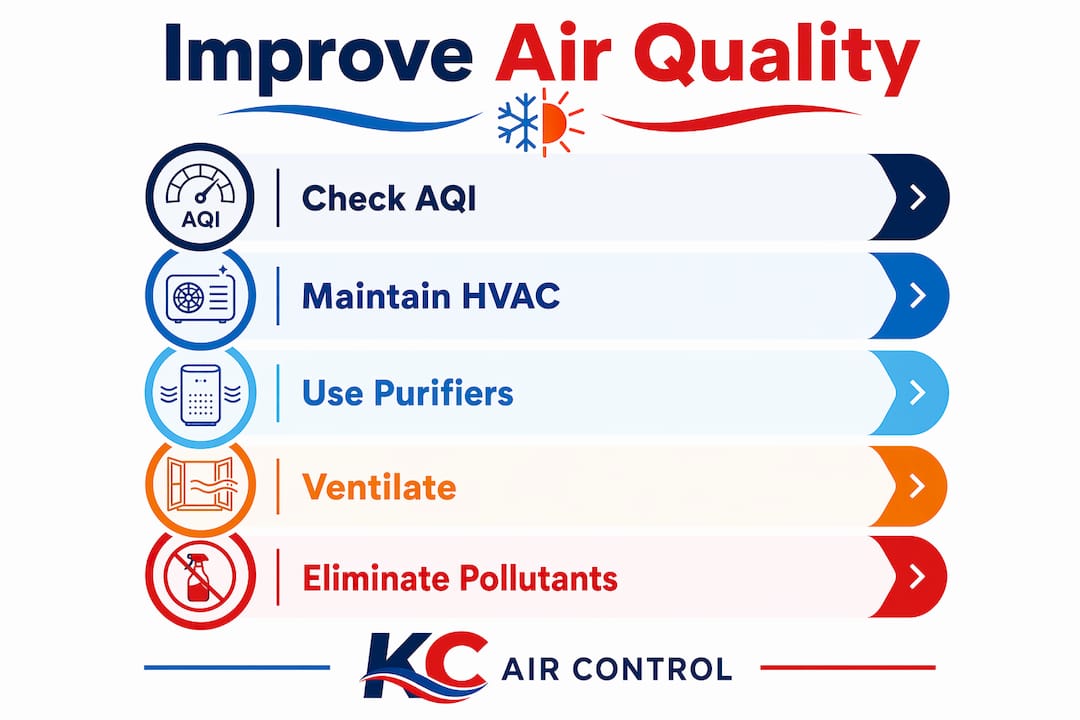
Monitor the AQI regularly. The AirNow.gov AQI scale runs from 0 to 500. AQI values above 100 indicate unhealthy air for sensitive groups, and values above 150 affect the general population. Checking this number takes 30 seconds and can prevent hours of unnecessary exposure.
Maintain your HVAC system. A dirty or poorly maintained heating and cooling system recirculates dust, mold spores, and allergens throughout your home. Regular filter changes, annual inspections, and professional duct cleaning services remove accumulated contaminants that no air purifier can address on its own. UV light systems installed inside HVAC units kill airborne bacteria and mold before they circulate, adding another layer of protection.
Use air purifiers with HEPA filters. HEPA filtration captures particles as small as 0.3 microns, including most allergens, dust, and fine particulate matter. Place units in bedrooms and living areas where you spend the most time.
Ventilate when outdoor air is clean. Open windows on low-AQI days to flush out accumulated indoor pollutants. Even 15 minutes of cross-ventilation significantly reduces VOC concentrations in a typical home.
Eliminate pollution sources. Switch to fragrance-free, low-VOC cleaning products. Use exhaust fans when cooking on a gas stove. Fix moisture problems immediately to prevent mold growth.
| Action | Effort level | Impact |
|---|---|---|
| Check AQI daily | Low | Reduces outdoor exposure risk |
| Change HVAC filters monthly | Low | Removes recirculated indoor pollutants |
| Professional duct cleaning | Medium | Eliminates deep-seated contaminants |
| HEPA air purifier | Medium | Captures fine particles in living spaces |
| Fix moisture and mold sources | High | Eliminates a primary IAQ health driver |
Pro Tip: When selecting a mask for wildfire smoke or high-pollution days, choose an N95 or KN95 respirator. Standard surgical masks do not filter fine particulate matter effectively and provide minimal protection against PM2.5 particles.
Key takeaways
Air quality directly determines health outcomes, and the most effective protection combines daily AQI monitoring, consistent HVAC maintenance, and targeted indoor pollution reduction.
| Point | Details |
|---|---|
| Air quality is a full-body health issue | Pollution affects the brain, heart, and lungs, not just respiratory function. |
| Indoor air often poses greater risk | Tight homes trap pollutants at higher concentrations than outdoor air. |
| Children and active adults face elevated risk | Developing systems and increased breathing rates amplify pollutant intake. |
| AQI monitoring is your first line of defense | Values above 100 signal unhealthy air; adjust outdoor plans accordingly. |
| HVAC maintenance is non-negotiable | Clean ducts and filters are the most direct way to control indoor air quality. |
Why I think most people underestimate their indoor air
After years of working with homeowners on air quality concerns, the pattern I see most often is this: people worry about smog and wildfire smoke, then go home and breathe air that is measurably worse without realizing it. The assumption that “inside is safe” is one of the most persistent and costly misconceptions in home health.
The research from University of Rochester Medicine on brain health and pollution genuinely shifted how I think about this issue. Cognitive decline linked to air pollution is not a distant risk for industrial workers. It is a slow, cumulative process happening in homes with gas stoves, aging ductwork, and no ventilation strategy. That is a problem most families can actually fix.
What I find encouraging is that indoor air quality is one of the few environmental health factors you have real control over. You cannot change the ozone levels over your city. You can change your filter, fix your ventilation, and stop using products that off-gas VOCs into your living room. The gap between knowing this and acting on it is mostly awareness, and that is exactly what this article is meant to close.
Healthy adults are not immune to air quality effects. They simply experience the damage more slowly. The time to act is before symptoms appear, not after a diagnosis.
— AB
Improve your home’s air quality with Kcaircontrol
If you are ready to take control of the air inside your home, Kcaircontrol has the expertise and services to help. With over 70 years of experience serving Kansas City homeowners, the team provides professional HVAC maintenance, duct cleaning, and indoor air quality solutions designed to reduce pollutants and keep your family comfortable year-round.

Start with a professional indoor air quality assessment to identify what is affecting your home’s air. From there, services like duct cleaning and UV light installation address the root causes rather than masking symptoms. Scheduling is easy online, and financing options are available. Your home should be the safest air you breathe all day.
FAQ
What is air quality and why does it matter?
Air quality refers to the condition of the air in a given environment and its effect on human health. Poor air quality causes respiratory disease, cardiovascular damage, cognitive decline, and premature death, making it one of the most significant health factors in daily life.
How does indoor air quality affect your health?
Indoor air pollutants from gas stoves, cleaning products, mold, and inadequate ventilation cause both short-term symptoms like irritation and fatigue and long-term diseases including heart disease and cancer, according to the EPA.
Who is most vulnerable to poor air quality?
Children, older adults with pre-existing conditions, and active adults who exercise outdoors during high-pollution periods face the greatest health risks from poor air quality.
How do I check the air quality where I live?
Use AirNow.gov to check the daily Air Quality Index (AQI) for your area. AQI values above 100 are unhealthy for sensitive groups, and values above 150 affect the general population.
Can improving my HVAC system help with indoor air quality?
Yes. Regular HVAC maintenance, filter changes, professional duct cleaning, and UV light systems remove and neutralize airborne contaminants before they circulate through your home, directly improving indoor air quality.