
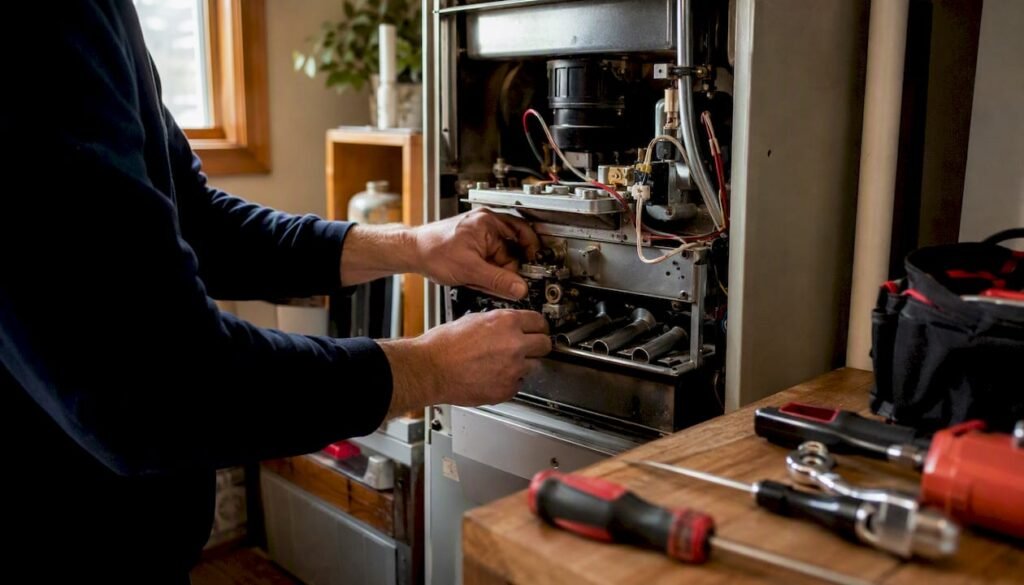
Furnace short cycling is when your furnace turns on, runs for just a few minutes, shuts off, and then repeats the cycle before your home reaches the set temperature. A normal heating cycle lasts roughly 7–20 minutes; anything consistently shorter than that is a short cycle. You can confirm it by timing how long the burner stays on after ignition. If it shuts off in under 7–8 minutes and your thermostat still reads below the setpoint, you have a short-cycling problem.
Do these two checks right now before anything else. First, pull out your air filter and hold it up to a light source. If you can’t see light through it, replace it. Second, pop open your thermostat and swap in fresh AA batteries. These two steps resolve a large share of short-cycling calls before a technician ever needs to visit.
Safety first: if you smell gas near the furnace, hear repeated clicking with no ignition, or your carbon monoxide (CO) alarm sounds, shut the system off at the power switch, leave the house, and call your gas utility and an HVAC professional immediately. Do not attempt any further checks.
Key Takeaways
Furnace short cycling is almost always caused by restricted airflow, a thermostat fault, or a safety switch response to overheating, and most cases resolve with a filter change, cleared vents, or a professional flame sensor cleaning.
| Point | Details |
|---|---|
| Check the filter first | A clogged filter is the most common cause; replace it before any other diagnostic step. |
| Normal cycle length | A healthy furnace runs 7–20 minutes per cycle; under 7–8 minutes consistently signals a problem. |
| Know when to stop DIY | Gas components, heat exchangers, and pressure switches require a licensed HVAC technician. |
| Prevent with annual maintenance | A pre-season tune-up and monthly filter checks prevent the majority of short-cycling causes. |
| Kcaircontrol for Kansas City homes | Kcaircontrol provides full short-cycling diagnostics, flame sensor and blower repair, and seasonal tune-ups in the Kansas City area. |
Table of Contents
- What causes furnace short cycling?
- Is short cycling dangerous?
- How to troubleshoot your furnace step by step
- How to prevent short cycling before it starts
- When should you call a licensed HVAC technician?
- What we see most often in Kansas City homes
- Kcaircontrol handles short-cycling diagnostics in the Kansas City area
- Sources
What causes furnace short cycling?
Short cycling has a clear hierarchy of causes, from the ones you can fix in five minutes to the ones that need a licensed technician. Knowing where your situation falls saves you time and money.
Causes you can fix yourself
- Dirty or clogged air filter. A restricted filter is the single most common homeowner-fixable cause. Blocked airflow causes the heat exchanger to overheat, which trips the high-limit safety switch and shuts the burner off. Replacing a $10–$20 filter is always the first step.
Learn more about how air filters affect your system. - Thermostat problems. Dead batteries, a thermostat mounted near a heat source (a sunny window, a lamp, a vent), or a temperature differential set too tight can all cause the system to cycle on and off rapidly. Move the thermostat away from heat sources and widen the deadband setting if your model allows it.
- Closed or blocked supply and return vents. Shutting vents in unused rooms feels like a good idea but actually increases static pressure, restricts airflow, and triggers the same overheating response as a dirty filter. Walk through the house and make sure every register is open and unobstructed.
- Duct leaks. Significant leaks in ductwork can bleed conditioned air into unconditioned spaces, reducing the heat delivered to living areas and causing the system to run short cycles trying to compensate. Home energy loss from duct leaks is a common and underdiagnosed problem.
Causes that require a professional
- Tripped or faulty high-limit switch. The limit switch shuts the burner off when the heat exchanger gets too hot. A filter or airflow fix usually resolves the underlying cause, but a switch that has tripped repeatedly can fail and need replacement.
- Dirty flame sensor. A contaminated flame sensor can’t confirm the burner is lit, so the control board shuts the gas off within seconds of ignition. You’ll notice the furnace lights briefly, then goes out, then tries again. Flame sensor contamination causes brief runs of a few seconds to a minute followed by repeated shutdown and retry sequences.
- Failing ignitor or pressure switch. A cracked hot-surface ignitor or a faulty pressure switch (which monitors combustion draft) can both prevent the burner from staying lit.
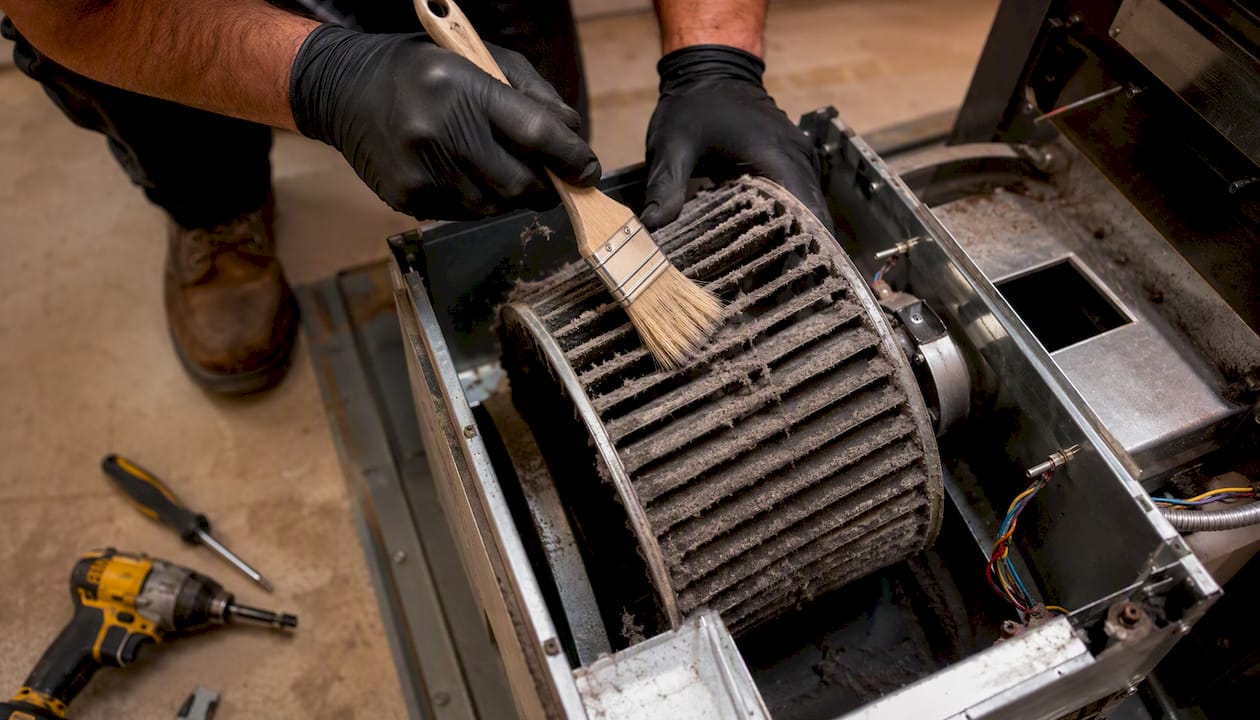
- Dirty or failing blower motor. The blower moves heated air through your ducts. A motor that’s failing or a blower wheel caked with dust reduces airflow significantly, causing overheating even with a clean filter.
- Cracked heat exchanger. A crack allows combustion gases to mix with circulated air, creating a CO risk. The furnace’s safety systems will often shut the unit down repeatedly. This is a serious safety issue requiring immediate professional attention.
- Blocked flue or exhaust vent. A bird nest, debris, or ice buildup in the external vent can cause pressure faults that trip safety switches and produce cycling. You can visually inspect the exterior termination cap from outside, but clearing a blocked flue should be done by a pro.
- Oversized furnace. A furnace that’s too large for the home heats the space so quickly that it satisfies the thermostat before completing a full cycle. This is a design problem, not a maintenance one. If your system short-cycles even after all airflow and thermostat checks pass, oversizing is worth discussing with a technician.
Is short cycling dangerous?
Short cycling is more than an annoyance. Left unaddressed, it creates real efficiency, mechanical, and safety problems.
Efficiency and cost.
Every startup cycle burns more fuel than a steady run. The furnace uses a disproportionate amount of energy during ignition and the initial warm-up phase, so a system that starts and stops repeatedly wastes fuel and raises your heating bills compared to one running normal full cycles.
Wear and component life. The igniter, blower motor, and control board all take stress at startup. Frequent ignition cycles will wear through those components faster. Repeated short cycling can meaningfully shorten the useful life of the entire system.
Safety. Chronic overheating from restricted airflow is the most direct path to a cracked heat exchanger. A cracked heat exchanger can allow carbon monoxide to enter your living space. CO is odorless and colorless, and exposure can be life-threatening. Every home with a gas furnace should have a working CO detector installed on each level, particularly near sleeping areas.
When to shut the system off immediately:
- Your CO alarm activates.
- You smell gas anywhere near the furnace.
- The furnace attempts ignition repeatedly but never stays lit.
- You see visible cracks, rust, or damage on the heat exchanger.
In any of these situations, turn the furnace off at the power switch (or the breaker), ventilate the home, and call a professional. Don’t restart the system until it’s been inspected.
How to troubleshoot your furnace step by step
Work through these steps in order. Most homeowners resolve the problem at step 2 or 3. Use the furnace troubleshooting checklist as a companion reference.
-
Time the cycles. Set a timer when the burner ignites and note when it shuts off. Do this for two or three cycles. If the burner consistently runs less than 7–8 minutes and the house isn’t reaching setpoint, you have confirmed short cycling.
-
Check and replace the air filter. Locate the filter slot (usually at the air handler or return air grille), remove the filter, and inspect it. A gray, clogged filter gets replaced immediately. Use the manufacturer-recommended MERV rating for your system.
-
Inspect all supply and return vents. Walk every room. Open any closed registers. Move furniture, rugs, or curtains blocking return air grilles. Restricted returns are a surprisingly common cause that’s easy to miss.
-
Check the thermostat. Replace the batteries. Confirm the thermostat is set to “Heat” and the fan is set to “Auto,” not “On.” Check whether the thermostat is near a heat source that could cause false readings. If you recently installed a new thermostat, verify the wiring is correct.
-
Reset the system. Turn the furnace power switch off, wait 30 seconds, and turn it back on. Some control boards latch a fault code that prevents normal operation until reset. Observe the next two or three cycles after the reset.
-
Inspect the external exhaust vent. Go outside and locate the PVC or metal flue termination cap on the exterior wall or roof. Look for visible blockages: bird nests, ice, debris, or a crushed cap. Do not attempt to clear a blocked flue yourself if it requires going into the venting system.
-
Listen for ignition patterns. If the furnace lights for a few seconds and then shuts off, repeating the attempt two or three times before locking out, a dirty flame sensor or failing ignitor is the likely cause. Note the pattern and report it to your technician.
There are also two distinct short-cycling patterns worth distinguishing: burner short cycling (the burner shuts off prematurely) and blower short cycling (the fan cycles on and off while the burner stays lit). Blower short cycling usually points to a limit switch, blower motor, or control board issue rather than an ignition problem.
Pro Tip: The blower wheel, the fan inside the air handler, accumulates dust and lint over years of operation. A heavily coated blower wheel can reduce airflow by a significant margin even when the filter looks clean, because the buildup narrows the blade channels. Professional blower-wheel cleaning typically costs $150–$250 and is worth scheduling if your system is more than five years old and hasn’t had a full cleaning.
Typical repair costs and timelines
| Repair | DIY or Pro | Typical Cost | Typical Time |
|---|---|---|---|
| Air filter replacement | DIY | $10–$20 | 5 minutes |
| Thermostat battery/settings | DIY | $5–$10 | 10 minutes |
| Flame sensor cleaning | Pro (or advanced DIY) | $150 | 1–2 hours |
| Pressure switch replacement | Pro | moderate cost | 1–2 hours |
| Blower wheel cleaning | Pro | $150–$250 | 1–2 hours |
| Blower motor or capacitor repair | Pro | higher cost | 2–4 hours |
| Heat exchanger replacement or new furnace | Pro | high cost | 1–2 days |
Cost ranges sourced from HVAC repair guides. Actual costs vary by region, system age, and parts availability.
After any fix, observe two or three complete heating cycles. A healthy cycle runs 7–20 minutes, the home reaches the setpoint, and the system shuts off cleanly without repeated restarts.
How to prevent short cycling before it starts
The most reliable way to avoid short cycling is a consistent maintenance routine combined with the right equipment for your home’s size.
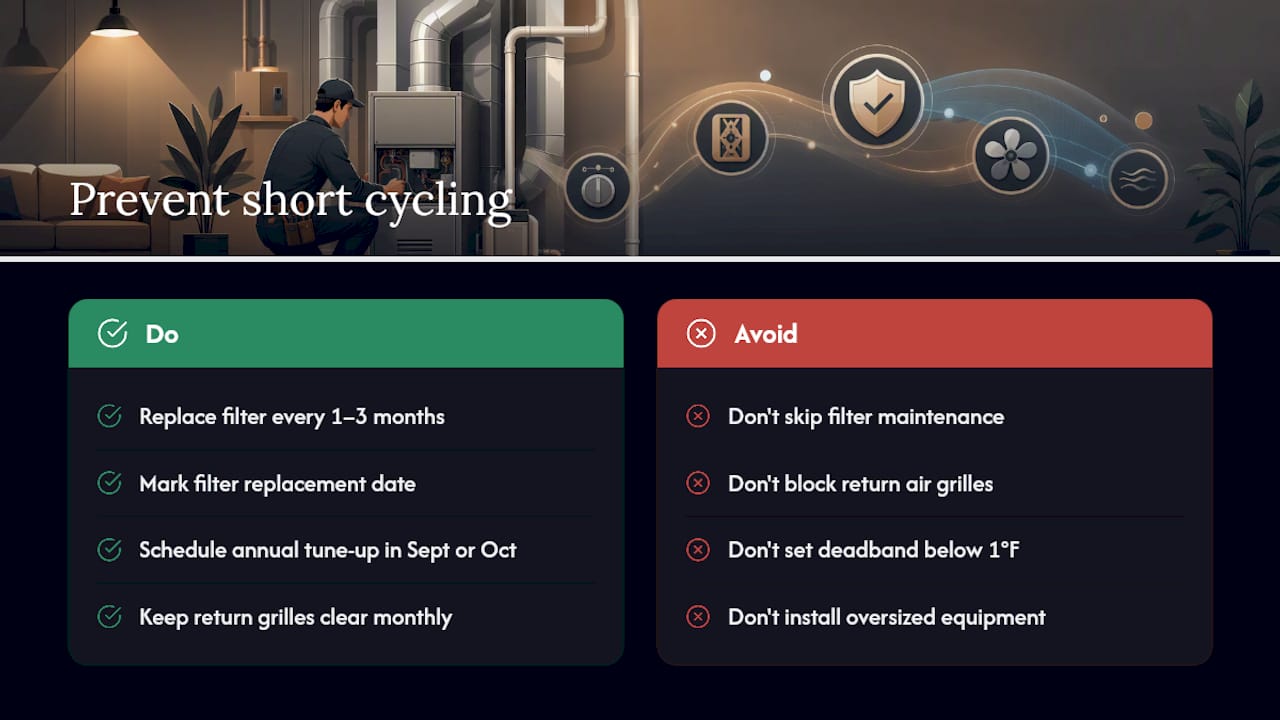
Filter changes. Replace your filter every 1–3 months depending on filter type, pet ownership, and dust levels in your home. A 1-inch fiberglass filter needs monthly attention; a 4-inch media filter can go 3–6 months. Mark the replacement date on the filter itself when you install it. Staying current on air filter maintenance is the single highest-return maintenance habit for furnace health.
Annual tune-up. Schedule a professional furnace tune-up before the heating season, ideally in September or October. A tune-up includes blower cleaning, flame sensor inspection, heat exchanger visual check, flue inspection, and control calibration. Catching a dirty blower wheel or a marginal flame sensor in October costs far less than an emergency call in January.
Keep returns clear year-round. Furniture rearrangements, new rugs, and seasonal décor all have a way of blocking return air grilles. A quick walk-through every month takes two minutes and prevents the most common airflow restriction.
Thermostat settings. Set the temperature differential (deadband) to at least 1°F, preferably 2°F, so the system doesn’t cycle on and off chasing a half-degree swing. Smart thermostats like the Ecobee or Honeywell T6 Pro allow you to configure this directly.
Consider a two-stage or variable-speed furnace. A single-stage furnace runs at
capacity every time it fires, which makes it prone to short cycling in mild weather when the home doesn’t need full heat output. Two-stage and variable-speed furnaces reduce short cycling by running longer at lower capacity, delivering steadier temperatures and lower fuel consumption over a heating season. When comparing a two-stage furnace vs. a single-stage unit, the two-stage model’s ability to run at 60–70% capacity on mild days is the key advantage. For homeowners weighing a single-stage vs. two-stage furnace on replacement, the two-stage option typically pays back in comfort and efficiency over several heating seasons.
Right-sized equipment. If you’re replacing a furnace, insist on a Manual J load calculation before the contractor selects equipment. An oversized unit will short-cycle regardless of how well it’s maintained. Proper sizing is the only real fix for that problem.
When should you call a licensed HVAC technician?
Some short-cycling causes are safe to address yourself. Others are not. Here’s how to know when to pick up the phone.
Call a pro when:
- The furnace lights for a few seconds, shuts off, and retries repeatedly (flame sensor or ignitor issue).
- You’ve replaced the filter, cleared the vents, and reset the system, but the cycling continues.
- You hear unusual sounds: banging, rattling, or a loud pop at startup (possible heat exchanger stress).
- The CO alarm has activated, even once.
- The system is more than 15 years old and short cycling has started recently (multiple components may be failing).
- You suspect a cracked heat exchanger, blocked flue, or faulty pressure switch.
What a technician will inspect:
- Cycle timing and airflow measurements at supply and return registers.
- Blower wheel condition and motor amperage draw.
- Limit switch and pressure switch function.
- Flame sensor resistance and ignitor integrity.
- Heat exchanger visual inspection (and combustion analysis if warranted).
- Flue and venting draft pressure.
- Control board error codes and thermostat calibration.
What to expect from the visit. Most HVAC companies charge a diagnostic fee of $75–$150, which is often applied toward the repair if you proceed. Simple repairs like flame sensor cleaning or a pressure switch swap are typically completed in the same visit. Parts like a blower motor or control board may require a return trip if not stocked on the truck. For a step-by-step look at what a Kansas City furnace repair visit covers, Kcaircontrol has a detailed walkthrough on its site.
How to prepare. Note the exact symptoms and when they started. Know your furnace’s model number (usually on a label inside the front panel). List any recent changes: new insulation, a new thermostat, or a recent duct modification. That context cuts diagnostic time significantly.
When replacement makes more sense than repair. A cracked heat exchanger almost always means replacement, because the repair cost approaches or exceeds the cost of a new unit. Repeated major component failures on a system older than 15–18 years follow the same logic. A consistently oversized unit that short-cycles even in perfect mechanical condition is also a replacement conversation, since no repair fixes a sizing mismatch. Ask your technician for a Manual J calculation before selecting a replacement unit.
For non-emergency situations, ask about maintenance plan options and confirm whether the repair is covered under any existing equipment warranty. Improper DIY repairs, particularly on gas components, can void manufacturer warranties, so confirm scope before attempting anything beyond filter and battery changes.
What we see most often in Kansas City homes
The pattern we see most consistently at Kcaircontrol is this: a homeowner notices the furnace cycling oddly in November, assumes it will work itself out, and calls us in January after the problem has compounded. By that point, what started as a clogged filter has become a tripped limit switch that has cycled repeatedly, and sometimes a flame sensor that’s now contaminated from the repeated incomplete combustion cycles.
The single most common mistake is delaying filter replacement. Homeowners often don’t realize how quickly a filter loads up in a Kansas City fall, when windows are closed and dust circulates more. A filter that looked fine in September can be fully clogged by late October. Pair that with a return vent blocked by a moved piece of furniture, and the system is working against two restrictions at once.
Poor thermostat placement is the second pattern we see regularly. A thermostat on a wall that gets afternoon sun, or near a kitchen that generates heat, reads the space as warmer than it is and cuts the heating cycle short. Moving the thermostat or adding a remote sensor is a straightforward fix that makes a real difference in cycle consistency.
If you’re seeing short cycling and the basic checks haven’t resolved it, you don’t have to figure it out alone. A professional diagnosis is straightforward, and most causes are fixable in a single visit.
Kcaircontrol handles short-cycling diagnostics in the Kansas City area
When the filter swap and thermostat battery check don’t stop the cycling, the fastest path to a warm, reliable home is a professional diagnosis. Kcaircontrol’s furnace repair service covers the full diagnostic workflow: cycle timing, airflow measurement, flame sensor and ignitor testing, blower wheel inspection, heat exchanger check, and flue verification. Most repairs are completed in a single visit, with transparent pricing before any work begins.
For homeowners who want to get ahead of the problem, a seasonal furnace tune-up from Kcaircontrol includes blower cleaning, combustion analysis, and a full safety inspection. Financing options are available for larger repairs or new system installations. If your furnace is short-cycling right now and you need same-day help, check Kcaircontrol’s emergency HVAC repair options or schedule online at kcaircontrol.com.
Sources
- Furnace Short Cycling: Causes and Solutions – Trane®
- What Is Furnace Short Cycling? Causes and Solutions | Carrier
- Furnace Blower Fan Cycles On/Off During the Heating Cycle – Short cycling furnace diagnosis
- Furnace Short Cycling: 5 Causes and Fixes (HVAC Tech Verified, 2026)
- Furnace cleaning cost (blower wheel insight) – Angi