
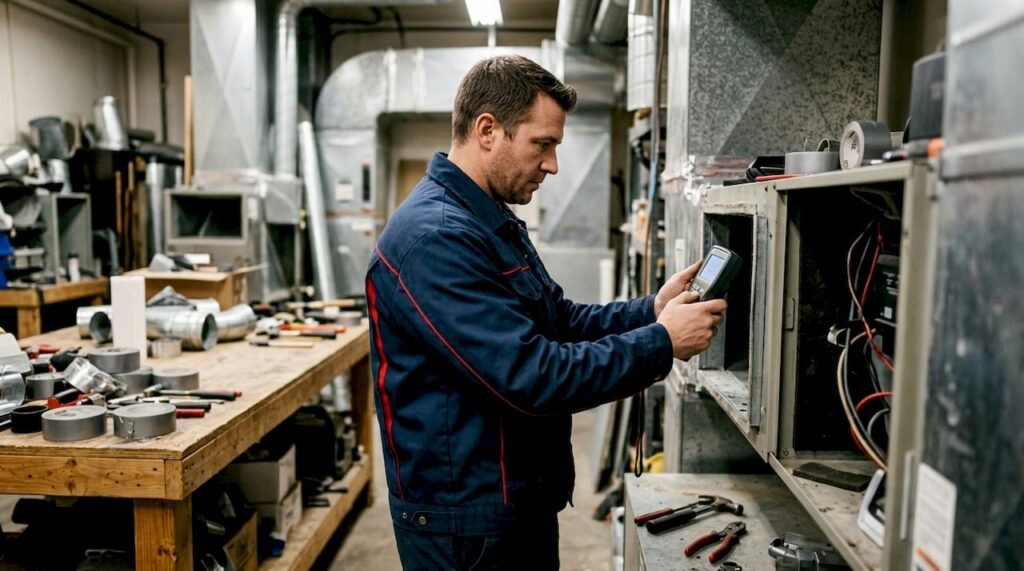
Airflow optimization is the technical process of measuring, adjusting, and designing air distribution to meet specific performance standards, most commonly expressed in Cubic Feet per Minute (CFM). In residential HVAC, the standard benchmark is 350–400 CFM per ton of cooling capacity. When your system hits that target consistently across every room, you get even temperatures, lower energy bills, and air that actually feels clean. When it doesn’t, you get hot upstairs bedrooms, rooms that never cool down, and an HVAC unit that runs constantly without satisfying the thermostat.
Airflow optimization is not the same as duct cleaning or simply opening your vents wider. Duct cleaning removes debris. Opening vents actually raises static pressure and can damage your equipment. True airflow optimization involves a diagnostic process with calibrated tools, calculated targets, and physical adjustments inside the ductwork itself.
Core components of airflow optimization:
- Measurement: Using flow hoods and manometers to capture actual CFM and static pressure at every register
- Calculation: Determining required CFM per room based on square footage and heat load
- Adjustment: Tuning branch dampers inside ductwork to redistribute airflow proportionally
- Verification: Re-measuring after adjustments to confirm targets are met
- Documentation: Recording baseline and final readings for future reference
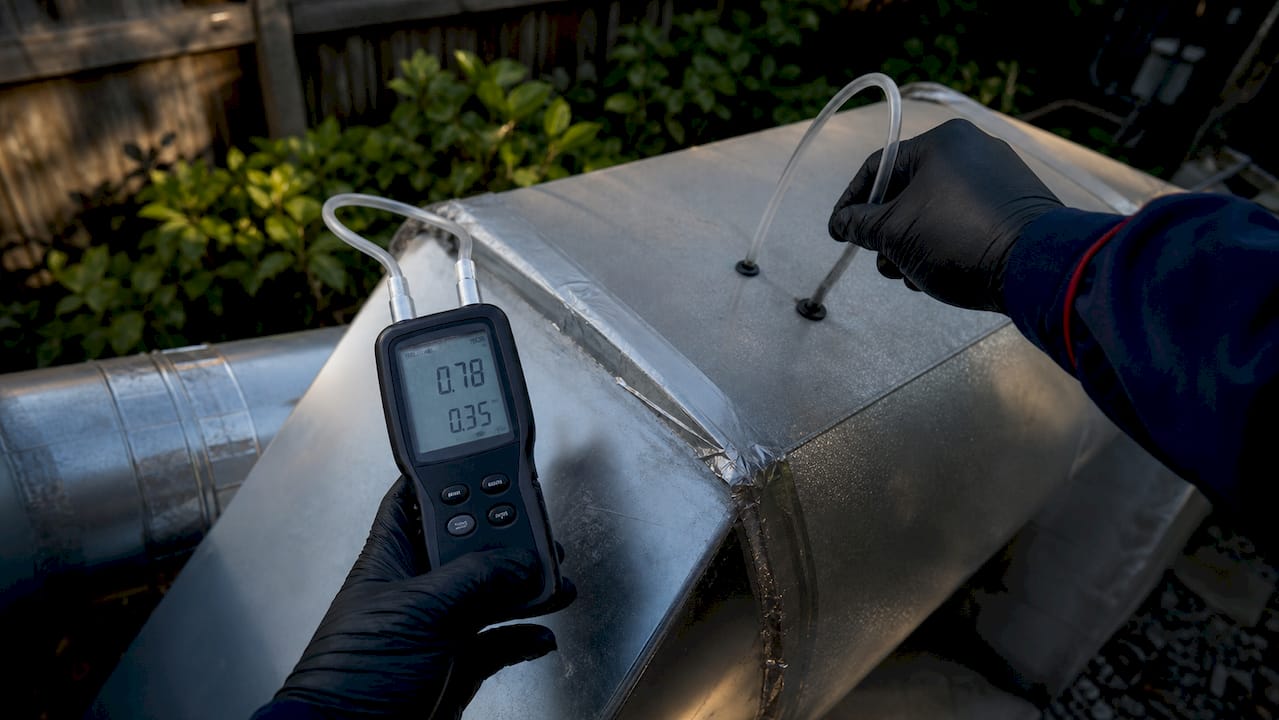
Static pressure is the other critical metric. Think of it as blood pressure for your HVAC system. The ideal range sits between 0.3 and 0.5 inches water column (IWC). Push it above 1.2 IWC and you risk premature blower motor failure and cracked heat exchangers.
Why airflow challenges are harder to fix than most homeowners expect
Poor airflow rarely announces itself with an obvious failure. Instead, it shows up as rooms that are 5–10°F warmer than others, humidity that lingers in certain spaces, or an energy bill that keeps climbing. The underlying causes are often invisible until a technician puts instruments on the system.
Common airflow challenges across HVAC systems, cleanrooms, and data centers include:
- Unbalanced distribution: Too much air going to one zone, not enough to another
- Bypass airflow: Conditioned air escaping before it reaches the intended space
- Recirculation: Hot exhaust air mixing back into the cold supply stream
- Duct leaks: Gaps and unsealed joints bleeding conditioned air into unconditioned spaces
- Duct restrictions: Crushed or kinked flexible ductwork reducing system capacity
- Undersized returns: A single return vent for a large home creates high static pressure and strains every component downstream
In controlled environments like pharmaceutical cleanrooms, the stakes are higher. Unbalanced airflow can compromise particle counts, disrupt containment zones, and trigger compliance failures. Data centers face a parallel problem: when cold supply air mixes with hot server exhaust, cooling units work harder and hot spots develop around the most heat-sensitive equipment. Poor air management leads to more air being circulated than required, which causes recirculation and is the root cause of most hot spots.
Blocked or incomplete ductwork at home can cause frozen evaporator coils and cracked heat exchangers, two repairs that cost far more than a professional balancing visit. Understanding why poor airflow develops in residential systems is the first step toward fixing it for good.
How to optimize airflow: proven implementation strategies
The most reliable approach to airflow improvement is systematic and layered. You start at the source of the problem, fix it, then verify before moving to the next level. Jumping straight to room-level cooling adjustments without addressing duct leaks or rack-level gaps first wastes time and money.
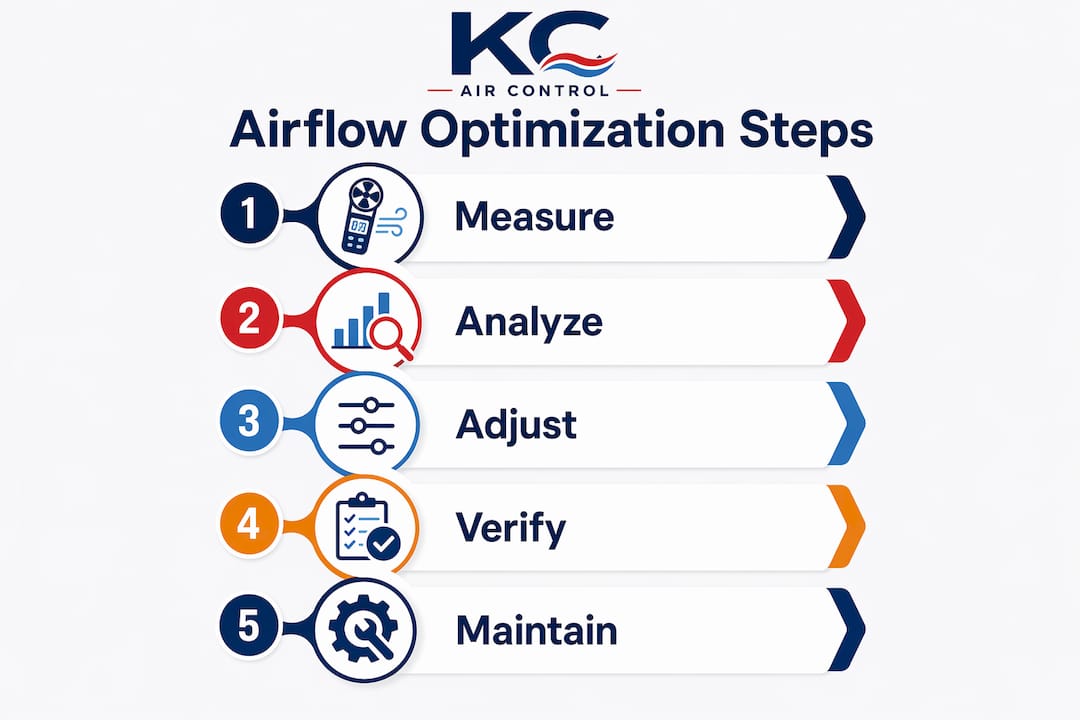
Step-by-step process for HVAC airflow balancing:
- Measure total system airflow at the air handler and confirm it meets the 350–400 CFM per ton target
- Calculate required CFM for each room based on square footage and heat load
- Measure actual CFM at every supply register using a calibrated flow hood
- Measure static pressure at supply and return plenums with a manometer
- Identify restrictions, leaks, and undersized ductwork
- Adjust branch dampers to redistribute airflow proportionally across zones
- Re-measure all registers and static pressure to verify improvements
- Document findings with before-and-after data
For data centers, Upsite Technologies developed the 4 R’s methodology, which addresses airflow at the Rack, Raised Floor, Row, and Room levels in sequence. Fixing leaks and obstructions at lower infrastructure levels before adjusting room-level cooling is what produces measurable energy savings.
Adaptive airflow control takes this further by using sensors and variable frequency drives (VFDs) on fans to respond dynamically to changing loads. Zoning systems divide a building into independently controlled areas, so airflow adjusts based on occupancy and heat load rather than running at a fixed rate all day.
Pro Tip: Never adjust dampers without measuring first. Guessing at damper positions can shift a problem from one room to another without solving the underlying cause. Instrument-based measurement before and after every adjustment is what separates a real fix from a temporary workaround.
What are the real benefits of airflow optimization?
Balanced airflow delivers results you can measure on your energy bill and feel in every room. A system that reaches its thermostat target faster runs fewer cycles, and fewer cycles mean lower operating costs. Balanced systems reduce energy consumption by up to 15–20%, which adds up quickly over a Kansas City summer.
Key benefits of optimized airflow:
- Energy savings: Up to 15–20% reduction in energy costs from reduced run time
- Extended equipment life: Less strain on the blower motor, compressor, and heat exchanger
- Better indoor air quality: Proper airflow carries contaminants to filters rather than letting them settle; see Kcaircontrol’s guide on indoor air quality for more detail
- Reduced humidity problems: Adequate airflow removes moisture from living spaces, preventing mold conditions
- Occupant comfort: Consistent temperatures room to room, no more hot upstairs or cold master bedroom
- Regulatory compliance: In pharmaceutical and cleanroom settings, airflow directly determines whether particle counts and pressure differentials meet standards like ISO 14644
The health impact is real and often underestimated. Poor airflow allows allergens, dust, and volatile organic compounds to accumulate in stagnant zones. Correcting distribution patterns means your filters actually capture what they are designed to capture, and your family breathes cleaner air as a result.
HVAC-specific factors that directly affect airflow performance
Ductwork condition is the single biggest variable in residential airflow performance. Crushed or compressed flexible ductwork can decrease total system airflow by 40–60%, cutting your system’s effective capacity nearly in half. A system that looks fine from the outside can be severely restricted by a single kinked flex duct run in the attic.
Critical HVAC airflow considerations:
- Duct sizing: Undersized ducts create velocity pressure that raises static pressure system-wide
- Return air design: A single return vent for a large home is a common design flaw that creates high static pressure and damages components over time
- Filter grille restrictions: Replacing restrictive filter grilles with dedicated return air boxes and high-flow filter housing can increase airflow up to 50%
- Fan placement: The blower must be sized and positioned to overcome total external static pressure without exceeding the safe operating range
- Static pressure targets: Ideal range is 0.3–0.5 IWC; anything above 1.2 IWC causes equipment damage
Understanding how heating system controls interact with airflow distribution helps homeowners make smarter decisions about zoning and thermostat placement. A thermostat located in a poorly served zone will call for heating or cooling longer than necessary, compounding the inefficiency caused by unbalanced ducts.
Pro Tip: If your HVAC system is short-cycling or your upstairs stays hot even when the AC runs constantly, check static pressure before replacing any equipment. Oversized static pressure is frequently misdiagnosed as equipment failure, and a balancing adjustment costs a fraction of a new system.
How airflow optimization works across different environments
The principles of airflow management apply everywhere, but the specific strategies vary by setting.
Residential homes: The most common problem is uneven temperature distribution caused by unbalanced duct systems. Professional air balancing for home comfort addresses this by measuring and adjusting dampers throughout the duct system. Hot upstairs rooms, cold bedrooms, and humidity that won’t drop are all symptoms of the same underlying airflow imbalance.
Pharmaceutical cleanrooms: These environments require precise airflow control to maintain particle counts within ISO classifications and to sustain pressure differentials between adjacent zones. Contamination containment depends on air moving from cleaner to less-clean areas at all times. Particle counters and pressure differential monitors run continuously, and any deviation triggers an investigation.
Data centers: Blanking panels cover unused rack space so cold supply air passes through equipment rather than bypassing it. A single 12-inch blanking panel can reduce rack temperatures by 20°F. Hot aisle/cold aisle containment separates supply and exhaust streams, and CFD modeling provides a detailed 3D thermal map to guide tile placement and cooling adjustments.
- Homes: Damper tuning, return air upgrades, duct sealing
- Cleanrooms: Continuous particle monitoring, pressure cascade management, HEPA filtration verification
- Data centers: Containment systems, blanking panels, floor grommet sealing, CFD-guided tile placement
Key performance indicators for measuring airflow effectiveness
You cannot manage what you cannot measure. These are the metrics that tell you whether your airflow optimization efforts are actually working.
| Metric | What it measures | Target range |
|---|---|---|
| CFM per ton | Total system airflow relative to cooling capacity | 350–400 CFM per ton |
| Static pressure | Resistance the blower overcomes to push air | 0.3–0.5 IWC |
| Temperature split | Difference between supply and return air temperatures | 16°F for cooling |
| Room temperature variance | Difference between hottest and coolest rooms | Less than 3°F |
| Particle count (cleanrooms) | Airborne particles per cubic meter | Per ISO 14644 class |
| Power Usage Effectiveness (PUE) | Data center energy efficiency ratio | Closer to 0.5 is better |
Tracking these metrics before and after any adjustment gives you a clear picture of what changed and by how much. For residential systems, temperature split and room variance are the fastest indicators of whether balancing work held up over time.
Tools and technologies used to measure and monitor airflow
Accurate measurement requires the right instruments. Guessing at airflow conditions leads to adjustments that fix nothing or create new problems elsewhere.
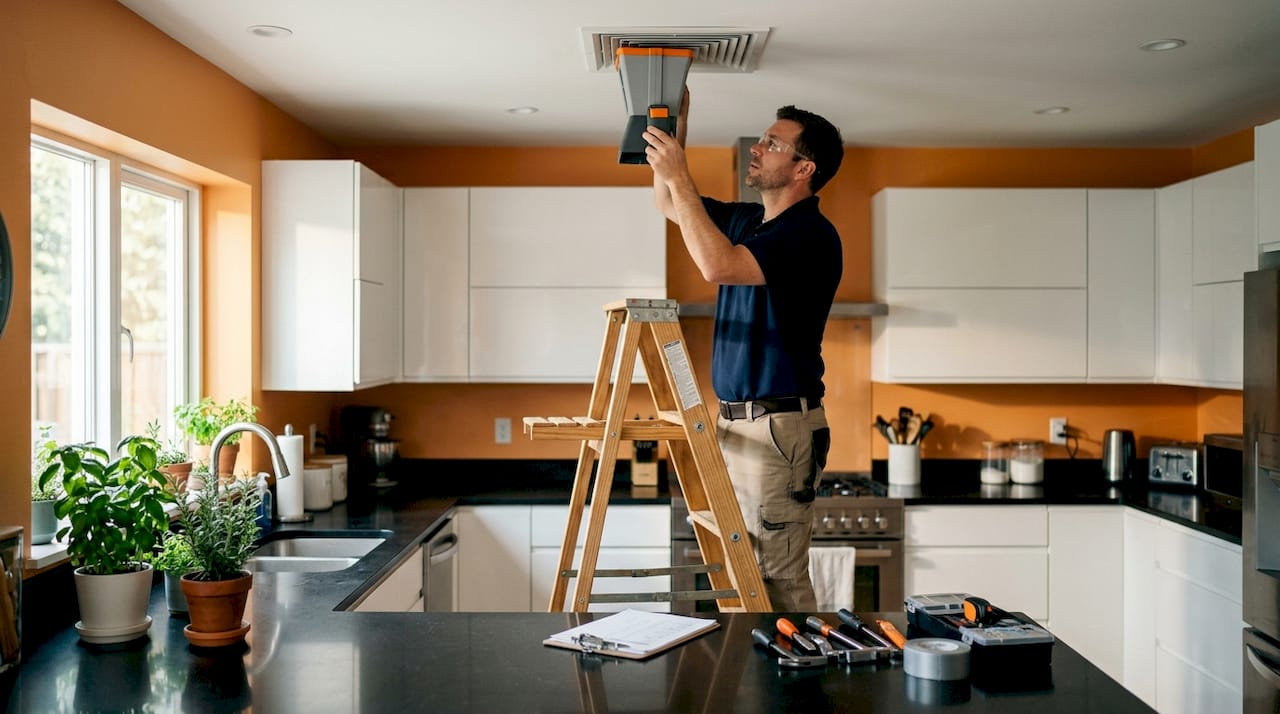
Flow hoods (capture hoods): These fit over supply and return registers to measure actual CFM at each outlet. They are the standard tool for HVAC airflow balancing and give you the numbers needed to calculate how far each room deviates from its target.
Manometers: Digital manometers measure static pressure at the supply and return plenums. This reading tells you whether the system is operating within its safe pressure range or is being pushed toward equipment-damaging levels.
Thermal imaging cameras: Infrared cameras reveal temperature patterns across duct runs, walls, and ceilings, making leaks and insulation failures visible without destructive inspection.
Computational fluid dynamics (CFD) software: Used primarily in data centers and large commercial buildings, CFD creates a 3D model of airflow patterns to predict how changes in tile placement, containment, or cooling unit positioning will affect temperatures before any physical work is done.
Particle counters: Required in cleanroom and pharmaceutical environments to verify that airflow is maintaining the required cleanliness class at all times.
Variable frequency drives (VFDs): Not a measurement tool, but a control technology that adjusts fan speed in real time based on demand, reducing energy use when full airflow is not needed.
Practical steps for conducting an airflow assessment
A thorough airflow assessment follows a consistent sequence. Skipping steps leads to incomplete diagnoses and fixes that don’t last.
- Review the floor plan and identify zones with known comfort complaints before arriving on site
- Set up diagnostic equipment: flow hood, manometer, thermometer, and moisture meter
- Measure total system airflow at the air handler and compare to the 350–400 CFM per ton benchmark
- Record CFM at every supply register and compare each reading to the calculated requirement for that room
- Check static pressure at supply and return plenums to confirm the system is within the 0.3–0.5 IWC range
- Inspect ductwork for visible crushing, disconnected sections, and unsealed joints
- Adjust dampers to redistribute airflow toward underserved zones
- Re-measure all registers and static pressure to confirm improvements and catch any new imbalances created by the adjustments
- Document everything with written before-and-after measurements
For a detailed walkthrough of the duct inspection process, Kcaircontrol’s air balancing homeowner guide covers each step in plain language. Ventilation compliance requirements, such as those outlined for washroom ventilation standards, follow a similar assessment logic and reinforce why documented measurement matters in regulated spaces.
Common pitfalls in airflow optimization and how to avoid them
Even well-intentioned airflow work can create new problems when it skips foundational steps or relies on assumptions instead of measurements.
Closing vents to redirect airflow. This is the most common homeowner mistake. Closing a supply vent does not send that air somewhere more useful. It raises static pressure system-wide, stresses the blower motor, and can freeze the evaporator coil. Always adjust dampers inside the ductwork, never at the register face.
Adding more fans without fixing the path. In data centers and PC builds alike, adding cooling capacity without addressing bypass airflow or recirculation just moves the problem around. Fix leaks and obstructions first, then evaluate whether additional cooling is actually needed.
Ignoring return air design. Supply-side balancing fixes are limited by the return air system. A single undersized return creates a pressure bottleneck that no amount of damper adjustment can fully overcome. Return air upgrades often deliver more improvement than any supply-side change.
Skipping re-measurement after adjustments. Damper changes affect the entire system, not just the targeted zone. A room that was receiving too much airflow before may now be receiving too little after you redirected flow elsewhere. Re-measuring every register after each adjustment is the only way to confirm the system is balanced as a whole.
Treating airflow balancing as a one-time fix. Duct systems shift over time. Insulation settles, dampers drift, and equipment ages. Annual checks keep the system performing at the level the initial balancing achieved.
How airflow optimization affects your health and daily comfort
The connection between airflow and occupant health is direct. Stagnant air allows allergens, dust mites, mold spores, and volatile organic compounds to concentrate in living spaces. Proper airflow carries these particles to your filters, where they are captured rather than recirculated.
Humidity control depends heavily on airflow. Insufficient airflow through a space means the system cannot remove moisture effectively, even if the equipment itself is working correctly. Rooms with chronically high humidity are almost always rooms with inadequate airflow, not just inadequate cooling capacity.
For people with asthma, allergies, or respiratory conditions, the difference between a balanced and an unbalanced system is felt daily. Consistent airflow distribution means consistent filtration across every room, not just the ones closest to the air handler. Kcaircontrol’s resource on why air quality matters for health covers the broader picture of how your HVAC system affects what you breathe every day.
Kcaircontrol can diagnose and fix your airflow problems

If your home has rooms that never reach the right temperature, humidity that won’t drop, or an HVAC system that runs constantly without keeping up, the cause is almost always airflow. Kcaircontrol has served Kansas City homeowners for over 70 years with exactly this kind of diagnostic work. We measure your system with calibrated instruments, show you the numbers, and make targeted adjustments that produce results you can feel.
Don’t replace equipment you don’t need to replace. Start with a professional airflow assessment. If your system needs urgent attention, our emergency HVAC repair options are available when comfort can’t wait.
Key Takeaways
Airflow optimization requires accurate measurement, targeted duct adjustments, and verified re-measurement to deliver lasting improvements in comfort, air quality, and energy efficiency.
| Point | Details |
|---|---|
| CFM target matters | Residential HVAC systems should deliver 350–400 CFM per ton of cooling capacity. |
| Static pressure range | Keep static pressure between 0.3 and 0.5 IWC to protect blower motors and heat exchangers. |
| Energy savings are real | Balanced systems reduce energy consumption by up to 15–20% by reaching temperature targets faster. |
| Duct condition is critical | Crushed flexible ductwork can reduce total system airflow by 40–60%, cutting effective capacity nearly in half. |
| Re-measure after every adjustment | Damper changes affect the whole system; verify every register after each adjustment to avoid creating new imbalances. |