
TL;DR:
- Ductwork transports air from HVAC systems to rooms and impacts energy efficiency and comfort. Leaky ducts waste up to 40 percent of conditioned air, increasing energy bills and equipment wear. Proper sealing, sizing, and maintenance improve airflow, lower costs, and enhance indoor air quality.
Ductwork is defined as the network of channels that carries heated and cooled air from your HVAC unit to every room in your home. Understanding why ductwork matters is the first step toward controlling your energy bills and keeping every room comfortable year-round. Leaky or poorly designed ducts waste 20–40% of conditioned air, meaning your furnace or air conditioner works harder while delivering less. The U.S. Department of Energy and ENERGY STAR both identify duct leakage as one of the largest sources of residential energy waste. Kcaircontrol has seen this play out in Kansas City homes repeatedly: a brand-new HVAC unit paired with aging, leaky ducts still leaves homeowners with high bills and uneven temperatures.
Why ductwork matters for energy bills and HVAC performance
Duct leakage forces your HVAC system to run longer cycles to reach the thermostat’s target temperature. Leaky ducts raise energy consumption by 20–30%, which shows up directly on your monthly utility bill. That wasted energy heats or cools your attic, crawl space, or basement instead of your living room.
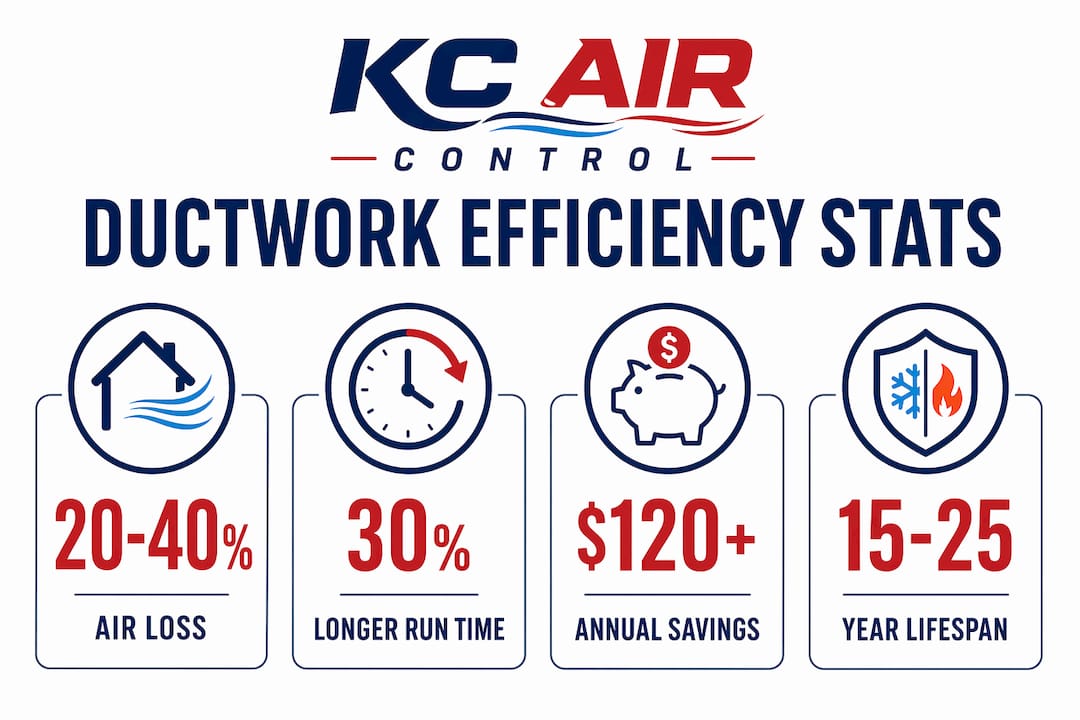
The financial case for sealing ducts is straightforward. Professional duct sealing saves homeowners $120 or more annually and typically pays for itself within 3–4 years. ENERGY STAR sets a post-sealing leakage target of 8% or less of total system airflow. Homes that hit that target consistently report lower bills and more even temperatures.
Extended run times also accelerate equipment wear. When a blower motor runs 30% longer than it should because conditioned air is escaping through duct gaps, its lifespan shortens. Replacing an HVAC unit costs thousands of dollars. Sealing ducts costs a fraction of that and protects the equipment you already own.
Pro Tip: Schedule a duct leakage test, sometimes called a duct blaster test, before replacing any HVAC equipment. You may find that sealing alone solves the comfort and efficiency problems you were blaming on the unit.
Key actions that reduce duct-related energy loss include:
- Sealing all accessible joints with mastic sealant or fiberglass mesh tape
- Insulating ducts that run through unconditioned spaces like attics and crawl spaces
- Scheduling a professional leakage test to measure actual loss rates
- Checking that supply and return registers are not blocked by furniture or rugs
How does duct design and sizing affect home comfort?
Duct sizing is not a guessing game. The industry standard for sizing residential duct systems is the Manual D protocol, developed by the Air Conditioning Contractors of America. Manual D calculates the correct duct diameter, length, and layout based on your home’s square footage, insulation levels, and HVAC equipment output. Skipping this step is one of the most common and costly mistakes in residential HVAC work.
Poor duct design causes temperature imbalances that homeowners routinely blame on their HVAC unit. A bedroom that stays 5°F warmer than the rest of the house in summer is almost always a duct sizing or balancing problem, not an equipment failure. Correct sizing and balancing fix uneven comfort without replacing any hardware.
Heat pump upgrades make proper sizing even more critical. Heat pumps require 30–50% more airflow than gas furnaces. Existing duct systems built for a furnace are often too narrow to handle that volume. The result is noise, reduced efficiency, and short cycling that wears out the compressor prematurely.
Signs that your duct system is undersized or poorly designed include:
- Hot or cold spots in specific rooms that persist regardless of thermostat settings
- Loud rushing or whistling sounds from registers when the system runs
- The HVAC unit cycling on and off more frequently than normal
- Weak airflow from registers in rooms farthest from the air handler
- Higher-than-expected energy bills despite a newer or well-maintained unit
When upgrading to a heat pump, duct modifications typically cost between $1,500 and $5,000. That investment covers trunk line upsizing, additional return registers, and balancing dampers. Skipping those modifications means the heat pump never reaches its rated efficiency.
Pro Tip: Ask your HVAC contractor to provide a Manual D calculation before any new equipment installation. If they cannot produce one, that is a red flag worth taking seriously.
Does duct sealing improve indoor air quality?
Duct sealing directly improves indoor air quality by stopping pollutants from entering your living spaces. Return ducts that run through attics, basements, or crawl spaces act like vacuums when they leak. They pull in dust, mold spores, insulation fibers, and pest debris, then distribute those particles through every room in the house.
The choice of sealing material matters as much as the act of sealing. Mastic sealant combined with fiberglass mesh tape is the code-approved method in most jurisdictions. It creates a flexible, durable bond that survives years of temperature cycling. Standard duct tape, despite its name, degrades within 1–2 years and fails at seams, leaving gaps that reopen quickly.
For finished homes where walls and ceilings cover most of the duct system, manual sealing is not always possible. Aeroseal technology reduces duct leakage by 60–90% without demolition. The process pumps aerosolized polymer particles through the duct system. Those particles collect and bond at leak points, sealing gaps from the inside. It is the most effective option for older homes with inaccessible ductwork.
Sealing also protects occupants with allergies or asthma. Properly sealed ducts prevent allergen infiltration from unconditioned spaces, reducing the particle load that your air filter has to capture. Pairing sealed ducts with clean air vents gives your HVAC system the best chance of delivering genuinely clean air.
| Sealing method | Durability | Best use case |
|---|---|---|
| Mastic with fiberglass mesh | 20+ years | Accessible joints and seams |
| Aeroseal polymer injection | 10+ years | Finished walls, hard-to-reach ducts |
| Standard duct tape | 1–2 years | Not recommended for permanent sealing |
Pro Tip: After any sealing work, replace your air filter within a week. The sealing process can dislodge debris inside ducts, and a fresh filter catches it before it circulates through your home.
When should you assess, upgrade, or maintain your ductwork?
Most residential duct systems last 15–25 years before seals degrade and flex duct material deteriorates. Age alone is not the only trigger for assessment. Any time you replace or upgrade your HVAC equipment, a duct inspection should be part of the project. Homeowners who skip duct assessment during equipment upgrades consistently report lower-than-expected energy savings and faster equipment wear.
Watch for these warning signs that your duct system needs professional attention:
- Energy bills that increase year over year without a change in usage habits
- Rooms that never reach the set temperature, even on mild days
- Visible dust buildup around registers shortly after cleaning
- Rattling or banging sounds when the system starts or stops
- A musty or stale smell coming from vents when the system runs
A professional duct assessment uses a duct blaster, a calibrated fan that pressurizes the system and measures leakage rates. This test gives you an exact number rather than a guess. It also identifies which sections of ductwork leak the most, so repairs target the highest-impact areas first. You can learn more about what a full duct cleaning service involves and how it fits into a broader maintenance plan.
DIY maintenance covers a limited but useful range of tasks. You can inspect visible duct sections in your basement or attic for disconnected joints, check that all registers open fully, and replace filters on schedule. What you cannot do at home is measure leakage rates, apply mastic to interior joints, or diagnose airflow imbalances without specialized equipment. Those tasks require a trained technician.
For homeowners considering a furnace upgrade, pairing the new unit with a duct inspection is the single most effective way to protect that investment. A new furnace connected to a leaky duct system delivers the same poor results as the old one.
Key Takeaways
Ductwork is the most overlooked factor in HVAC efficiency, and fixing it delivers faster returns than replacing equipment in most Kansas City homes.
| Point | Details |
|---|---|
| Duct leakage wastes significant energy | Leaky ducts increase HVAC energy consumption by 20–30%, raising utility bills directly. |
| Sealing pays for itself quickly | Professional sealing saves $120 or more annually and typically recoups its cost within 3–4 years. |
| Manual D sizing prevents comfort problems | Correct duct sizing eliminates hot and cold spots without replacing HVAC equipment. |
| Sealing improves air quality | Sealed ducts stop dust, allergens, and pollutants from entering living spaces through return leaks. |
| Aeroseal works where manual sealing cannot | Aeroseal reduces leakage by 60–90% in finished homes without opening walls or ceilings. |
What most homeowners get wrong about ductwork
Homeowners spend thousands on new HVAC equipment and then wonder why their bills barely change. The answer, almost every time, is the duct system. I have seen this pattern more times than I can count: a high-efficiency heat pump installed in a home with 20-year-old flex duct full of disconnected joints. The unit’s rated efficiency never shows up in real-world performance because the air never reaches the rooms it is supposed to heat or cool.
The misconception I hear most often is that ductwork is a one-time installation that never needs attention. In reality, duct seals degrade, insulation settles, and flex duct sags and kinks over time. Every one of those changes reduces airflow and forces your equipment to compensate. The common causes of HVAC failure that technicians diagnose most often trace back to duct problems, not unit defects.
My practical recommendation: treat duct assessment as a standard part of any HVAC service call, not an optional add-on. If your contractor does not mention ductwork when quoting a new system, ask about it directly. The duct system is where efficiency is either preserved or lost.
— AB
Kcaircontrol’s duct and HVAC services for Kansas City homeowners
Kcaircontrol has served Kansas City area homeowners for over 70 years, and ductwork integrity is central to every service we provide.

Whether you need a full duct inspection, professional sealing, or a complete system upgrade, our technicians use proven methods including mastic sealing and Aeroseal technology to restore airflow and cut energy waste. We also offer emergency HVAC repair for urgent situations where duct failures or equipment breakdowns leave your home without heating or cooling. Every assessment includes a clear diagnosis and honest recommendations. Schedule your duct inspection with Kcaircontrol and find out exactly where your system is losing efficiency.
FAQ
Why does ductwork matter for my energy bill?
Leaky ducts waste 20–40% of conditioned air, which forces your HVAC system to run longer and consume 20–30% more energy. Sealing those leaks directly reduces your monthly utility costs.
How often should ductwork be inspected or replaced?
Duct systems typically last 15–25 years, but an inspection is recommended any time you install new HVAC equipment or notice uneven temperatures and rising energy bills.
What is the best material for sealing duct leaks?
Mastic sealant combined with fiberglass mesh tape is the code-approved standard. It outlasts duct tape by decades and holds up through years of temperature cycling.
Can leaky ducts affect my family’s health?
Yes. Leaky return ducts pull dust, mold spores, and allergens from attics and crawl spaces into your living areas. Sealing those ducts reduces the pollutant load in your home’s air supply.
What is Aeroseal and when should I use it?
Aeroseal is a duct sealing technology that injects aerosolized polymer particles to seal leaks from the inside, reducing leakage by 60–90%. It is the best option for finished homes where duct joints are hidden behind walls or ceilings.