

TL;DR:
- Your FICO score determines your eligibility for HVAC financing and the interest rates you will pay.
- Higher scores unlock the best promotional offers, while lower scores limit options and increase costs.
Your FICO score is the primary tool lenders use to determine whether you qualify for HVAC financing and what interest rate you will pay. The role of FICO score in HVAC financing is straightforward: a higher score unlocks better terms, lower rates, and access to promotional offers like 0% APR, while a lower score limits your options or raises your borrowing cost. Whether you are replacing a furnace in Kansas City or upgrading to a new central air system, understanding how your credit score shapes your financing choices gives you real leverage before you ever sign an application.
How your FICO score determines HVAC financing eligibility
Your FICO score is a three-digit number ranging from 300 to 850, and lenders use it as a fast, standardized measure of credit risk. For HVAC financing, the score you carry on application day directly controls which loan products you can access and at what cost. Manufacturer-backed 0% APR financing typically requires a FICO score of 680 or higher, while standard installment loans accept scores as low as 620 to 640 with higher interest rates. That gap between 640 and 680 can mean the difference between paying nothing in interest on a promotional plan and paying 15% or more on a standard loan.
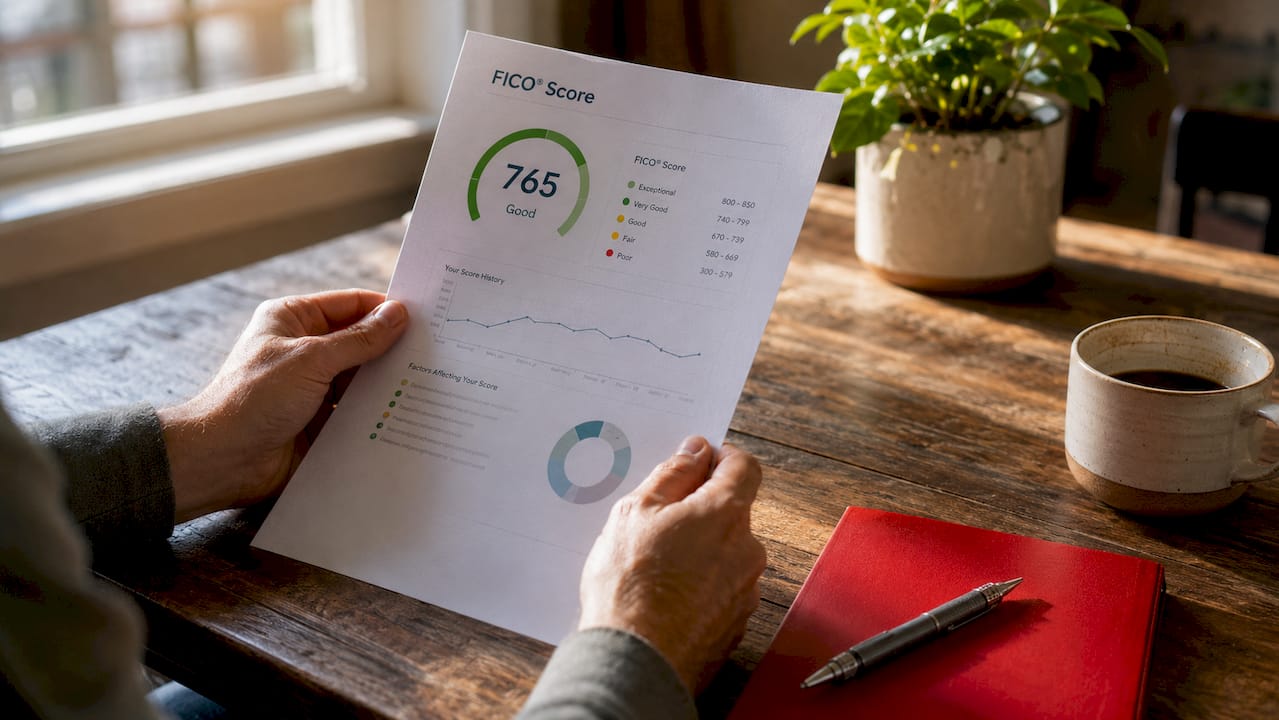
The table below shows how FICO score ranges map to typical financing products and approximate APR ranges for HVAC loans in 2026.
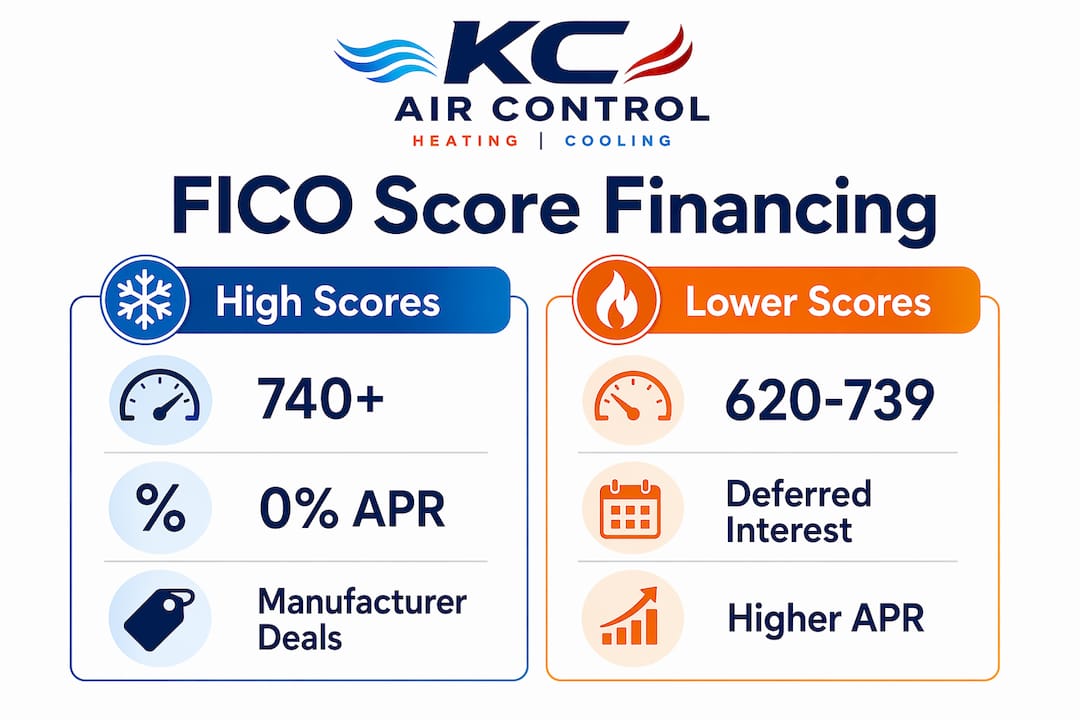
| FICO Score Range | Financing Options Available | Typical APR Range |
|---|---|---|
| 740 and above | 0% APR promotions, HELOCs, personal loans at best rates | 0% to 6% |
| 680 to 739 | Manufacturer financing, personal loans, some HELOCs | 6% to 14% |
| 620 to 679 | Standard installment loans, some contractor financing | 14% to 22% |
| 580 to 619 | Subprime personal loans, lease-to-own, PACE programs | 20% to 29% |
| Below 580 | Utility-bill programs, in-house contractor financing, PACE | Varies or fee-based |
One important nuance: the interest rate curve flattens above a FICO score of 720 to 740, meaning pushing your score from 740 to 800 yields very little additional rate improvement. This tells you where to focus your energy. Getting from 650 to 700 is far more financially valuable than going from 750 to 800.
Pro Tip: Check your FICO score through a free service like Credit Karma or your bank’s credit monitoring tool at least 60 days before applying for HVAC financing. That window gives you time to dispute errors or pay down balances before a lender pulls your report.
Which HVAC financing options use FICO scores and which do not
Not every HVAC financing path runs through a traditional credit check. Knowing which programs use FICO scoring and which do not helps you match your credit situation to the right product.
Programs that rely on FICO scores include:
- Manufacturer financing programs offered through brands like Carrier, Trane, and Lennox. These run through third-party lenders and almost always require a hard credit pull with FICO scoring as the primary approval factor.
- Personal loans from banks, credit unions, and online lenders like LightStream or Marcus by Goldman Sachs. These use FICO scores heavily, though some lenders also weigh income and debt-to-income ratio.
- Home equity lines of credit (HELOCs) and home equity loans. These use FICO scores but also require sufficient home equity, which can work in your favor if your score is borderline. You can read more about using home equity for HVAC purchases if this path fits your situation.
Programs that bypass or minimize FICO scoring include:
- PACE financing (Property Assessed Clean Energy). These equity-based programs typically require no FICO check and instead rely on your property value and equity. Geographic restrictions apply, and repayment is added to your property tax bill.
- Utility-bill financing programs offered through local energy companies. These often skip traditional credit checks entirely.
- Lease-to-own and in-house contractor financing. Some HVAC contractors offer their own payment plans with lenient or no credit requirements, though the total cost is usually higher.
Revenue-based underwriting means steady monthly income and deposits can offset lower FICO scores in some programs, enabling approvals for scores as low as 580. Lenders using this model treat consistent bank deposits as evidence of repayment ability, which is a meaningful alternative path for homeowners with thin or damaged credit histories. Multiple variables influence financing approval beyond credit score alone, including income, existing debt load, and the specific lender’s underwriting rules.
How applying for HVAC financing affects your FICO score
Applying for financing does not just reflect your credit score. It also changes it, at least temporarily. Here is what happens in sequence when you apply for an HVAC loan:
- Hard inquiry recorded. When a lender pulls your credit report to evaluate your application, a hard inquiry is added to your file. A hard credit inquiry can reduce your FICO score by 5 to 15 points temporarily, typically recovering within 2 to 3 months with timely payments. This is a short-term effect, not a lasting one.
- New account lowers average account age. Opening a new loan account reduces the average age of your credit accounts, which is a factor in your FICO score calculation. This effect fades as the account ages.
- On-time payments rebuild and improve your score. Every payment you make on schedule is reported to the credit bureaus and contributes positively to your payment history, which is the single largest component of your FICO score at 35%.
- Missed payments or deferred interest traps cause serious damage. Deferred interest promotions often backfire if not fully paid before the promotional period ends, resulting in retroactive interest at rates up to 26 to 29%. A missed payment on top of that retroactive charge can drop your score significantly and leave you with a much larger balance than expected.
Pro Tip: If you are rate-shopping across multiple lenders, submit all applications within a 14-day window. FICO scoring models treat multiple inquiries for the same loan type within that period as a single inquiry, protecting your score from repeated drops.
The practical takeaway here is that HVAC financing, handled responsibly, can actually help your credit over time. The risk is not the application itself. The risk is signing up for a deferred-interest plan without a clear payoff strategy. You can learn more about same-as-cash financing risks before committing to a promotional offer.
Practical steps to improve your credit and get better HVAC financing terms
You do not need a perfect credit score to finance an HVAC system. You need a good enough score to access the product that fits your budget. These steps help you get there.
- Target the 680 threshold first. Getting from 640 to 680 opens manufacturer financing and promotional rates. Improving credit by about 50 points before financing can save thousands in interest over the loan term on a $10,000 HVAC loan. That is a meaningful return on a few months of credit discipline.
- Pay down revolving balances. Credit utilization, meaning how much of your available credit card limit you are using, is the fastest-moving factor in your FICO score. Getting utilization below 30% can produce noticeable score gains within one to two billing cycles.
- Apply during off-peak seasons. Applying for HVAC financing outside peak seasons can yield better terms due to less demand and lender accommodation. Fall and winter are typically slower periods for HVAC contractors, and some lenders and manufacturers offer more flexible terms to drive volume.
- Evaluate total loan cost, not just monthly payments. Homeowners often focus on monthly payment amounts and miss evaluating the total financing cost, especially with subprime or deferred-interest loans. A $150 monthly payment sounds manageable until you realize you are paying it for 84 months at 22% APR.
- Use credit monitoring tools. Free tools like Credit Karma, Experian’s free tier, or your bank’s built-in monitoring give you a real-time view of what is moving your score and what is holding it back.
- Review all financing documents before signing. Confirm whether a promotional offer is true 0% APR or deferred interest. These are fundamentally different products, and the distinction matters enormously if you carry any balance past the promotional end date.
Understanding HVAC financing options in full before you apply puts you in a far stronger negotiating position with any lender or contractor.
Key takeaways
Your FICO score directly controls which HVAC financing products you qualify for and how much interest you pay, making credit preparation as important as system selection.
| Point | Details |
|---|---|
| 680 is the key threshold | Scores of 680 or higher unlock manufacturer 0% APR promotions and the best standard loan rates. |
| Rate gains plateau above 740 | Pushing your score past 740 yields minimal additional interest rate improvement on HVAC loans. |
| Alternatives exist below 620 | PACE programs, lease-to-own, and in-house financing bypass FICO checks for lower-score homeowners. |
| Hard inquiries are temporary | A credit pull drops your score 5 to 15 points but typically recovers within 2 to 3 months. |
| Deferred interest is a real risk | Unpaid balances after a promotional period trigger retroactive interest as high as 29% APR. |
What I have learned from watching homeowners finance HVAC systems
Most homeowners I talk with come in focused on one number: the monthly payment. That instinct is understandable. Budgets are real, and a $200 monthly payment feels concrete. But the FICO score conversation is where the real money is, and most people skip it entirely until they are sitting in front of a lender.
Here is what I have seen repeatedly: a homeowner with a 650 score gets approved for a 24-month deferred-interest plan, assumes they will pay it off, and then life happens. The balance is still there at month 25, and suddenly they owe retroactive interest on the full original amount. That single event can cost more than the interest savings they thought they were getting.
The other pattern I notice is homeowners who obsess over getting their score from 760 to 800 before applying. That effort is largely wasted. The rate improvement above 740 is minimal. If your score is already above 720, stop waiting and start comparing loan structures instead.
For Kansas City homeowners specifically, the seasonal timing strategy is underused. Applying in October or November rather than June or July often means more flexible terms and more attentive service from contractors who want to close business before the slow season. That is a practical edge that has nothing to do with your credit score.
My honest advice: get your score to 680 if you are not there yet, avoid deferred-interest plans unless you have a written payoff plan, and focus your energy on the total cost of the loan rather than the monthly number.
— AB
How Kcaircontrol helps Kansas City homeowners finance with confidence
Kcaircontrol has served Kansas City homeowners for over 70 years, and we understand that financing a new heating or cooling system is as much a financial decision as it is a comfort one. Whether you need an emergency HVAC repair with immediate financing support or you are planning a full system upgrade and want to understand your credit options first, our team is here to guide you through both the technical and financial sides of the process. We work with financing programs designed to fit a range of credit profiles, and we are transparent about terms so you never face a surprise bill. Contact Kcaircontrol today to schedule a consultation and explore financing options that match your credit situation and your home comfort goals.
FAQ
What FICO score do you need for HVAC financing?
Most standard HVAC installment loans accept scores of 620 to 640, while manufacturer-backed 0% APR promotions typically require a score of 680 or higher. Scores below 620 can still qualify through PACE programs, lease-to-own options, or in-house contractor financing.
Does applying for HVAC financing hurt your credit score?
A hard credit inquiry from an HVAC financing application typically causes a temporary 5 to 15 point drop in your FICO score, with recovery expected within 2 to 3 months if you make payments on time.
Can you get HVAC financing with bad credit?
Yes. PACE financing, utility-bill programs, and some contractor in-house plans do not require a FICO check and instead rely on home equity or income verification. These options carry higher costs but remain accessible for scores below 580.
What is deferred interest financing and why is it risky?
Deferred interest financing offers 0% interest for a promotional period, but if any balance remains unpaid when the period ends, retroactive interest at rates up to 26 to 29% APR is charged on the original full amount. Paying off the balance before the deadline is the only way to avoid this cost.
Does paying off an HVAC loan improve your credit score?
Yes. Consistent on-time payments on an HVAC loan build positive payment history, which is the largest factor in your FICO score at 35% of the total calculation. A fully paid installment loan also improves your credit mix over time.
Recommended
- Home Equity Loan for HVAC: What Homeowners Need to Know – KC Air Control Heating & Cooling – Expert HVAC Services – Kansas City, MO
- How HVAC financing works: smart options for KC homes – KC Air Control – Heating & Cooling
- Same-as-Cash HVAC Financing: Risks and What You Need to Know – KC Air Control – Heating & Cooling